
Hamilton’s historic First Bank reopens as Philly museum in time for semiquincentennial
The 229-year-old classical building on 3rd Street has been closed to the public for decades.
Listen 1:33
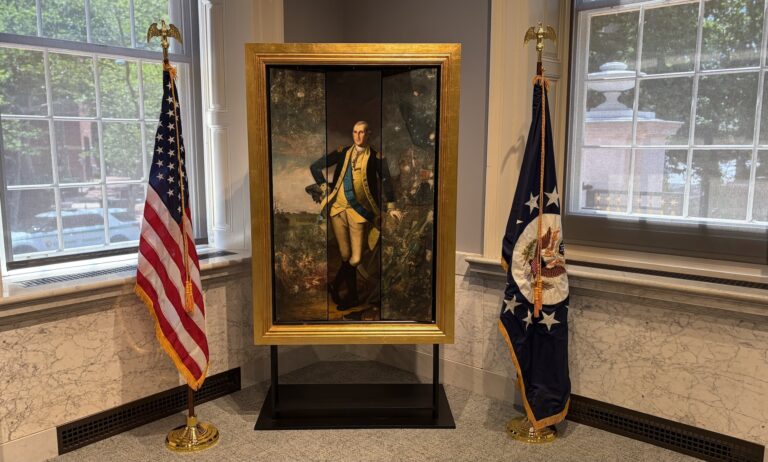
A recreation of a portrait of General George Washington after the Battle of Princeton, at the First Bank of the United States, shows how the damaged painting by Charles Wilson Peale was conserved. (Peter Crimmins/WHYY)
After decades of being closed to the public, the bank that Hamilton built reopens in Philadelphia’s Old City this Wednesday.
After $43 million of renovations by the National Park Service, the First Bank of the United States building at 3rd Street near Chestnut is once again a public amenity, with an exhibition by the U.S. Department of State featuring precious diplomatic gifts that have never been publicly displayed before.
The classical building, wrapped in marble with towering columns and grand steps, was built in 1797 as the flagship of the First National Bank, Alexander Hamilton’s bold and controversial idea to create a federal banking system. Some of the founding fathers, most prominently Thomas Jefferson, were fundamentally opposed to the new government centralizing banking and currency.
Independence National Historic Park ranger Bill Caughlan said Hamilton needed to sell the concept of national financial stability by creating monumental buildings.
“The building itself is designed to convey confidence, strength, stability for a bank at a time when not everyone thought well of banks,” Caughlan said. “You want to have something that looks impressive and would instill confidence in people.”
Several branches of the First National Bank were built in coastal cities with a lot of trade. One of the chief functions of the bank was to collect tariffs from merchants importing goods from overseas.
“A lot of times these merchants weren’t able to afford to pay the tariff, they haven’t sold their goods yet, so they could take a loan out from the bank at a percentage, maybe for 60 days, deal with what they had to do with their goods and then repay the loan,” Caughlin said. “That part of it worked pretty well.”
One of the surviving First Bank buildings is in Charleston, South Carolina, where it is now used as City Hall.
A brief history of the First Bank of the United States building
The Philadelphia building outlasted the institution for which it was built. The U.S. Congress chartered Hamilton’s idea for 20 years, from 1791 to 1811, when it did not renew the charter. The building was then bought by Stephen Girard, then the wealthiest man in America, for use as a private bank. After Girard’s death in 1831, the building was sold to another private bank that named itself after Girard.
In the 20th century, the building was acquired by the National Park Service, which then used it for storage.
“The architectural collection was stored here,” Caughlan said. “In the basement, we kept our brochures.”
Although the public was not allowed inside the building, interest never faded. The front steps are popular with wedding photographers, and following the success of the musical “Hamilton,” people come just to see his legacy.
“There was a random day in the last 10 years, I couldn’t tell you the exact year … the building was open to the public for one day,” said park ranger Michael Carbonaro. “In that day, about 3,000 people came through.”
In 2023, the Independence Historic Trust announced plans to restore and renovate the building, with preliminary ideas to transform it into a museum of the American economy. Since then, the concept has narrowed to the building’s history.
“We’re trying to focus on what this building represents because it is an actual artifact itself,” said Rosalind Remer, director of Drexel University’s Lenfest Center for Cultural Partnerships. “It is an artifact that allows us to tell the story of Hamilton, the founding of the bank, why he did it, what happened to it after 20 years, and why there’s a Second Bank around the corner.”
Such an exhibition will likely be ready in 2028. Until then, the building will be open with temporary exhibitions.
Related Content
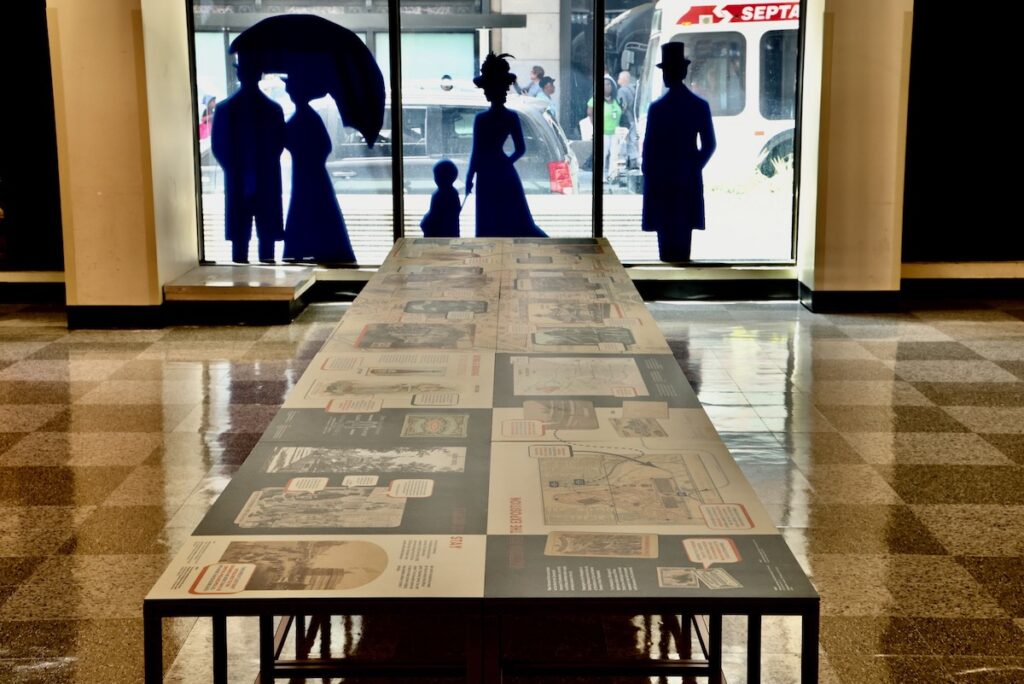
An empty storefront on Market East pops up with the story of Philly’s Centennial Expo
“Revisit 1876” shows the good and the bad of Philadelphia’s shining international moment 150 years ago.
3 months ago
Listen 1:15The First Bank’s new life
The building will officially open on Wednesday with a formal ribbon cutting. Underneath the domed rotunda on the ground floor are two exhibitions: Artifacts from Philadelphia’s previous celebrations of the Declaration of Independence in 1876, 1926 and 1976, and treasured objects culled from U.S. embassies in other countries.
“When the state came into its inception roughly 250 years ago, Ben Franklin, considered the first diplomat, he goes abroad, gifts are given to him,” said Joseph Angemi, senior curator with the Department of State’s Office of Cultural Heritage. “They don’t belong to him. They belong to the American people.”
Over the ensuing 250 years, the collection of diplomatic gifts has accumulated exponentially. Although the objects are owned by the American people, the public can never see them unless they happen to visit a U.S. embassy abroad.
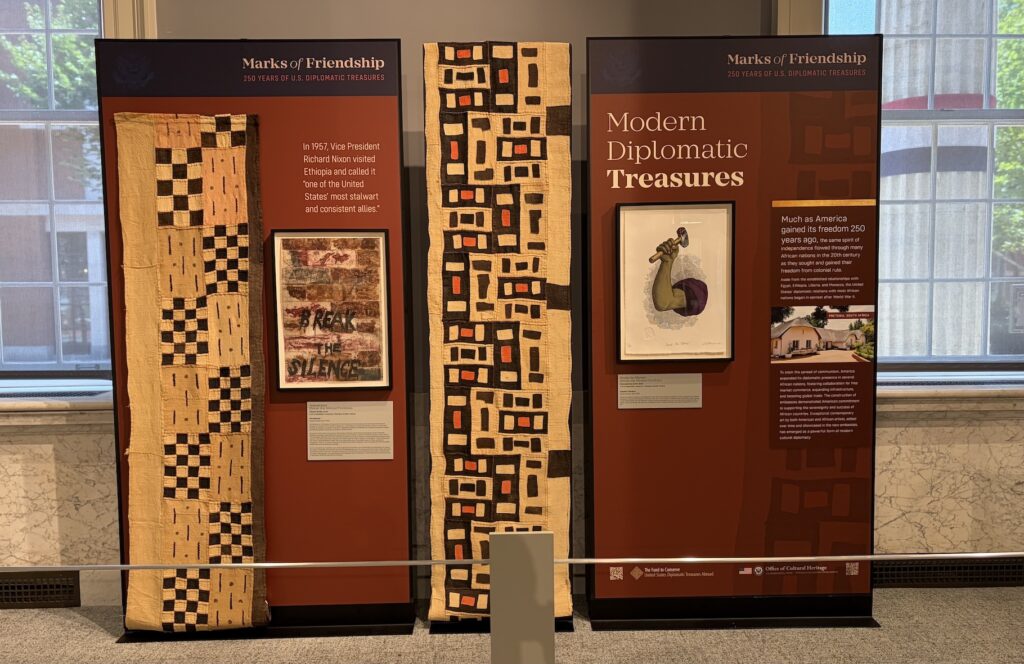
Among the objects on display are scrolls of hand-woven African Kuba cloths given to the U.S. embassy in Kenya, an 18th-century chair upholstered in tapestry depicting scenes from Aesop’s fables from the embassy in Prague, and an Indonesian batik wall hanging featuring a U.S. seal that is not quite accurate.
“It’s the State Department seal without quite being the State Department seal,” Angemi said. “It was a host country’s way of capturing who they thought we were. It’s from a really well-known artist, Iwan Tirta, one of the pre-eminent batik designers of the 20th century. It’s incredible for that reason: it captures the artist, it captures that country, and it captures the United States. Anytime an object can do that, it’s a win in cultural diplomacy.”
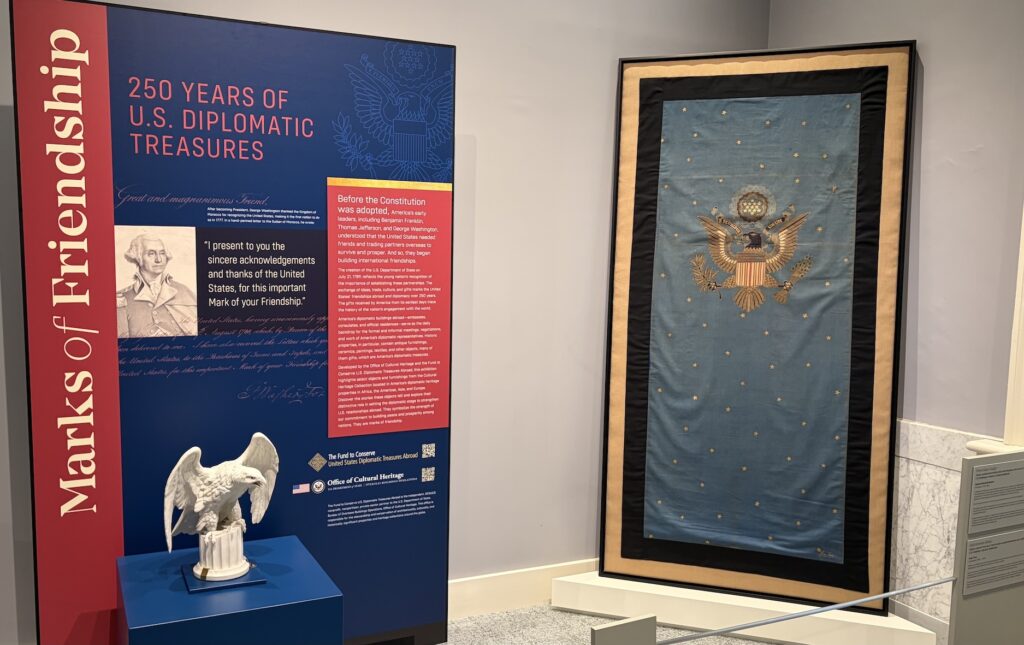
Although the United States has been receiving diplomatic gifts for almost 250 years, it has only recently begun to care for and curate them professionally. The private Fund to Conserve United States Diplomatic Treasures Abroad was created in 2012, and the Office of Cultural Heritage, for which Angemi is a curator, was launched in 2015.
“When a country gives you something that represents who they are as a culture, it means they’re entrusting you with who they are as a people,” he said. “To me, there’s no greater moment in cultural diplomacy than when somebody says, ‘Can you take care of this for us?’ because it’s who they are at their core.”
-
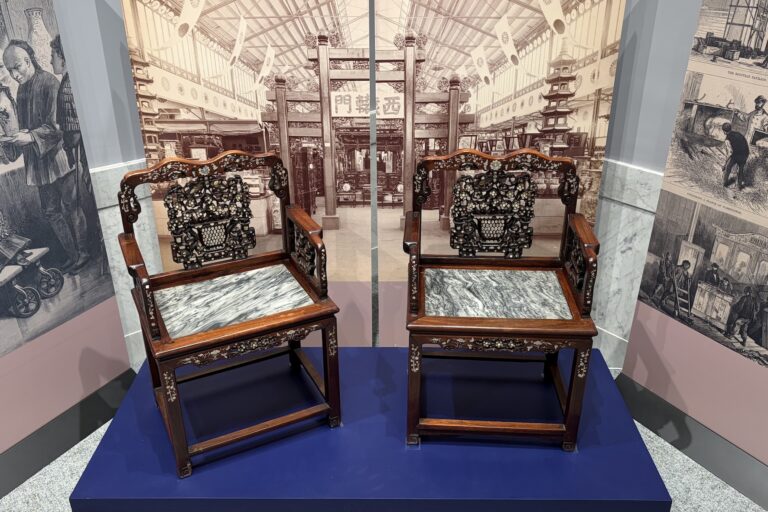
Two chairs that appeared in the Chinese pavilion of the 1876 Centennial Expo helped spur a national interest in Asian aesthetics. (Peter Crimmins/WHYY) -
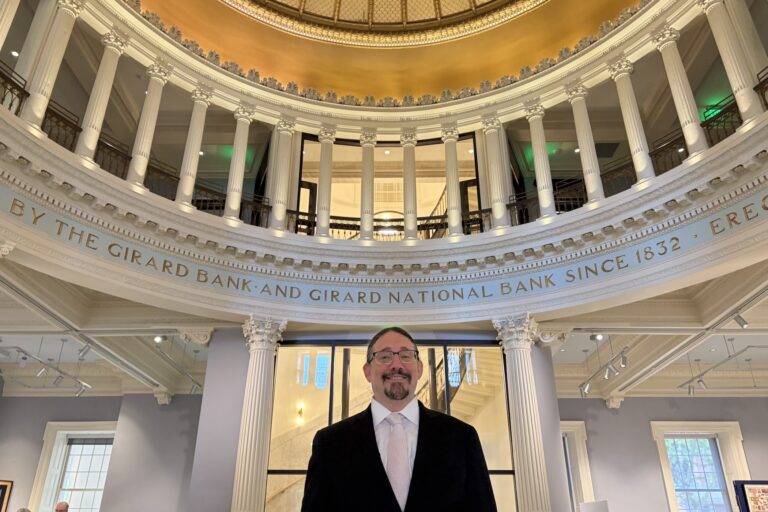
Joseph Angemi, of the U.S. Department of State's Office of Cultural Heritage, curated an exhibition at the First Bank of the U.S. of diplomatic gifts to embassies abroad. (Peter Crimmins/WHYY) -
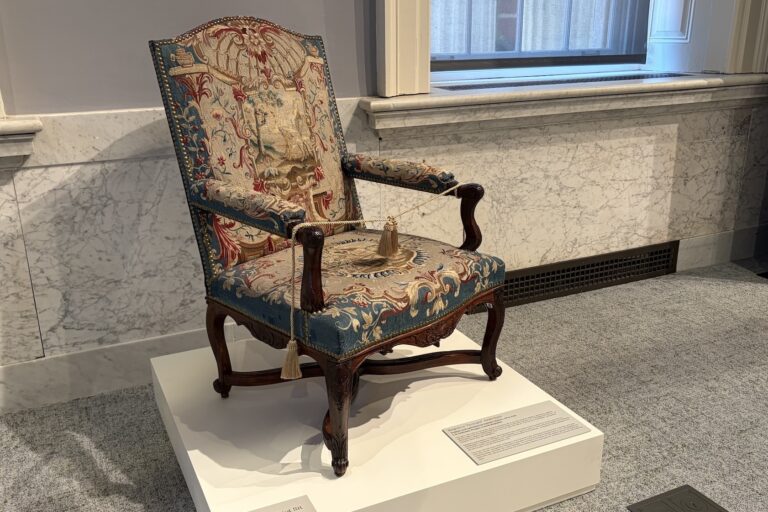
An 18th century chair given to the U.S. embassy in Prague by the host country is upholstered in tapestries depicting scenes fro Aesop's fables. It is on view at the First Bank of the U.S. in Philadelphia. (Peter Crimmins/WHYY)
How Philadelphia has celebrated the Declaration of Independence
The First Bank building is also hosting a temporary exhibition about how Americans celebrated anniversaries of the Declaration of Independence as seen through artifacts from the Atwater Kent Collection at Drexel University, formerly the archive of the Philadelphia History Museum.
Sharing a space with the U.S. Department of State, Stacey Swigart, director of the Atwater Kent Collection, chose to look at 1876, 1926 and 1976 through an international lens.
For example, the 1876 Centennial Exposition was the first time many Americans were exposed to Chinese material culture. Swigart brought out a pair of armchairs that are ornately carved and inlaid with mother-of-pearl.
“In China, they were considered junk and wouldn’t have been something that was really important,” Swigart said. “But when Americans were seeing this for the first time, they thought, ‘Oh my gosh, this is so beautiful.’The Asian influence in design in the 19th century came from the 1876 Centennial.”
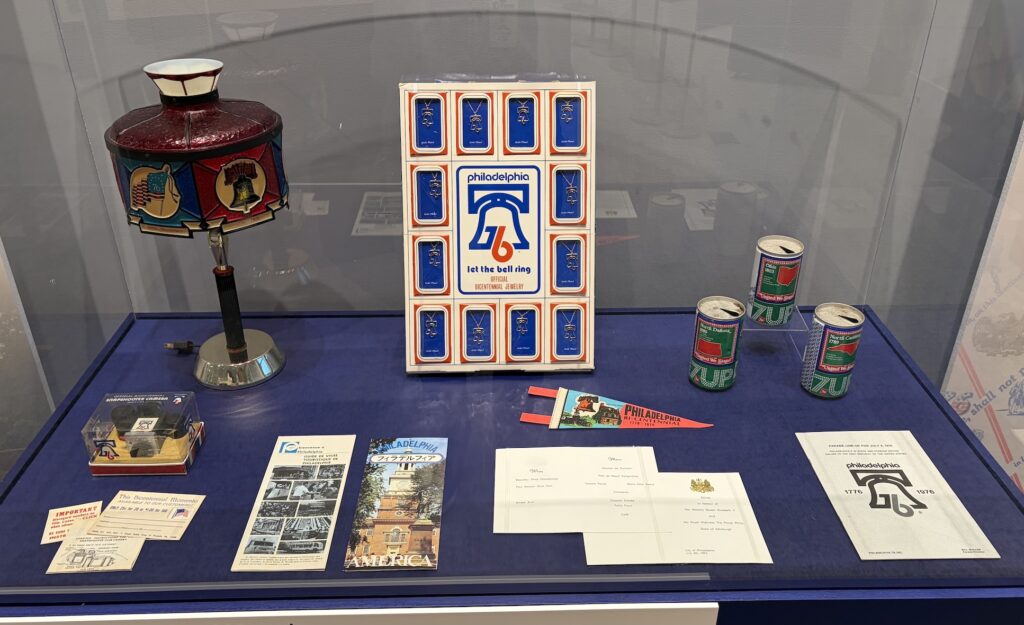
By the time of the Bicentennial celebration in 1976, many of the artifacts were plastic. Swigart pointed to a parlor lamp stamped with liberty bells and “Spirit of ‘76” flags that is “reminiscent of a Pizza Hut from the 80s,” she said.
The twin exhibitions by the U.S. Department of State and Drexel University will be on view through the end of 2026.

Get daily updates from WHYY News!
WHYY is your source for fact-based, in-depth journalism and information. As a nonprofit organization, we rely on financial support from readers like you. Please give today.
Part of the series
Philadelphia 250
The United States is marking its semiquincentennial — or its 250th anniversary — in and around the City of Brotherly Love.
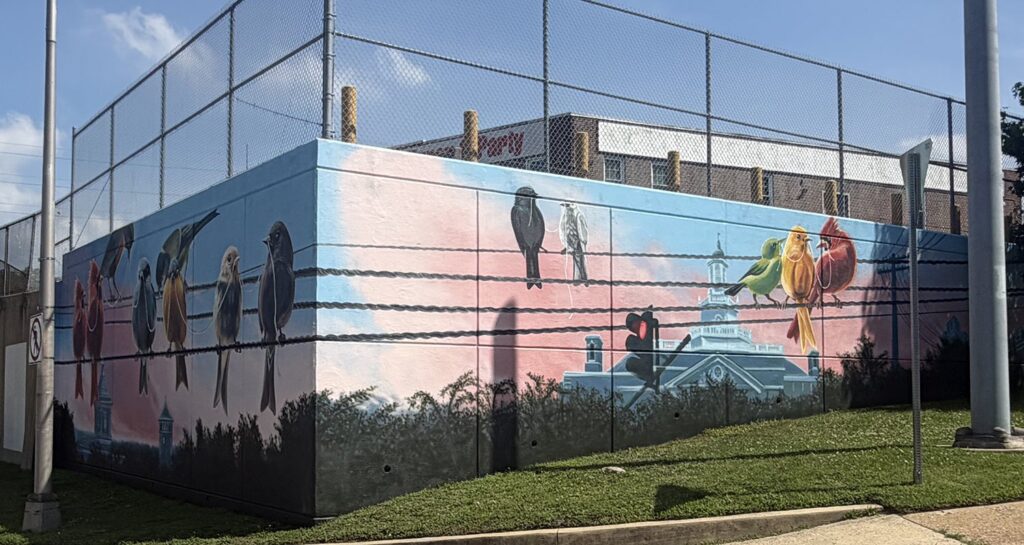
El muralista Christian Kanienberg afirma que le interesa “más crear obras de arte que, simplemente, resultan ser murales capaces de suscitar conversaciones”.
3 months ago
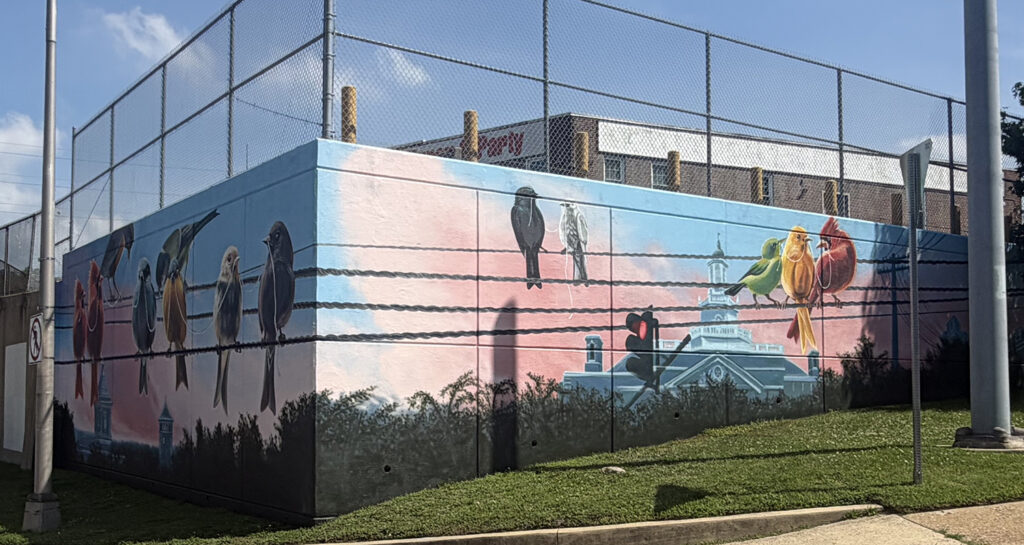
Muralist Christian Kanienberg says he’s “more interested in creating pieces of art that just happen to be murals that are conversation starters.”
3 months ago
Listen 2:11
The city’s free July Fourth concert on the Parkway is still on. Organizers say Saturday's star-studded show will happen rain or shine.
3 months ago