

Report: Center City apartment construction boom aids Philadelphia’s long-term housing goals
More than 40% of recent new housing is in the Center City area, but more incentives are needed to keep the boom going, a business group says.
Listen 1:19
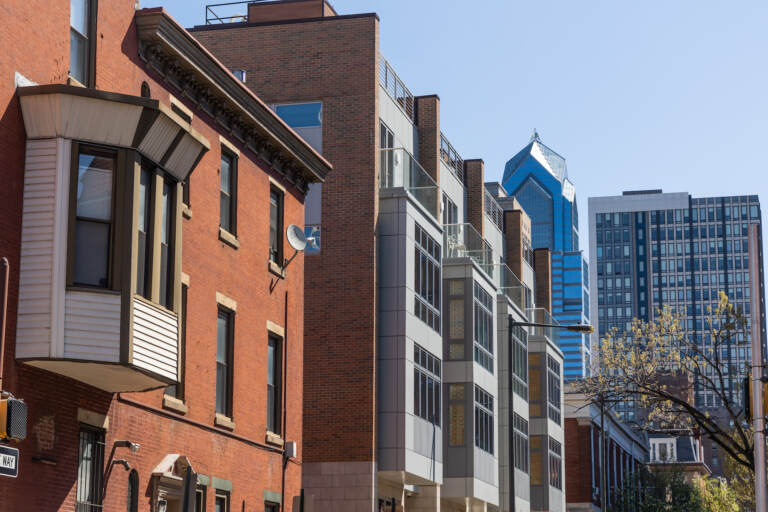
Center City, Philadelphia. (Kimberly Paynter/WHYY)
Have a question about Philly’s neighborhoods or the systems that shape them? PlanPhilly reporters want to hear from you! Ask us a question or send us a story idea you think we should cover.
Philadelphia’s ongoing downtown apartment construction boom is helping the city achieve its housing goals and slowing increases in rental costs in other neighborhoods, according to the Center City District business organization.
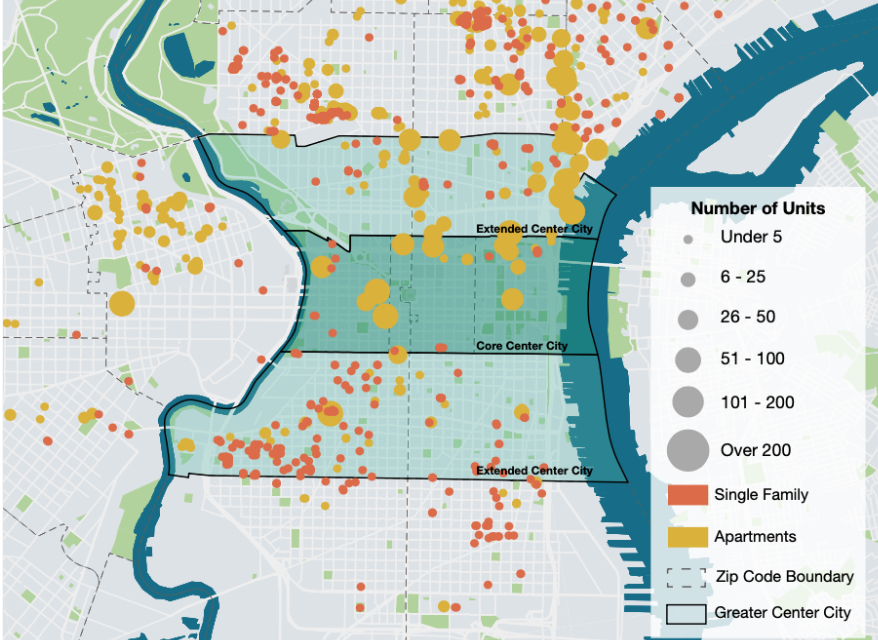
The group’s latest housing report found that of the roughly 10,000 units built across the city since the start of 2025, more than 40% are in the greater Center City area, which covers the area from Girard Avenue to Tasker Street and from river to river.
Looking back further to January 2024, when Mayor Cherelle Parker took office, the broader downtown area has gained 7,800 units, according to the report, released Monday. That’s equivalent to 26% of Parker’s goal of building, preserving or restoring 30,000 units citywide as part of her Housing Opportunities Made Easy, or HOME, plan.
Within the downtown core, little of the new construction is traditional affordable housing, and it’s primarily studios and one-bedrooms, with few new units large enough to accommodate families with children, said Clint Randall, Center City District’s vice president of economic development. Affordability is a central focus of the HOME plan.
In addition, housing costs have generally been climbing in Philadelphia in recent years.
However, Randall pointed to data showing that from 2016 to 2025 rents have risen more slowly in Center City than in lower Manhattan, downtown Boston and some other northeastern urban centers.
Because so much more housing is available in Center City, it has absorbed many newcomers to the city and other homeseekers who might have otherwise looked to live in outlying neighborhoods and driven rents up further in those areas, he argued.
“If there’s lots and lots of options in and around Center City, and they’re all saying two months free, three months free — which is absolutely what starts to happen when there’s too many units and not enough people — you’re going to capture a lot of the newcomers in either a high-rise or the downtown area, and that’s one less person looking in Brewerytown or Point Breeze or Germantown or Mayfair,” he said.
Related Content
Philadelphia developers are seeking more building permits for new rentals. Here’s why
The uptick is raising questions about Philadelphia's broader identity as a city of homeowners.
1 month ago
Listen 1:10Pros and cons of a slowdown
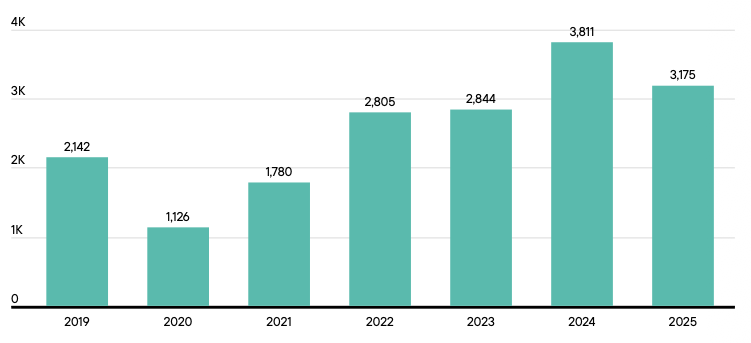
Housing production in greater Center City hit a recent peak in 2024, with 3,811 units completed. That surge resulted from a rush to start projects under the city’s old 10-year tax abatement on new construction, which was changed in 2019 to reduce its value by about half.
It also reflects a trend of converting office towers into housing as the rise of work-from-home and other factors have reduced demand for office space, Randall said.
In 2025, the number of units finished in the larger downtown area declined to 3,175. Currently, 1,300 units are being developed in the Center City area, and 5,600 total citywide, according to the report. Projects underway include the construction of 622 apartments in the Wanamaker building near City Hall.
In addition to the smaller tax abatement, high interest rates on construction loans and unpredictable pricing of labor and materials, due in part to Trump administration tariffs, have made developers more cautious about launching new projects, Randall said.
While that means it may take longer for city officials to reach their housing goals, the slowdown has arguably been beneficial in that it has reduced what had been a glut of units in Center City and adjoining neighborhoods, he said.
The residential occupancy rate has reached 90% across the broader downtown area, creating more foot traffic, boosting restaurants and other local businesses, and adding to the area’s vibrancy, he said. The figure is slightly higher in Center City and slightly lower in neighborhoods just to the north and south.
“We can see every day the impact that we’ve had converting millions of square feet of office space over 20 years into apartments and condos,” he said.
More room for housing
Downtown still has plenty of space for additional residential development, including a number of undeveloped parking lots along the eastern section of Market Street and late-20th century offices west of Broad that are more challenging to convert to housing, Randall said.
“We’re seeing a lot of exciting conversions, but if you talk to people who work in the office district, a lot of them will still say, ‘Oh, it feels quiet,’ or ‘There aren’t as many places to eat as there used to be,’” he said. “Adding hundreds or even thousands of units into these areas that were a little less residential before just starts to strengthen all of the fundamentals.”
To help make it easier to finance more housing, City Council should consider opting parts of Center City into the revamped Transit Oriented Communities Overlay, which allows larger buildings and smaller parking requirements for projects near transit stations, the report said.
Under state legislation passed last year, the city could also adopt a new, 20-year tax abatement for converting abandoned or underutilized buildings into housing, Randall said. Pittsburgh recently enacted the abatement for certain downtown housing projects.
Considering just a selection of properties in Center City that could accommodate high-density development, “even if half of them ended up being office or hotel or other uses, we could still probably fit another 15,000 to 25,000 housing units, just in the core of Center City, without really any additional changes to zoning,” he said.
“Center City still has the potential to continue to be this real engine of housing production for the city writ large.”

Saturdays just got more interesting.
WHYY is your source for fact-based, in-depth journalism and information. As a nonprofit organization, we rely on financial support from readers like you. Please give today.
Brought to you by PlanPhilly
PlanPhilly
In-depth, original reporting on housing, transportation, and development.
South Jersey woman opts for mediation in eminent domain fight over her Whitesboro property
Dawn Robinson has been fighting efforts from the city to force her to sell her 2.4-acre property in Middle Township.
3 months ago
Listen 0:57
Harrowgate affordable housing project will transform industrial lot
The development from Odin Properties in North Philadelphia is the company’s first government-backed project.
1 year ago
Large-scale apartment building on track to replace former Hoa Binh Plaza
The project is part of a broader movement away from the industrial heritage of Philly’s Washington Avenue corridor.
1 year ago
Listen 1:09