

‘It’s a good day’: Philadelphia business leaders, legislators celebrate Supreme Court ruling against Trump’s tariff authority
Republican U.S. Rep. Brian Fitzpatrick joined Democrats in applauding the decision.

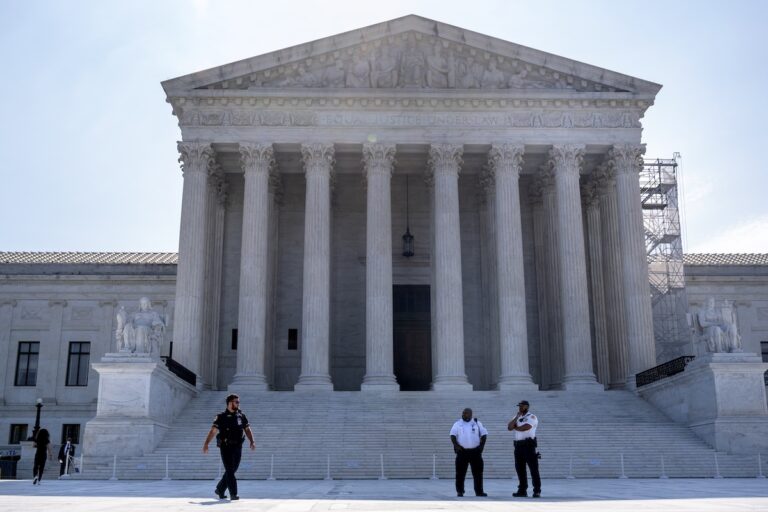
The Supreme Court building is seen on Friday, June 28, 2024, in Washington. (AP Photo/Mark Schiefelbein)
From Philly and the Pa. suburbs to South Jersey and Delaware, what would you like WHYY News to cover? Let us know!
Karl Brown founded Pretzel Pete in 2012, building the company partly through exports that now make up around half of the company’s sales.
Brown, who has served as president of SB Global Foods for three decades, said “there is so much opportunity overseas that I think a lot of American companies miss.”
“Any kind of consumer brands that are made in the United States require and demand and receive a premium due to the goodwill and the value that consumers overseas see in the ‘made in America’ brand,” he said.
Pretzel Pete also relies on imports for ingredients that are “impossible” to source domestically.
However, President Donald Trump’s implementation of broad — and sometimes haphazard — tariffs through the International Emergency Economic Powers Act, or IEEPA, had an “immediate impact” on the company, Brown said, making those imports more costly and even “prohibitive” in some cases.
Brown also worried other countries would soon enact their own retaliatory tariffs, concerned that would lead to decreases in profits and possibly even layoffs at his Hatboro-based factory, which employs around 80 people.
But Brown is feeling some relief today, now that the U.S. Supreme Court ruled against Trump’s tariff power under the IEEPA.
“It’s a good day,” he said. “It’s a win for small businesses like mine, a major win in and credit to the Supreme Court for stepping up and I think doing the right thing.”
Small businesses paid tariff costs
Pretzel Pete is far from the only local company to be impacted by the recent tariff crisis, with businesses across the board forced to pay more on imports, including manufacturers, restaurants and even coffee shops.
U.S. Sen. Ed Markey, D-Massachusetts, the ranking member of the Committee on Small Business and Entrepreneurship, released a report that found small businesses nationally paid more than $63.1 billion between March 2025 and November 2025 in tariffs, including $1.6 billion from Pennsylvania’s small businesses.
Area Democrats, who long opposed Trump’s tariff policy, applauded the Supreme Court decision.
U.S. Rep. Dwight Evans, D-Philadelphia, called it a “win for YOUR wallet!” in a social media post.
“The Constitution is clear- only Congress has the power to levy tariffs and other taxes,” he posted,” adding he co-sponsored legislation to return the power to Congress.
Related Content
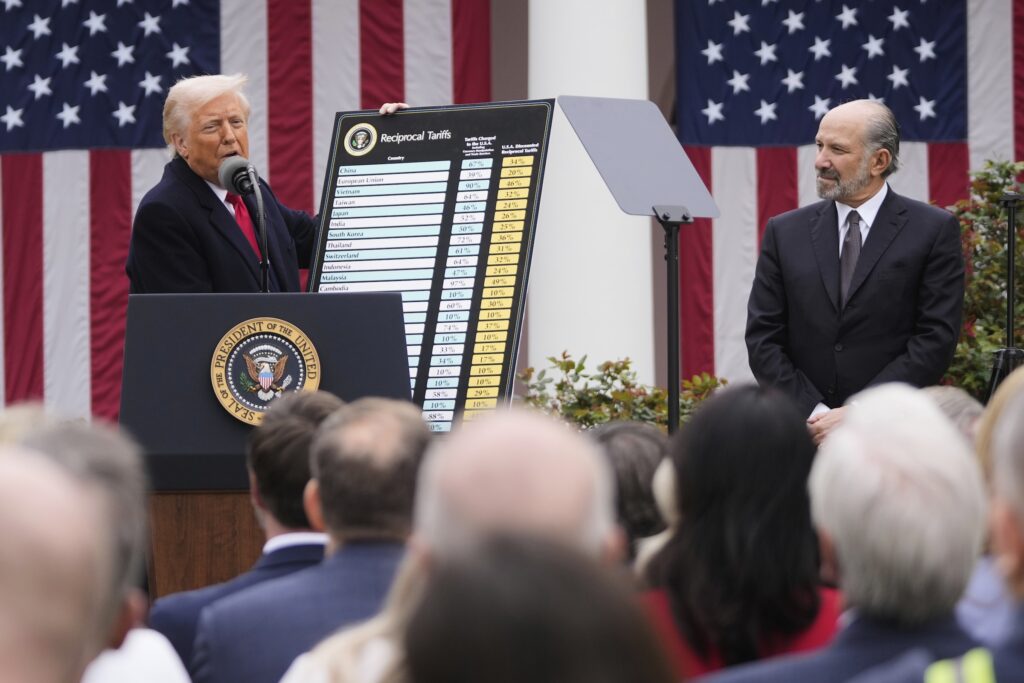
Supreme Court strikes down Trump’s sweeping tariffs, upending central plank of economic agenda
The 6-3 decision centers on tariffs imposed under an emergency powers law, including the sweeping “reciprocal” tariffs he levied on nearly every other country.
8 months ago
U.S. Rep. Brendan Boyle, D-Philadelphia, called the ruling “a victory for every American family paying higher prices because of Trump’s tariff taxes.”
“Trump’s tariffs weakened our economy, hurt American workers and made it harder for families to make ends meet,” Boyle, who serves as the ranking member on the House Budget Committee, said in a statement.
U.S. Sen. Chris Coons said the decision Today’s decision “makes clear that the Constitution gives Congress, and Congress alone, the power to implement taxes and tariffs.”
“President Trump’s signature economic policy has raised prices on everyday goods for Americans, squeezed businesses large and small in Delaware and across the country, and strained relationships with our partners and allies around the world,” he said in a statement. “The tariffs have stifled manufacturers that need products from abroad and done nothing to strengthen the American industries they were supposed to help.”
Coons said that “many” of his Republican colleagues are “privately breathing sighs of relief” but that they should have “done more to stop these tariffs when they had the chance.”
At least one Republican joined his Democratic colleagues in their support of the decision. Casey-Lee Waldron, spokeswoman for U.S. Rep. Brian Fitzpatrick, R-Bucks, said the decision “validates the Congressman’s opposition to blanket and indiscriminate tarriffs that are not narrowly tailored, and that do not lower costs for the American consumer.”
“Families are already stretched thin due to an ongoing affordability crisis that has been caused by hyper-partisan politicians from both political parties for decades,” she said in a statement, noting Fitzpatrick’s vote to rescind the president’s emergency authority to enact a tariff on Canada.
However, the same week Fitzpatrick voted to block legislative challenges to tariffs imposed by the president. Three different Republicans voted with Democrats against that ban, which led to the result on the Canada tariff.
U.S. Sen. David McCormick said in a statement he was “disappointed in the Supreme Court’s ruling,” calling it one of the “tools that shrink our trade deficit, stop the dangerous flow of fentanyl, bring critical manufacturing jobs home, and prevent foreign competitors from cheating Pennsylvania workers.”
“As I have said many times, I believe President Trump was using legitimate emergency authorities very effectively to protect our national security and achieve fair trade for U.S. companies and American workers,” he wrote. “We must stay focused on the President’s goals of protecting America’s economic and national security.”
Related Content
Trump has stocked his administration with people who have backed his false 2020 election claims
Those election conspiracists now holding official power range from the attorney general to lawyers filing lawsuits for the Justice Department.
8 months ago
Pay back
Kent Smetters, a professor of economics at the University of Pennsylvania Wharton School of Business and faculty director of The Penn Wharton Budget Model, said that the overall impact on the economy was not particularly significant, likely less than two-tenths of 1%. Consumers, he said, paid around an additional $800 last year in increased costs.
That’s because many companies and industries, warned of likely impending tariffs, had the opportunity to stock up on necessary equipment or ingredients in advance, ensuring that they could weather the initial effects.
However, Smetters added that some of the “worst impacts” are still to come.
“Investors out there know that President Trump is going to look for another mechanism to reimplement those tariffs, and that will still discourage investment and increase interest rates and increase the cost of capital for U.S. firms,” he said.
Also, while the Trump administration has touted that tariffs brought in more than $200 billion in revenue, the government may have to pay most of that back to the companies that paid them, a decision the Supreme Court remanded to the lower court.
Historically, firms have three months to request a refund for tariffs that were inappropriately applied, though this is an unprecedented situation.
“It’s likely that the lower court will say, ‘Alright, the firms will have like 90 days to pursue a refund.’ Or it’s possible that the lower court will simply order the treasury to automatically refund tariffs that it collected,” Smetters said.
However, that won’t help Brown, given his company did not pay the tariffs directly. He called it a “daisy chain” in which the importer passed on some of the costs to a distributor who then passed on some of the costs to Pretzel Pete.
“I don’t see any way they could prove how much of the tariff was actually paid by all of those participants in the chain,” Brown said. “Whoever said that chaos would be unleashed is absolutely correct.”
He added that some of the damage from Trump’s first term tariffs still lingers. China was the company’s “largest customer by far” until Trump imposed a 25% tariff on China, which retaliated with a comparable tariff.
“Since those tariffs were imposed, our business with China dropped to about 10% of the level that it was and has never recovered,” he said.

Get daily updates from WHYY News!
WHYY is your source for fact-based, in-depth journalism and information. As a nonprofit organization, we rely on financial support from readers like you. Please give today.
Trump administration asks Supreme Court to halt order providing full SNAP payments for November
A U.S. district judge had given the administration until Friday to make the payments through the Supplemental Nutrition Assistance Program.
12 months ago
Here are Gov. Shapiro’s lawsuits against the Trump administration this year
Pennsylvania's first-term Democratic governor has either filed or joined more than a dozen lawsuits against the Trump administration in 2025.
1 year ago
Judge blocks Trump from cutting funding from 34 cities and counties over ‘sanctuary’ policies
A judge has ruled the Trump administration cannot deny funding to Philadelphia, Boston, Chicago, Denver and 30 other cities and counties.
1 year ago