
Pennsylvania launches new privacy protections for people with disabilities, including autism
The protections are included in a series of new executive orders aimed at supporting people with disabilities.
Listen 1:01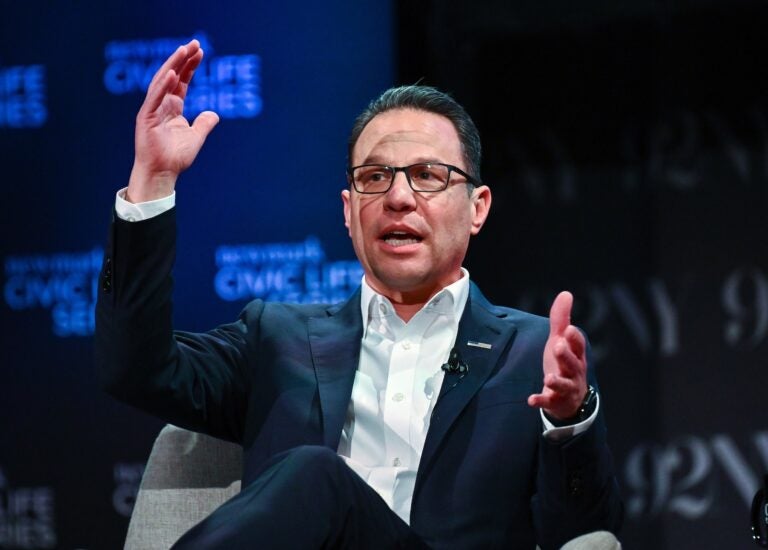
Pennsylvania Gov. Josh Shapiro discusses his new memoir, "Where We Keep the Light: Stories from a Life of Service," at the 92nd Street Y on Tuesday, Jan. 27, 2026, in New York. (Photo by Evan Agostini/Invision/AP)
From Philly and the Pa. suburbs to South Jersey and Delaware, what would you like WHYY News to cover? Let us know!
Pennsylvania is adding more privacy protections for people with intellectual disabilities, including autism spectrum disorders, after federal plans to collect more health information raised concerns.
Any state agency collection of personal and private information on people with disabilities, including autism spectrum disorder, will be limited to the minimum level of detail that is absolutely necessary, Pennsylvania leaders announced Wednesday.
This data will also not be shared with or disclosed to federal agencies “without legitimate need,” Gov. Josh Shapiro said during a press conference in Harrisburg. That includes any attempts to create federal databases or registries of people with disabilities, he said.
“All across the country, we have seen the consequences of federal overreach,” Shapiro said. “We will not let them get ahold of your private, personal information, and the action I am taking today helps protect against that.”
The protections are outlined in a series of new executive orders Shapiro issued Wednesday that aim to better support members of the disability community and their families.
Privacy concerns among autistic residents and parents stem from a National Institutes of Health announcement last April that indicated the agency had plans to collect Americans’ private health information from pharmacies, insurance claims, hospitals and other sources.
Related Content

Founders of the new Independent Autism Coordinating Committee say they will act as an alternative body to a federal advisory group under RFK Jr.
5 months ago
Listen 1:20It would be part of U.S. Department of Health and Human Services Secretary Robert F. Kennedy Jr.’s controversial plan to investigate causes of autism and potential cures.
The news quickly drew backlash from the autism community, and federal leaders later clarified that HHS would specifically draw information from federal health insurance programs Medicare and Medicaid to build a “real-world data platform” for research into the “root causes of autism.”
But the announcement already had a chilling effect on parents and families, said Erin Lopes, a Pennsylvania parent of an adult son with autism.
“How would the privacy and civil rights of autistic individuals and their families be protected? How would this very sensitive data be used?” she asked. “And how would a national registry protect individuals with autism from bias and from being excluded?”
Families then turned to state agencies and officials in calling for stronger privacy protections in Pennsylvania. Lopes’ son, Tom Bak, who is 26, said he worries about how that information could be used to discriminate against him in job opportunities as he pursues a career in music after recently graduating college.
“I worry about being openly autistic in these times. I worry a lot that people may not understand me, or they might judge me because I’m autistic,” he said. “I feel that some of the actions of the federal HHS in the last year only make people understand autism less and they haven’t shown what autism really is.”
Bak called the new privacy protections in Pennsylvania reassuring and said they respected his autonomy.
Shapiro’s recent executive orders also create the new Advisory Commission on People With Disabilities, which will report directly to the governor’s office. The commission will be made up of people with intellectual, developmental, physical and other disabilities, as well as family members, advocates and service providers from across the state.
Members will give direct input on state laws, policies and programs that are designed for people with disabilities.
Related Content

Children’s Hospital of Philadelphia has partnered with Soar Autism Center to open new early-intervention sites for kids 6 and younger.
7 months ago
Listen 0:59Historically, decisions about support services and care for people with disabilities are often made without involving those from the disability community, said Sherri Landis, chief executive officer of the ARC of Pennsylvania. The new commission changes that, she said.
“It ensures that people with disabilities have a voice, and not just a voice, but a seat at the table,” she said. “This matters because lived experience brings insight that policies alone cannot capture.”
A third executive order will reestablish the Developmental Disabilities Council, which is an independent group that advises the governor on issues affecting people with developmental disabilities in Pennsylvania. The group is tasked with creating a statewide plan for making improvements to support systems and services across the commonwealth.

Get daily updates from WHYY News!
WHYY is your source for fact-based, in-depth journalism and information. As a nonprofit organization, we rely on financial support from readers like you. Please give today.
ICE abandons plans to convert 2 rural Pennsylvania warehouses into detention centers
The Pennsylvania Department of Environmental Protection said doubling the population of the rural communities would tax the sewage system and drain drinking water supplies.
4 weeks ago
Listen 1:00
State Democratic leaders announced the effort in the district of U.S. Rep. Scott Perry, one of four Republican-held seats they hope to flip in November.
1 month ago
Listen 1:13
Under Trump, immigration arrests surge in Pennsylvania, Delaware and New Jersey
New Jersey and Pennsylvania rank among the 10 states with the most immigration arrests during the first 14 months of President Donald Trump’s second term.
2 months ago
Listen 1:43