
Pa. Gov. Shapiro says regulated utility system is ‘broken’
In a letter to the state’s regulated utilities, the governor laid out a new system to rein in corporate profits.
Listen 6:05
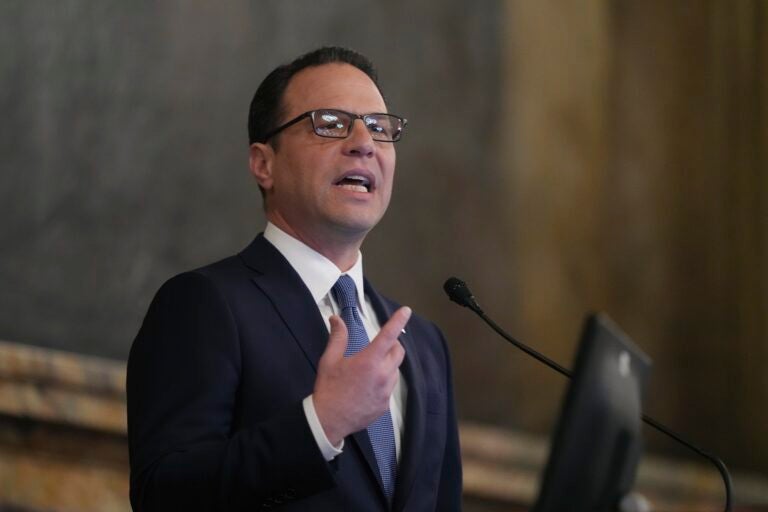
Pennsylvania Gov. Josh Shapiro delivers his budget address for the 2025-26 fiscal year to a joint session of the state House and Senate at the Capitol, Tuesday, Feb. 4, 2025, in Harrisburg, Pa. (AP Photo/Matt Rourke)
This story is part of the WHYY News Climate Desk, bringing you news and solutions for our changing region.
From the Poconos to the Jersey Shore to the mouth of the Delaware Bay, what do you want to know about climate change? What would you like us to cover? Get in touch.
In a letter sent to 24 electric, gas and water utilities, Pennsylvania Gov. Josh Shapiro told the companies’ CEOs that “the 20th century utility model is broken – we can no longer simply prioritize corporate profitability to drive infrastructure development.”
“Rather, we must be laser focused on delivering on the actual needs of our Communities,” Shapiro wrote in the letter dated April 29.
The letter points to 13 utilities in the state that sought $975 million in additional rates in 2025 “after those very same utilities earned a total of $1.4 billion in profits in 2024.”
“We have reached a tipping point,” Shapiro wrote, “and this is a moment to put your customers first and change the behaviors causing rate increases.”
Shapiro is proposing a radical departure from the status quo of ratemaking cases. He writes that utilities should provide cost-benefit analysis of needed infrastructure upgrades and expansion, take on more low cost debt, and engage in a competitive transparent process that publicizes the expected profits before a rate increase is approved.
“Let me be clear: my Administration and I will vocally and forcefully oppose rate case requests from utilities that fail to adhere to these three commonsense practices,” the governor wrote.
But the letter has received lukewarm responses from industry, and resistance from the Pennsylvania Public Utility Commission, which asserts its independence and defends the status quo.
Why Shapiro wants reform
Investor-owned utilities that provide gas and electricity make their profits on infrastructure upgrades, not the supply of gas and electricity, so the more they build, the more profit they can make. Because utilities enjoy a monopoly when it comes to the distribution of gas and electricity, any increase in distribution rates must be approved by regulators, which in Pennsylvania is the Public Utility Commission.
Shapiro, who is facing reelection and a potential future run for president, has been actively weighing in on affordability issues related to utility rates. He was highly critical of PECO’s planned rate hike announced in March, which the company had proposed after its previous rate increase resulted in record profits for the utility. Net income shot up 47.7% to $814 million in 2025 over the previous year, according to earning reports by its parent company Exelon. The proposal faced immediate backlash with Shapiro calling it “pure greed.” Several weeks later, PECO was forced to withdraw its proposal.
Nationwide, the CEOs of investor-owned gas and electric utilities earned $626 million in 2025, according to an analysis by the Energy and Policy Institute, marking an average of 16% jump in pay.
Last year also broke records for the number of Pennsylvania families who experienced utility shutoffs. More than 400,000 households lost water, electric or gas service, according to Elizabeth Marx, executive director of the Pennsylvania Utility Law Project.
Marx said the letter is a welcome surprise.
“Pennsylvania families are facing runaway rate increases,” Marx said. “There are exponential increases in the cost of energy just over the last year and a half, and that’s really straining both families and businesses.”
Related Content
Pennsylvania Gov. Josh Shapiro calls PECO rate hike request ‘pure greed’
PECO seeks to raise rates again by 12.5% for Philly and suburban electric customers. The governor's office says Shapiro believes the rate case should be withdrawn immediately.
4 months ago
Listen 1:33What are Gov. Shapiro’s benchmarks to curb rate hikes?
Borrow more money — more cheaply
In the letter, Shapiro lays out three benchmarks for utilities to follow in order to get his support for future rate hikes.
First, Shapiro wants the utilities to borrow more money more cheaply. He suggested applying for a U.S. Department of Energy loan.
“This means debt should normally represent a clear majority of a utility’s proposed ratemaking capital structure, as it does in many other lower-risk industries,” Shapiro wrote.
Cost-benefit analysis of utility investments
The second benchmark aims to force utilities to provide a transparent cost-benefit analysis of the infrastructure investments connected to the rate increase.
The infrastructure upgrades and expansions that are the source of profit for investor-owned utilities and paid for by ratepayers often include new poles, pipelines, wires or substations that provide safety and reliable service.
“Creating real value for customers also means maximizing existing grid resources in ways that control costs and defer the need for future upgrades,” Shapiro wrote. “You must also describe explicitly what amount of your requested rate increase will be remitted to shareholders through corporate dividends or other means, as compared to what would be used to directly advance the needs of your customers.”
End ‘black box settlements’
The infrastructure is financed through a combination of debt and equity, or funds contributed by their shareholders. The shareholders expect a return on that investment. Shapiro says those returns on investment, referred to as return on equity, are too high and are the source of a growing affordability crisis for the average customer. For example, the return on equity that PECO sought in its March rate request was 10.95%.
“These vestiges of the past need to evolve to ensure that utilities are not seeking excessive profits but only the opportunity to earn the fair rate of return to which they are entitled,” he wrote.
Shapiro is advocating for a completely new regulatory practice where a utility has to seek bids for its equity “through a competitive, transparent process.” This would likely lower their current rates of return by several percentage points. The other option would be to seek a return on equity no higher than the current stock market rate based on Federal Reserve data.
“In simple terms, this allows the filing utility to earn the same expected return as the stockmarket as a whole, according to Federal Reserve estimates, comfortably exceeding typical Public Utility Commission calculations of risk for the utility sector,” he wrote.
Related Content

‘Splintered, rotting’ electric poles: PECO union asks state regulators to investigate
IBEW Local 614, which represents 1,400 workers, filed a petition with the Pennsylvania Public Utility Commission seeking an investigation into PECO’s record of repairs.
3 months ago
Listen 1:27Reaction to the governor’s letter to utilities
It remains to be seen whether Shapiro can radically alter the current regulatory process and gain the support of the Public Utility Commission, while influencing the utilities. Although the governor appoints members of the Public Utility Commission, they are confirmed by the state Senate and are independent. The commissioners were all copied on the letter, but it’s unclear what, if any, of these benchmarks the commission will adopt.
In a statement, the commission said it values “the interest and input of the Administration and other stakeholders,” but stressed its independence.
“The Commission is an independent, quasi-judicial agency that evaluates each rate case through a formal, transparent process,” the statement reads. “The Commission’s decisions are based on the specific facts and evidence in the case record, and carefully balance consumer affordability with the need to maintain safe and reliable utility service. Consistent with that role, we remain committed to ensuring utilities are providing safe and reliable service at just and reasonable rates.”
In a letter from the Energy Association of Pennsylvania, an industry group that represents investor-owned gas and electric utilities, executive director Andy Tubbs responded to the governor’s letter, saying that they “are committed to transparency and to continuing to operate within the statutory framework under which utility rates are established.”
But the association, while not rejecting the proposals outright, did not express enthusiasm for changing the current regulatory practices.
“Rate filings are exhaustive, lengthy, evidence-based proceedings governed by the Pennsylvania Public Utility Commission,” Tubbs wrote. “Regulated utilities have an obligation to maintain the financial integrity necessary to support continued investment in critical infrastructure, system reliability, resilience, and customer service that Pennsylvanians expect. Strong financial metrics and access to capital markets directly affect the long-term cost of service delivered to customers and utilities’ ability to support thousands of Pennsylvania jobs and drive economic growth.”
Still, Tubbs left the door open to the governor.
“We appreciate your leadership and look forward to continued dialogue,” he wrote.
Wall Street also seems to have paid attention to the letter. The day after the letter was sent, share prices for major energy companies that operate in Pennsylvania, including Exelon, FirstEnergy and PPL dropped, while others rose.
Editor’s note: An earlier version of this story pointed to an incomplete data source for one of the two components the Governor is proposing to determine utility returns.

Get daily updates from WHYY News!
WHYY is your source for fact-based, in-depth journalism and information. As a nonprofit organization, we rely on financial support from readers like you. Please give today.
Part of the series
New Jersey Gov. Sherrill signs data center legislation that aims to protect ratepayers
Sherrill signed a package of legislation this week that aims to prevent data centers and utility companies from passing costs onto ratepayers.
1 month ago
Pennsylvania lawmakers push federal bill to boost clean energy
The Energy Bills Relief Act would reinstate tax incentives and speed the development of new clean energy projects.
2 months ago
Listen 1:12
The primary could have nationwide implications if Democrats want to flip the U.S. House in November, and has gained national pressure from both parties.
3 months ago