
N.J. Gov. Phil Murphy urges microplastics regulations in tap water. Can water providers meet the challenge?
There currently are no federal regulations for microplastics in public drinking water, and most water providers don’t monitor for these contaminants.
Listen 1:12
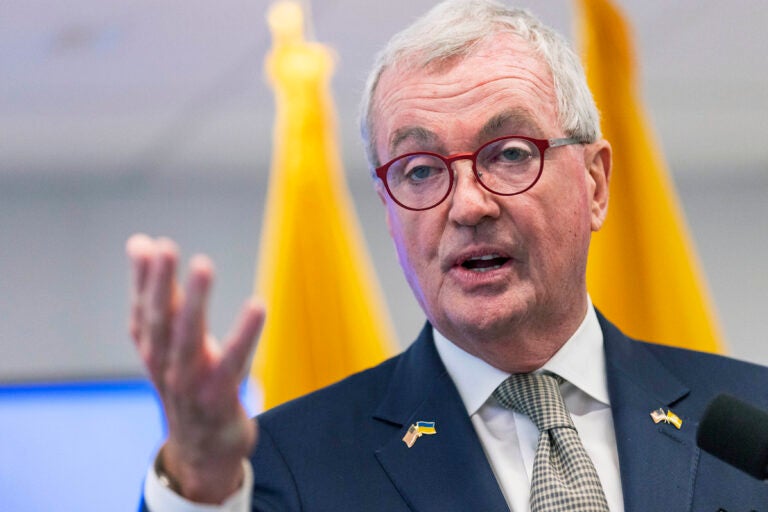
File: New Jersey Gov. Phil Murphy speaks during a press conference in Newark, N.J., Aug. 16, 2024. (AP Photo/Eduardo Munoz Alvarez, file)
From Philly and the Pa. suburbs to South Jersey and Delaware, what would you like WHYY News to cover? Let us know!
New Jersey Gov. Phil Murphy this week led a petition that was sent to the U.S. Environmental Protection Agency, urging for nationwide monitoring of microplastics in public drinking water.
The tiny particles come from a variety of plastic products and can contaminate soil, air, food and water. Once ingested, they can bioaccumulate in the body.
There currently are no federal regulations for microplastics in public drinking water, and most water providers don’t monitor for these contaminants.
“We deserve to better understand the potential for microplastics contamination in our drinking water,” Murphy said in a statement.
The petition, signed by six other governors, including Delaware Gov. Matt Meyer, requests the EPA to include microplastics in its Unregulated Contaminant Monitoring Rule.
The program allows the EPA to collect contaminant data and decide whether to restrict them in drinking water. The agency will soon release its sixth version of the rule, which will add 30 contaminants to the list by 2027.
Health experts say microplastics monitoring would help them better understand the potential harms, and lead to standards that protect public health.
“We need more epidemiological studies. In order to do epidemiological studies, you need the exposure data,” said Philip Demokritou, a professor of nanoscience and environmental bioengineering at Rutgers University.
However, most water providers currently aren’t equipped to test for these pollutants, and scientists have yet to determine a safety threshold.
“It’s good to monitor, but that will open the can of worms in terms of, ‘What is the level that is safe?’ If we assume that we want zero microplastics, that will also decide the level of interventions and what technologies will be implemented to remove them from the drinking water,” Demokritou said. “Everyone is entitled to know what’s in the food we eat, the water we drink and the air we breathe. But we need to be prepared, and discuss it and debate how we go about it.”
Related Content
How Philadelphia seniors are tracking microplastics in streams and working to ‘leave a better world’
Members of the Senior Environment Corps wade into streams, peer through microscopes and teach kids how to identify aquatic critters.
7 months ago
Listen 5:03Drinking water suppliers struggle with treating for microplastics
More than 400 million metric tons of plastic are produced worldwide each year, ultimately making their way to landfills and incinerators. From there, plastics break apart into tiny particles, and pollute the air, water and soil. The particles are also discharged from industrial facilities and wastewater treatment plants.
“We need to move towards a more sustainable modus operandi when it comes to dealing with materials in general and more specifically for plastics,” Demokritou said.
Other common sources of microplastics include cosmetics, textiles, fertilizers, food packaging and clothing.
Microplastics and nanoplastics, which contain harmful chemicals, are often invisible to the eye and are easily ingested. These particles have been detected in the human bloodstream, brain tissue and other organs, and researchers say exposure could increase the risk of heart attack or stroke.
“They can bypass biological barriers and make it to organs,” Demokritou said. “We don’t have the epidemiological data to support the disease question. So there’s a lot of risk uncertainty.”
Demokritou, who has been researching microplastics for about 15 years, is calling for increased funding to answer those questions.
Testing for microplastics is a significant undertaking, however. Scientists can detect particles, but it’s difficult to distinguish a plastic particle from one that’s naturally occurring.
“If I have a large piece of plastic in my hand, and I have a rock in the other hand, I know what a rock and a plastic is. But as we get smaller [particles], everything just looks like dust,” said Samantha McBride, a professor of chemical and biomolecular engineering at the University of Pennsylvania.
She said most public water providers currently are not equipped to test for and treat microplastics, because it’s expensive and time consuming. Research on drinking water treatment options for micro and nanoplastics have also shown inconsistent results, McBride said.
Related Content
Rutgers researchers are exploring the impact of microplastics on the digestive system
The university received a $3.2 million grant from the National Institutes of Health, which will fund the five-year study.
2 years ago
Listen 1:13In a statement to WHYY News, investor-owned utility American Water said microplastics present significant challenges, including how to identify its presence, the need for an EPA-approved testing method and lab capacity.
The water provider said it’s committed to finding “solutions to the challenges related to microplastics and other contaminants of emerging concern.”
If the EPA begins the process of collecting data on microplastics in drinking water, McBride said it could take another decade before regulations are implemented.
Until then, she said residents can avoid using single-use plastic bottles, in which microplastics can leach. A plant-based diet can also reduce exposure, McBride said.
“Unfortunately, because of the way that microplastics bioaccumulates, the higher up the food chain you go, the more likely you are to encounter these contaminants. Meat and dairy, for example, is almost certainly going to have a higher concentration compared to plant-based foods,” McBride said. “Aside from that, limiting the plastic as much as possible in daily life, but of course, it’s not possible to completely eliminate it. It’s ubiquitous. It’s all around us.”

Get daily updates from WHYY News!
WHYY is your source for fact-based, in-depth journalism and information. As a nonprofit organization, we rely on financial support from readers like you. Please give today.
How Philadelphia seniors are tracking microplastics in streams and working to ‘leave a better world’
Members of the Senior Environment Corps wade into streams, peer through microscopes and teach kids how to identify aquatic critters.
7 months ago
Listen 5:03
Pa. Republican congressmen applaud Trump administration plan to roll back Biden-era climate rules
Pennsylvania Republican lawmakers say it will boost the state’s economy. Environmental groups say it will worsen climate change and harm public health.
11 months ago
Listen 1:09
The former regulators' warning comes in the wake of the U.S. Environmental Protection Agency's announcement to roll back dozens of air and water protections.
1 year ago
Listen 1:39