
New Jersey firefighters take toxic PFAS firefighting foam off their shelves
New Jersey has partnered with Revive Environmental to remove and destroy 150,000 gallons of aqueous film forming foam.
Listen 1:20
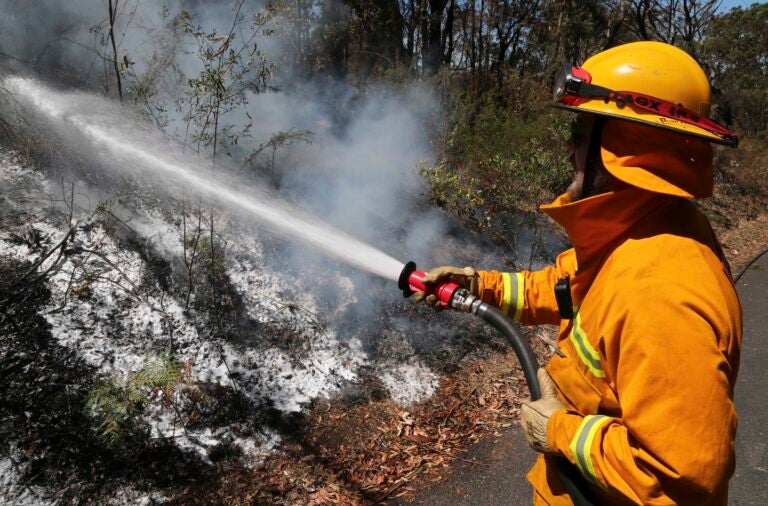
File - A firefighter sprays foam on smoldering bush to help reduce re-flash fires after a blaze swept through Faulcombridge, 53 miles west of Sydney, in Australia Thursday, Oct. 24, 2013. (AP Photo/Rob Griffith)
This story is part of the WHYY News Climate Desk, bringing you news and solutions for our changing region.
From the Poconos to the Jersey Shore to the mouth of the Delaware Bay, what do you want to know about climate change? What would you like us to cover? Get in touch.
Firefighting foam containing toxic PFAS chemicals have contaminated drinking water across the country for decades. The so-called “forever chemicals” have been linked to serious health problems, including some cancers.
The state of New Jersey has partnered with the remediation company Revive Environmental to help fire departments and academies remove and destroy 150,000 gallons of the toxic foam. New Jersey is investing $16.6 million in state appropriations to fund the disposal of aqueous film forming foam, which it will ban in 2027.
“We [used to] use it in car accidents on the side of the road, and then it goes into a ditch on the road, which goes into the waterway and we have the potential to contaminate a lot of things — now we don’t have that potential,” said Rob Gancarz, fire chief of the Jacobstown Volunteer Fire Company.
PFAS, widely used in consumer products such as nonstick cookware and waterproof clothing, have been linked to serious health problems, including some cancers, thyroid disease, developmental delays in children and other health conditions.
The chemicals are also found in the foams used to put out fires. The foam, also known as AFFF, is one of the most effective fire-suppressing foams because it not only smothers fires but is also fuel-resistant.
Primarily used for extinguishing liquid fuel fires, AFFF has been most frequently discharged at military bases and airports during practice drills and emergencies such as aircraft fires.
Industrial facilities like tank farms and refineries also store AFFF on site in case of an emergency. Oil refineries and petroleum terminals have been granted an eight-year extension to comply with New Jersey’s ban on the foam.
Fire companies also frequently use AFFF when responding to incidents such as vehicle fires, and the product is used in large quantities at fire academies during training exercises.
“Even as far as training goes, as it was getting close to the expiration date, I know departments would just run it through their regular Tuesday evening training as a hose drill and just blanket an open field with the foam,” said Joseph Hales, the director of the Camden County Training Center, which is giving 6,000 gallons of its AFFF to Revive.
Related Content

New Jersey bans some products with toxic PFAS chemicals. Here’s what to know
People can be exposed to the so-called “forever” chemicals from household products like carpets and cosmetics.
4 months ago
Listen 1:03How do you destroy ‘forever chemicals’?
PFAS can stay in the environment — and the human bloodstream — for years. For this reason, the U.S. Department of Defense has already begun phasing out AFFF, and more than a dozen states have banned its usage.
“I’ve been in this industry a long time and PFAS is the most challenging environmental contaminant we’ve ever faced for a few reasons,” said Rick Gillespie, CEO for Revive Environmental. “Number one, it’s persistent in the environment. It doesn’t degrade. It accumulates in human tissue and it’s toxic at very low levels — some of the lowest levels we’ve ever seen. So, removing these PFAS sources from the environment is critical.”
Revive will use a technology called supercritical water oxidation to remove and destroy the PFAS. The technology involves heating water under high pressure to solubilize the PFAS in the AFFF and break the carbon fluorine bond.
“You don’t ever have to take a chemistry class to think of it as like a really high-temperature, high-pressure cooker, where you feed AFFF into it, and then clean water comes out,” Gillespie said.
Gancarz said he’s grateful for the state-funded initiative because his company wouldn’t be able to dispose of the foam without support from the state.
“It would just lay around the station until somebody provided us some answer. My small volunteer company, we don’t have large funds to be able to spend on disposing of hundreds of gallons,” he said.
Hales, who also is Camden County’s emergency management coordinator and chief fire marshall, said he’s relieved to start using PFAS-free foam.
“The last place where we applied AFFF foam was at a residential fire, so there is ground remediation and all of that,” he said. “With the new green foam, there’s none of that, there’s no health risks or safety factors. It’s not an issue that’s being passed on to them after they’ve already had the worst day of their life.”

Get daily updates from WHYY News!
WHYY is your source for fact-based, in-depth journalism and information. As a nonprofit organization, we rely on financial support from readers like you. Please give today.
Part of the series
Philadelphia Gas Commission rejects PGW’s expanded Port Richmond LNG plant until further study
The Philadelphia Gas Commission tabled the $182 million proposal but agreed to fund $5 million for engineering and environmental studies.
5 days ago
Listen 1:25
Delaware City Refinery to emit toxic gas as it repairs machinery
The Delaware City Refinery has a history of releasing sulfur dioxide while fixing equipment issues.
1 week ago
Listen 0:57
Toxic ‘forever chemicals’ in New Jersey’s tap water have dropped 55%, Rutgers study finds
PFAS are commonly found in household items and can remain in the environment — and our blood — for decades.
1 month ago
Listen 1:19