

Philadelphia Gas Commission rejects PGW’s expanded Port Richmond LNG plant until further study
The Philadelphia Gas Commission tabled the $182 million proposal but agreed to fund $5 million for engineering and environmental studies.
Listen 1:25
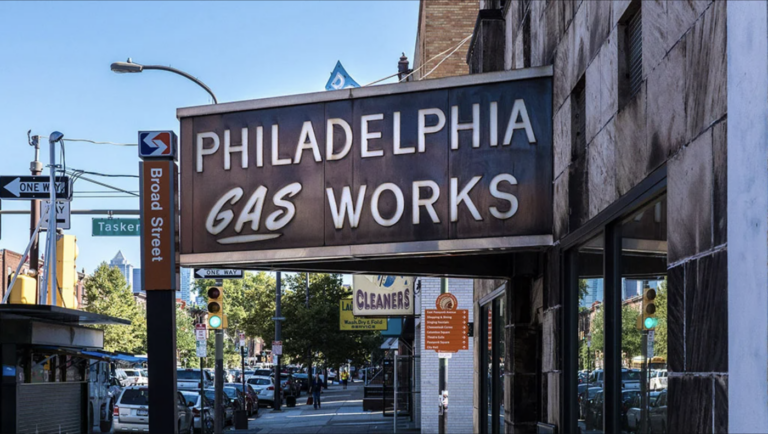
A Philadelphia Gas Works sign is pictured on South Broad Street. (Danya Henninger/Billy Penn)
This story is part of the WHYY News Climate Desk, bringing you news and solutions for our changing region.
From the Poconos to the Jersey Shore to the mouth of the Delaware Bay, what do you want to know about climate change? What would you like us to cover? Get in touch.
The Philadelphia Gas Commission on Tuesday approved $213 million for Philadelphia Gas Works’ fiscal year 2027 capital budget. In a unanimous vote that included four of the five commissioners present, a decision on the utility’s controversial request to spend $182 million to replace its natural gas liquifier in Port Richmond was tabled for the second time.
The proposal would increase PGW’s capacity to liquefy and store natural gas by 1 billion cubic feet, about one-third larger than its current 2.2 billion cubic feet processing facility. Instead, the commission approved $1 million for an environmental impact study and $4 million for an engineering study.
The studies will “evaluate the liquefier’s current condition, structural integrity, operational efficiency, and remaining useful life along with emissions and air quality effects,” according to a press release sent immediately after the vote by City Controller and Chair of the Philadelphia Gas Commission Christy Brady and City Councilmember and vice-chair of the commission Mike Driscoll.
Driscoll and Brady said more information is needed to review the impact of an expanded liquified natural gas facility.
“We need a fuller picture of the proposed LNG liquefier replacement before moving forward with the approval of PGW’s $182 million cost estimate,” Brady said in a statement. “It hasn’t been shown that the replacement project was ready and lacked important details such as design plans and the total costs to ratepayers.”
Speaking after the vote, Patrick Houston, who testified against the project as part of the coalition HERE 4 Climate Justice, said he’s happy with the decision to table the approved funding for now.
“It’s a move in the right direction,” Houston said. “They are not allocating the $182 million for the LNG plant, and that’s exactly what we demanded. We need greater scrutiny from the Gas Commission on PGW for any new energy projects, and we need to start to direct our money towards more affordable renewable alternatives and not more fossil fuel infrastructure.”
Neighborhood residents, health care workers and climate activists have testified against the plans to replace and expand the plant, which sits along the Delaware River in the Port Richmond neighborhood.
Gas Commission staff reverses their position on PGW’s proposed Port Richmond LNG project
In March, the commission’s staff had reviewed the proposal as part of the utility’s 2027 capital budget and recommended that the five commissioners reject the $182 million project, saying the design plans were incomplete and that the utility did not justify the increased capacity. The Public Advocate agreed, saying the new proposal was oversized and could overburden PGW customers with higher rates.
But PGW argued approval for the plant was urgent, as the utility needed to have the liquefier operating by 2030 for safety and affordability. The utility said the increase in size is needed to meet demand and at the commission’s meeting April 15, urged the commissioners to reject the staff’s recommendation. Liquefied natural gas requires a substantial amount of energy to cool methane in its gaseous form to -260° Fahrenheit, where it becomes a liquid. The plant has been operating since the 1970s and stores the gas in 12-story white storage tanks.
One issue continues to be a lack of agreement between the two sides as to how much money the LNG plant saves ratepayers, and how much of the expansion costs would fall to ratepayers.
But in a surprise move at the commission’s meeting April 15, the commissioners tabled the vote.
In an updated recommendation by the commission staff posted a week and a half later on April 27, the hearing examiners continued to recommend rejecting the $182 million for the LNG plant in the fiscal year 2027 capital budget due to a lack of engineering plans. But it reversed course on other issues based on new information it said PGW provided. The commission staff now agrees with the utility that it needs to update the plant for safety reasons and agreed that it needs an increased capacity.
Community Legal Services supervising attorney Rob Ballenger, who serves as the Public Advocate, told the commissioners Tuesday that staff should not have reversed its position on the need and size of the LNG plant.
“I fundamentally disagree with staff’s conclusion that PGW has substantiated its need for a liquifier capable of producing 3.3 [billion cubic feet] of LNG annually,” Ballenger told the commissioners. “Staff previously recognized PGW’s proposal was outsized, and so could adversely impact rates. Staff now completely ignores those findings, placing customers at risk.”
Ballenger said PGW relied on “unsubstantiated and severely outdated” data that dates back to the 1960s to justify the capital expense.
“It has never faced a shortage of gas with its existing facility capable of producing no more than 2.2 [billion cubic feet]. In fact, in many years, PGW has had excess supply. It has sold that excess supply in off-system transactions … to be trucked out of its facilities outside of Philadelphia.”
Related Content
PGW’s proposed liquefied natural gas plant in Philadelphia’s Port Richmond neighborhood now in limbo
PGW says it needs to replace an aging liquefier in Port Richmond. Philadelphia Gas Commission staff had recommended not to approve the project.
5 months ago
In an emailed statement, PGW said the expansion would enable it to provide more affordable rates.
“Without a budget that includes funds to support critical components of PGW’s LNG (liquefied natural gas) infrastructure – customer safety, reliability and affordability are put at risk,” said Christina Clark, director of media relations at PGW. “Just a few months ago, Winter Storm Fern caused reliability and affordability challenges across the northeast. PGW customers were spared price spikes and service interruptions due to PGW’s LNG infrastructure. That infrastructure saved customers an estimated $90 million in additional expenses.”
Ballenger has said the $90 million figure does not factor in the operating costs of liquefying the gas.
PGW has two LNG facilities: the Richmond Plant in Port Richmond has one liquifier and the Passyunk Plant in South Philadelphia stores LNG. The utility uses the facilities to liquefy and store gas that it purchases at a lower price during the offseason and then sells to customers during cold winters when demand is high.
PGW is also negotiating a public-private partnership to fund the new plant, which, if successful, would negate the need for the $182 million in capital funds.
Public commenters challenge the city’s climate commitments and Gas Commission’s transparency
During the public comment period, several residents said expanding the city’s capacity to liquefy and store natural gas does not align with the goal of becoming carbon neutral by 2050.
Port Richmond resident Sara Baier asked the commission to consider the city’s goal of reaching carbon neutrality by 2050 and objected to the lack of public engagement over the project in her neighborhood.
“We should not have to learn about a $182 million project like this through social media, neighborhood groups or back channels,” Baier testified. “We deserved a seat at the table from the beginning.”
Baier said her Port Richmond neighbors organized because they felt the process lacked transparency.
Commissioner Dominic McGraw urged PGW during the meeting to follow the city’s best practices for community engagement.
PGW did not answer WHYY News’ questions about past or future public outreach plans.
Dr. Paul Devine Bottone, a pediatrician, told commissioners to reject the LNG plant due to its potential to increase climate warming emissions and public health concerns, especially since Port Richmond residents are exposed to air pollution from I-95.
“When we think about the extraction, the processing, the transport, the storage of natural gas, we know that lots of volatile organic compounds that have been extensively linked to cancer are at much higher rates in the areas around those plants,” Devine Battone said.
Devine Bottone also questioned the reversal of staff recommendations between the commission’s April and May public meetings.
“It’s very concerning to me that all of a sudden this review that said one thing last time now says something different,” Devine Bottone said. “It was very confusing to everybody why last time we all just kind of adjourned. There was no decision made. Now we’re all coming back, and there’s this new report that says something different. So it raises the concern that something happened behind the scenes that we didn’t get to see.”
PGW’s capital budget now heads to Philadelphia City Council for approval.

Get daily updates from WHYY News!
WHYY is your source for fact-based, in-depth journalism and information. As a nonprofit organization, we rely on financial support from readers like you. Please give today.
Part of the series
PGW agreed to hold public meetings on reducing its carbon footprint. At the first meeting, there were lots of questions from the public but no answers from the utility.
3 months ago
Listen 1:23
Philly climate activists celebrate a rare win in their battle to reform PGW
The settlement with PGW lowers the utility’s planned rate hikes, and forces the natural gas provider to hold public hearings over climate impacts.
1 year ago
Listen 1:19
Local climate activists rallied against Philadelphia Gas Works’ financial support to an industry group lobbying against clean energy.
1 year ago
Listen 1:31