
New Jersey restaurant patrons must ask for single-use plastic utensils starting Saturday
New restrictions take effect as part of the Garden State’s crackdown on plastic waste.

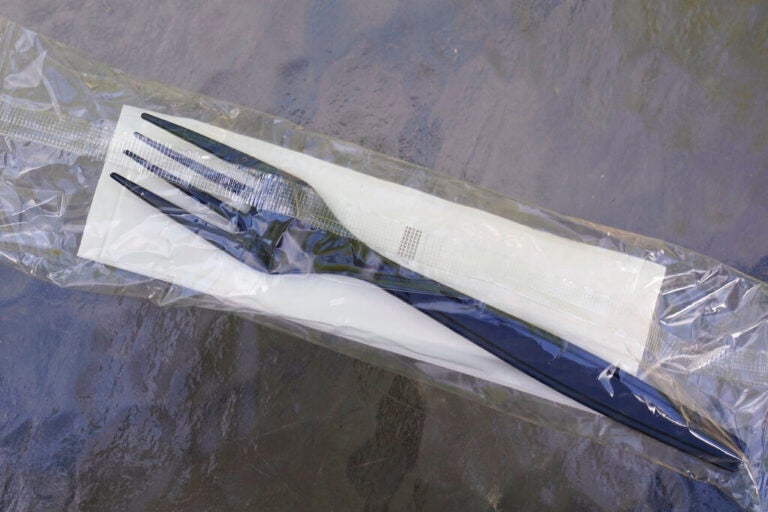
A plastic fork is seen in Sacramento, Calif., Friday, June 17, 2022. (AP Photo/Rich Pedroncelli)
From Camden and Cherry Hill to Trenton and the Jersey Shore, what about life in New Jersey do you want WHYY News to cover? Let us know.
Starting Saturday, if you want plastic utensils from a New Jersey restaurant, you have to ask for them. The state’s “Skip the Stuff” law takes effect.
Some restaurants are now prohibited from handing out single-use plastic utensils and condiments without a customer asking for them. It is the latest effort by the Garden State to reduce plastic pollution.
New Jersey joins states including California and Washington, and cities including New York City, in adopting such provisions. Environmentalists have hailed the new law as the strongest in the country for reducing plastic waste.
“This is pretty darn common sense,” said Doug O’Malley, director of Environment New Jersey. “If we want to reduce plastic waste and pollution and keep millions of kitchen junk drawers free of unneeded plastic utensils, this is a win for reducing plastics. It’s a win for reducing waste in our homes. It’s a win for businesses that don’t need to give out as many plastic utensils.”
The food service industry has long sought ways to be environmentally sustainable, according to Amanda Stone, vice president of public affairs for the New Jersey Restaurant and Hospitality, who added that the new law makes sense.
“First, obviously protecting the environment,” she said. “But also, there will be a cost savings in the end as consumers begin to change their habits and are asking for these items less and restaurants start giving them out less.”
Stone added that they noticed “Skip the Stuff” laws being put on the books in municipalities across the state. More than 60 towns had implemented such measures by the time they asked the Legislature to create a statewide law so there would be consistency.
“Not just for consumers, but business owners, especially with multiple locations, could follow the same rules no matter where their location was,” she said.
Related Content

New Jersey Gov. Sherrill signs the Fair Price Protection Act, banning surveillance pricing
The new law prohibits companies from using your location, browsing history and income to help set the price you pay for merchandise.
1 month ago
Listen 0:44Who is required to ‘Skip the Stuff’?
Under the new law, no full-service restaurant with on-site seating capacity for 10 or more customers can provide single-use utensils or condiments to customers who dine in.
They can only provide these items if a customer requests them for a take out order or if an order is placed on an online food delivery platform like GrubHub, Door Dash or Uber Eats. Also, those companies must set their default settings to “no utensils or condiments.”
Casual dining restaurants, like Applebee’s, are also required to limit utensils or condiments unless a customer asks for them, but they can also make them available at a self-serve station.
Who is not required to ‘Skip the Stuff’?
Public and private schools, health care facilities, and correctional facilities are exempt from the new law.
Single-use plastic utensils are allowed if they were included with prepackaged food products.
What happens to restaurants that give out unrequested utensils?
Any establishment that violates the law will receive a warning first.
For a second offense, they will be fined $100. Subsequent violations will be fined at $250.
Further plastic restrictions are coming
Next year, restaurants and food service companies will be prohibited from providing packages with multiple single-use utensils or condiments.
Establishments that operate in food courts will be prohibited from automatically handing out single-use utensils and condiments beginning in 2028.
Other single-use plastic restrictions
The state’s first step toward reducing plastic pollution was restrictions on single-use plastic straws, which took effect in 2021.
One year later, New Jersey implemented one of the strictest plastic bag bans in the country. The law banned single-use plastic bags, polystyrene foam containers and single-use paper bags, with few exemptions such as newspapers, prescriptions and packing loose items.

Get daily updates from WHYY News!
WHYY is your source for fact-based, in-depth journalism and information. As a nonprofit organization, we rely on financial support from readers like you. Please give today.
Campbell’s announces 13% salaried workforce reduction as part of campaign to improve bottom line
The soup and snack maker is hoping to cut costs by a half-billion dollars by 2030.
2 days ago
Listen 0:55
Want to grow native plants? This Hopewell Twp. group will help you get started
The Hopewell, NJ Native Plant Swap group gives away plants and seeds, and teaches newbies how to garden.
2 months ago
Listen 1:03
Camden County offers free legal services to military personnel and veterans
Attorneys will help prepare documents like wills and powers of attorney for free.
3 months ago