
New Jersey Gov. Sherrill signs the Fair Price Protection Act, banning surveillance pricing
The new law prohibits companies from using your location, browsing history and income to help set the price you pay for merchandise.
Listen 0:44
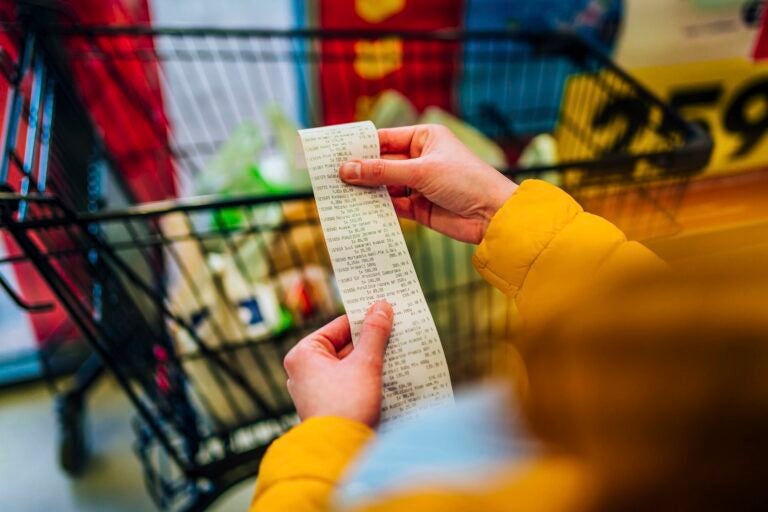
A new law aims to protect shoppers from surveillance pricing. (LordHenriVoton/iStock)
From Camden and Cherry Hill to Trenton and the Jersey Shore, what about life in New Jersey do you want WHYY News to cover? Let us know.
New Jersey Gov. Mikie Sherrill has signed the Fair Price Protection Act, legislation designed to protect consumers from surveillance pricing, which tracks an individual’s location, income and browsing history to help determine a price for merchandise.
The law covers goods, commodities, services or activities and other items sold to the public.
Same item, higher price
Sherrill said surveillance pricing weaponizes your data against you.
“Companies figure out where you live, where you shop and even what you’re Googling and they use that data to calculate specific, often higher prices for items you need, without your knowledge,” she said.
The governor said that means you may pay more for the same item than someone else ahead of you on the checkout line.
“Surveillance pricing essentially gives Big Brother a look into your shopping cart. It’s incredibly expensive and it’s invasive,” Sherrill said.
Consumer Reports examined pricing at grocery chains and found that many items are priced differently for various shoppers, with some consumers paying as much as 23% more for identical items at the same store.
“Over the course of a year a family could spend $1,200 more for groceries, just because of an invisible algorithm. That’s just wrong,” Sherrill said.
Related Content
State officials unveiled the New Jersey Report Card portal to give residents information about the proposed budget and state spending.
5 months ago
Listen 0:50Enforcing the fair pricing law
State Attorney General Jennifer Davenport said in a statement that the new law will help ensure a fair marketplace for household essentials.
“The price New Jersey families pay at the grocery store should be based on the cost of a product, not on what invasive data collection suggests they may be willing to pay,” she said. “My office is committed to enforcing this new law to ensure grocery prices are fair, transparent, consistent, and not driven by the exploitation of consumers’ personal data.”
A violation of the new law will be treated as unlawful practice under the Consumer Fraud Act, which carries a $10,000 fine for a first offense, and a $20,000 fine for subsequent offenses.
Violators may also face cease-and-desist orders issued by the attorney general, along with an assessment of punitive damages.
Not everyone is on board
After Sherrill signed the legislation, Michelle Sierkerka, president of the New Jersey Business and Industry Association, said the new law could have “unintended consequences.”
“While we can appreciate the intention of strengthening consumer trust and transparency in the pricing of groceries and food goods, this legislation ultimately went to the governor’s desk with a false choice between those consumer protections and operational efficiencies for our store owners — when it could have achieved both,” she said in a statement.
“In the end, this law will compromise the very cost-saving programs that consumers rely on, particularly during an affordability crisis,” she continued. “The unintended consequences could very well be the elimination of some loyalty programs, coupons, and other customer-specific discounts due to new limits on consumer data.”
Sherrill said “this bill isn’t going after the loyalty programs or discounts that so many families rely on. Deals are fine, surveillance-driven surcharges driving up costs are not.”
Related Content

Soup kitchens across New Jersey are serving more patrons as demand rises for products and services
The Trenton Area Soup Kitchen reports more families with children are seeking help.
6 months ago
Support for the fair pricing protection law
State Sen. Joe Cryan, D-Union, was a prime sponsor of the measure.
“It’s as American as apple pie that we all pay the same,” he said. “This bill today helps to protect each and every consumer in the state of New Jersey and I hope it will become a national model.”
“Consumers should not have to wonder whether the price they see is the same price someone else is paying for the exact same product,” said Assemblyman Chigozie Onyema, D-Essex, a prime sponsor in the lower house. “As technology becomes more sophisticated, so do the ways companies can use personal information to influence what people pay. Fairness, transparency and privacy should not disappear simply because a transaction happens online or through an app.”
Damon King, the senior counsel in the Economic Justice Program at the New Jersey Institute for Social Justice, applauded the law.
“At a time when many New Jerseyans are struggling to make ends meet, surveillance pricing has the potential to exacerbate economic strain — especially for low-income and communities of color who are already struggling more than others and are less able to adjust to price increases,” he said in a statement. “This legislation is a proactive step to prevent unpredictable and potentially exploitative surveillance pricing practices, and to protect New Jerseyans when they buy food for their families.”
New Jersey Citizen Action Executive Director Dena Mottola Jaborska said the law is about maintaining a level playing field for consumers.
“Surveillance-based pricing is a threat to marketplace fairness, consumer privacy and affordability,” she said. “At a time when families across New Jersey are struggling to make ends meet, the idea that the price of something as essential as groceries could be manipulated, often based on information that isn’t even reliable, just to maximize profits, is unacceptable.”
Sherrill said that, as a mother of four, she understands the stress of grocery shopping, and prices are rising for many items.
“The average family paid $310 more at the grocery store last year because of Trump’s illegal tariffs, which inflate the cost of everything from olive oil to orange juice,” she said. “Sky-high prices are putting immense pressure on people across our state. With the act, we’re helping make New Jersey even more affordable and more accountable.”

Saturdays just got more interesting.
WHYY is your source for fact-based, in-depth journalism and information. As a nonprofit organization, we rely on financial support from readers like you. Please give today.
Foes decry them as warrantless mass surveillance but 20 police agencies statewide use them. The ACLU says “Get the Flock Out.”
1 month ago
Listen 3:12
Biden signs bill extending a key US surveillance program after divisions nearly forced it to lapse
The measure extends for two years the program known as Section 702 of the Foreign Intelligence Surveillance Act.
2 years ago
Philadelphia lawmakers question nonfunctioning city surveillance cameras
City Council members questioned surveillance cameras that are not working, and how to move cameras from place to place to catch trash dumpers.
4 years ago