

As kratom and 7-OH use grows, clinicians are developing protocols for addiction treatment
Kratom and 7-OH may be marketed as herbal supplements, but they function like opioids — shaping how clinicians treat addiction.
Listen 1:06
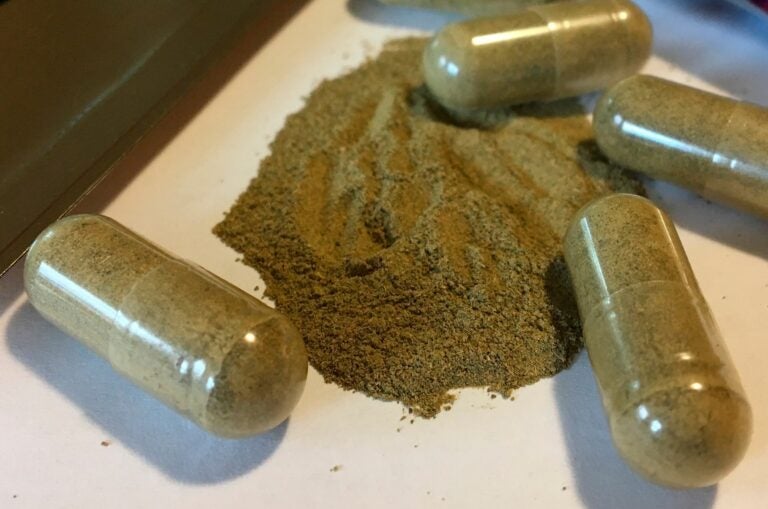
FILE - This Sept. 27, 2017 file photo shows kratom capsules. (AP Photo/Mary Esch, File)
From Philly and the Pa. suburbs to South Jersey and Delaware, what would you like WHYY News to cover? Let us know!
It was about a year ago that Jonathan Paolini, a nurse practitioner and director of medical operations with Crossroads Treatment Centers, first started noticing patients coming in seeking help for addictions to kratom and its synthetic derivative, 7-OH — and, since then, that population has only grown.
“I would say, within the last six months, we’ve seen an even bigger increase with kratom and 7-OH patients coming in looking for help to stop using those substances,” Paolini said. “Kratom has been around for a long time, but I think it’s kind of gained popularity in recent years. And then 7-OH has been an even more recent development.”
While it’s unclear how many people nationally are using both substances — estimates for use of the herbal substance kratom from over a million to as many as 20 million people, while the Food and Drug Administration notes that 7-OH is too new for reliable estimates — clinicians have noticed growing mentions by patients, and a recent Centers for Disease Control and Prevention report found that kratom-related poison control calls were about 13 times higher in 2025 than in 2015. Many of those calls, experts speculate, are being driven by 7-OH.
Addiction experts and clinicians say both substances can function like opioids, and that 7-OH is particularly potent, drawing comparisons to morphine and fentanyl. As government officials, ranging from the municipal level all the way to the FDA, grapple over how to regulate — or even ban — these relatively new drugs, addiction clinicians have been left to figure out health risks and treatment options largely on their own.
“We have grown to understand that these products work very similar to opioids in the body,” Paolini said. “And when they try to stop or cut down on using them, often withdrawal symptoms are very similar to opioid withdrawal symptoms.”
Related Content
A look at the ‘Wild West’ of synthetic kratom, which doctors are calling ‘more potent than fentanyl’
Since 2015, kratom poisonings have surged by 1,200%, according to a recent report.
5 months ago
Listen 1:05The effects and risks of 7-OH and mitragynine pseudoindoxyl
In toxic quantities, kratom functions more as a stimulant, says Corneliu Stanciu, an assistant professor of psychiatry at the Geisel School of Medicine at Dartmouth College who’s been studying the substance and its derivatives for more than a decade.
“So they get seizures, they get high blood pressure, tachycardia,” Stanciu said. Tachycardia is a higher-than-average resting heart rate.
But with 7-OH and mitragynine pseudoindoxyl — another synthetic derivative of kratom that’s even stronger than 7-OH — toxicity looks a lot more like an opioid overdose.
“It’s just like ingesting fentanyl,” Stanciu said. “So you get the respiratory depression and death after that.”
It’s unclear how many deaths can be traced back to 7-OH and mitragynine pseudoindoxyl — in part, Stanciu says, because lab testing hasn’t yet caught up to these new substances.
“The problem is that there’s no standard when it comes to testing,” he said. “They may test for mitragynine [which is present in kratom], but not other alkaloids, like 7-OH.”
Further complicating the picture, he added, is the presence of alcohol and other drugs.
“A lot of the fatalities involve other substances,” Stanciu said. “We definitely need better lab testing for that, and better interpretation on what is a toxic level that [means] we should call this a kratom-related death as opposed to maybe a polysubstance-related death.”
Other risks include interactions with prescription drugs — especially drugs that raise seizure risk, like Adderall, and those that impact respiration, like benzodiazepines and opioids.
There are also products on the market that mix kratom or its derivatives with other substances, like Feel Free — a drink that contains kratom and kava, both of which can bring risks of liver toxicity.
“To me that’s dangerous,” Stanciu said. “We’re in uncharted territory there.”
And then there are the risks associated with addiction.
“Just like oxycodone or other opioids, once people who may be vulnerable to addiction get exposed, then the cat’s out of the bag and you really have to do a lot of work to undo that brain sensation of the positive euphoria of these drugs,” said Jeanmarie Perrone, an emergency physician and director of the Penn Center for Addiction Medicine and Policy. “You’re going to spend more money. And then that results in addiction behaviors because you need the money to buy it. You don’t realize what’s happening. You might hide your use.”
As for people who are using these products as a means to get or stay off opioids, she adds, they can sometimes have the opposite effect, leading them back to opioids.
“So it’s really problematic for both populations — the at-risk recovery population, and then the new people who are using it or who are unaware of the addiction component of it,” Perrone said.
Related Content
Chester County accidental overdose deaths dip because of public health response
There were 69 accidental overdose deaths in 2024. The county’s Department of Drug and Alcohol Services is projecting another reduction in 2025.
11 months ago
Emerging treatment options
For people who are already addicted to kratom, 7-OH or mitragynine pseudoindoxyl, researchers like Stanciu have been developing treatment protocols.
He said the first step is figuring out why someone started using these substances in the first place, and addressing that issue in other ways.
“So is it because they have some underlying anxiety or mood disorders? Is it because they’re trying to get off of opioids or other addictive disorders? They’re trying to manage pain?” he said. “You really have to understand the reason and try and have a discussion with them about more of the FDA-approved treatment modalities for what they’re trying to address, explain to them the process that the FDA goes through in order to approve a medication, the clinical trials, looking at not just efficacy, but also safety, and seeing if they’re willing to consider that.”
The next step is treatment for withdrawal. Unfortunately, Stanciu said, “kratom use disorder” isn’t yet an official diagnosis, which can make it tricky to get inpatient rehabilitation covered by insurance. But there are outpatient options.
“First we want to get them through the withdrawal period, whether that’s through supportive means, whether that’s using a similar approach to opioid withdrawal by supporting them through a taper with a full agonist opioid,” Stanciu said. “So you want to get them through withdrawal. If that doesn’t work, then you have to think about long-term maintenance treatment just like you would with opioid use disorder. So depending on their comorbidities, you have to tailor your approach.”
Options include methadone and buprenorphine, to prevent withdrawal, reduce cravings and block the effects of other opioids, as well as naltrexone, which blocks the effects of opioids but, Perrone says, requires the patient to have been off opioids for at least a week.
The latter is available in the form of a long-acting injection known as Vivitrol, while buprenorphine, better known as Suboxone, comes in multiple forms, including pills, films and long-acting injectables like Sublocade and Brixadi, Paolini said.
“Some patients prefer to take something orally because they like to be able to have that control of taking the medication when they feel like they need it,” he said. “Whereas some patients prefer an injection, and one of the benefits of the injections is that once a patient stabilizes, it keeps them at what we call a steady state with the medication, where they don’t have the ups and downs.”
Perrone said Sublocade is often a favorite of patients and their doctors.
“It’s extremely effective for opioid use disorder,” Perrone said — not only because it cuts out problems with compliance, like forgetting to take a daily pill, but because many patients find it less stigmatizing than carrying around bottles of Suboxone.
“And patients really appreciate the long-acting buprenorphine products. It would also help with 7-OH,” Perrone said. “It hasn’t really been tested, but because daily buprenorphine works, Sublocade will work.”
From there, it’s a matter of tapering the buprenorphine — which, at Crossroads, they do based on the patient’s individual needs.
“Some patients require them for a longer period of time — and that’s okay too; there’s not a rush to taper off or stop them,” Paolini said. “That could be months, it could be up to a year, it could be whatever the patient feels like they need.”

Get daily updates from WHYY News!
WHYY is your source for fact-based, in-depth journalism and information. As a nonprofit organization, we rely on financial support from readers like you. Please give today.
The Future of Pain Relief: Managing Chronic Pain, Laughing Gas and Safer Opioids
Exploring new research on the causes of — and potential solutions to — different kinds of pain.
Air Date: July 31, 2026
Listen 49:34
A look at the ‘Wild West’ of synthetic kratom, which doctors are calling ‘more potent than fentanyl’
Since 2015, kratom poisonings have surged by 1,200%, according to a recent report.
5 months ago
Listen 1:05
Fears and evidence clash in the battle over kratom
The government is reviewing the status of an herbal supplement touted to ease opioid addiction.
8 years ago
Listen 9:58