

‘This was an answer to prayers’: Incarcerated people help prep fresh produce for kids through a new Delaware food program
Under the newly expanded program, volunteers at the Sussex Community Corrections Center will clean, prep and package fresh produce that will help feed hungry kids.
Listen 0:54
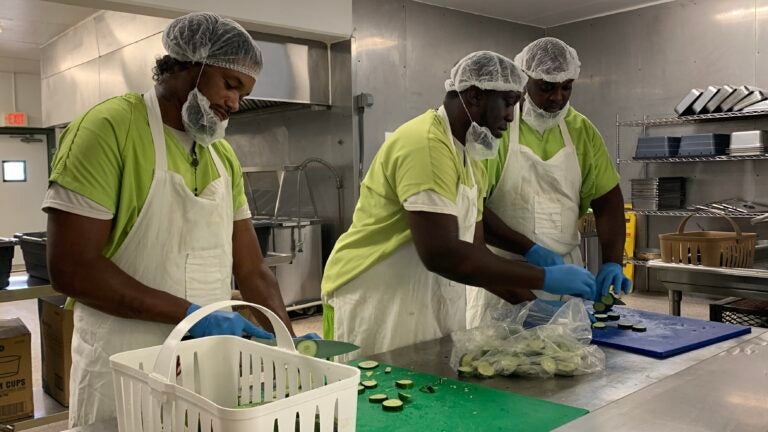
Volunteering correctional residents Anthony McGuire, Jamar Archer and Troy Sanders cut and package cucumbers inside the Sussex Work Release Building at the Sussex Community Corrections Center. (Sarina Grossi/WHYY)
What are journalists missing from the state of Delaware? What would you most like WHYY News to cover? Let us know.
Inside the Sussex Community Corrections Center, a group of incarcerated people wash and slice cucumbers. They place the sliced cucumbers inside bags that will later be shipped to Seaford to feed hungry kids.
Delaware’s Farm to Processing program officially launched this week. It’s an expansion of the Farm to Community program, a state initiative operated by the Delaware Farm and Food Council that aims to deliver food from local farms to communities.
The expansion focuses on addressing gaps in processing for fresh produce.
David Marvel, a farmer based in Kent County, announced the project at a media briefing Tuesday and said that farmers do not have the infrastructure to prepare produce for consumption.
“I can easily drop off an average bin of watermelons, about 800 pounds, but what are they going to do with it for now? Do you have the kitchen? Do you have to have the staff and such?” Marvel said.
Under the program, those who are incarcerated — referred to as correctional residents — fill the gap by cleaning, prepping and packaging produce so it can be shipped to the Western Sussex Boys and Girls Club. The labor is part of the correctional facility’s larger skill development and learning opportunities program to prepare residents for reentry into society.
“Every cucumber sliced, every vegetable packed represents two investments at once. It’s an investment in healthier kids and an investment in real opportunity and real second chances,” Gov. Matt Meyer said at the briefing.
Related Content

Delaware Gov. Matt Meyer’s executive order raises questions about whether members of other task forces could meet the standards.
1 month ago
Listen 0:50The state Department of Corrections Commissioner Terra Taylor said that the training also helps correctional residents contribute to their community.
“For many of our participants, this may be the first time in a long time that they have been able to directly help someone in our community. I’m sure we all agree that there is a tremendous value and knowing that your work matters,” Taylor said.
Taylor also said the program teaches the correctional residents who volunteer about nutrition and food handling skills that are desirable to employers in the food service industry.
Participants receive credit toward community service hours that can be later applied to their financial obligations. According to Taylor, correctional residents participating in the program who have a “realistic pathway to employment” are less likely to reenter the criminal justice system.
“It’s good to know that the food is going to a good place. Plus, it gives us the time to go ahead and get some training for when we go home,” Anthony McGuire, one of the volunteering correctional residents, told WHYY.
Produce processed at the corrections center includes cauliflower, asparagus, broccoli, strawberries, cantaloupe and cucumbers. According to Nancy Staisey, the chair of the Delaware Farm and Food Council, the program currently works with three local farms on supplying produce.
“It’s a win for our farmers because we’re buying local products, and when everybody buys local products from local farmers, those dollars don’t just help our farmers, who are Delaware small business people, but those dollars also get spread into the local economy,” Staisey said during the briefing.

The Sussex Work Release Building at the Corrections Center houses the kitchen used for the program. About 18 correctional residents currently volunteer for the program, working roughly six hours a day.
Related Content

Delaware election 2026: Primary voter guides, key races and more
Primary elections will take place Tuesday, Sept. 15. Here’s what you should know beforehand, from voter deadlines to who’s on the ballot.
1 month ago
Volunteers have been prepping food for the program since late April. Tony Windsor, the food program development director for the Boys and Girls Club of Delaware, said the organization has been able to increase the number of meals they give out per week from 500 in the early stages of the program to nearly 1,800.
“I’m not exaggerating when I say this was manna from heaven, this was an answer to prayers,” he said.

Get daily updates from WHYY News!
WHYY is your source for fact-based, in-depth journalism and information. As a nonprofit organization, we rely on financial support from readers like you. Please give today.

County Councilwoman Dee Durham supports Kyle Grantham’s primary foe but says he’s “twisting our conversation” about potential post.
7 hours ago

Delaware governor signs legislation that aims to make data centers ‘pay their fair share’
The legislation would prevent data centers from passing the costs of running data centers onto ratepayers.
2 weeks ago
Listen 1:03
House Speaker Melissa Minor-Brown said she has not had a single conversation with Meyer about his creation of a state surgeon general.
1 month ago
Listen 0:57