

Advocacy groups offer guidance on your rights for documenting, interacting with ICE
Fears of an intensified crackdown in Philadelphia have sparked increased interest about how to interact with immigration enforcement agents and document ICE activity.

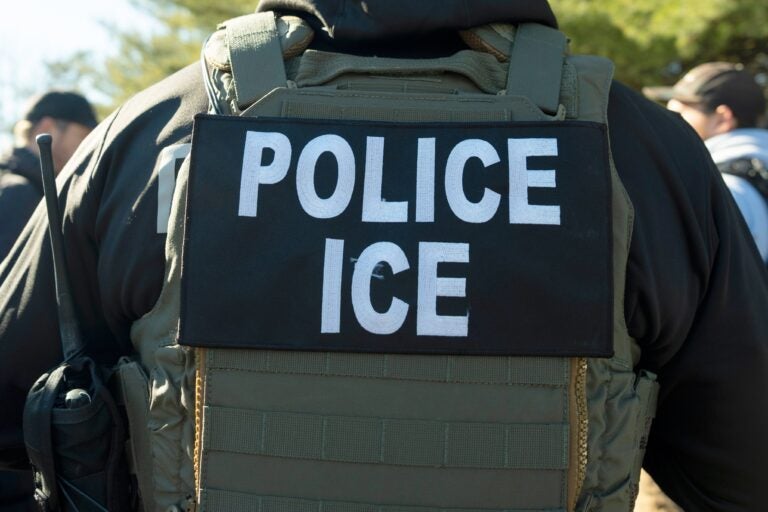
File: A U.S. Immigration and Customs Enforcement officer listens during a briefing, Monday, Jan. 27, 2025, in Silver Spring, Md. (AP Photo/Alex Brandon, File)
From Delco to Chesco and Montco to Bucks, what about life in Philly’s suburbs do you want WHYY News to cover? Let us know!
As President Donald Trump’s immigration enforcement crackdown continues, more people across the United States are recording arrests and documenting activity by officers from U.S. Immigration and Customs Enforcement, U.S. Customs and Border Patrol and other federal agencies.
After an ICE agent shot and killed Renee Nicole Good in Minneapolis last week, thousands of Philadelphians protested the agency and the Trump administration’s immigration enforcement policies. Fears of an intensified crackdown in Philadelphia similar to ongoing ICE operations in Minneapolis have sparked increased interest among community members about how to interact with immigration enforcement agents and document ICE activity.
Here’s what to know about your rights if you are stopped by immigration enforcement agents or are documenting an arrest. The following are recommendations from Juntos, an immigrant rights organization based in South Philadelphia, the American Civil Liberties Union, the American Civil Liberties Union of New Jersey, the American Civil Liberties Union of Pennsylvania and the National Immigrant Justice Center.
If you’re stopped by ICE on the street or in a traffic stop:
- Don’t run. Remain calm and do not try to resist or obstruct agents or officers.
- Ask if you are under arrest or if you are free to leave. If they say you are free to leave, do so calmly.
- You can ask officers or agents to show you their badges and identify themselves, including whether they are with a police department, ICE or another law enforcement agency.
- Keep your hands where officers can see them and inform them if you reach for the glove compartment for any papers or ID, or if you otherwise want to reach for your belongings.
- Say your legal name if asked, according to Juntos. Don’t give a false name, because giving false information is a crime.
- You have the right to remain silent. The only thing you have to say is your name. You can also say that you want to exercise the right to remain silent out loud.
- You have the right to refuse to be searched. But if ICE or the police attempt to search you because of “probable cause,” remain calm and do not try to stop them.
- If you’re over 18 and have valid unexpired immigration documents, you are required by law to carry those with you.
- Don’t carry identification from another country. Safe identification to carry includes school IDs, library membership cards, organizational membership cards and bank ID cards.
- You don’t have to answer questions about where you were born, your immigration status or how you entered the U.S. The ACLU notes that separate rules apply at international borders and airports, and for some people with nonimmigrant visas, including tourists and business travelers.
Related Content
‘Like a father figure’: Family mourns Parady La, Upper Darby man who died in ICE custody
Parady La died Jan. 9 while in ICE custody. La was hospitalized after being held at the Federal Detention Center in Philadelphia.
2 months ago
Listen 1:05If you’re detained by ICE
- You continue to have the right to remain silent.
- You have the right to consult with a lawyer, although the government does not have to provide you with one.
- You have the right to refuse to sign documents.
- Immigrant rights organizations recommend memorizing the phone numbers of your family members and lawyer ahead of time, and/or keeping the name and phone number of a trusted immigration lawyer on you.
- You have the right to contact your consulate or ask an officer to inform your consulate about your detention.
- Remember your immigration “A” number and give that to your family so that they can find where you are detained.
If you’re documenting ICE arrests or other activity
The right to document and record ICE agents, police and other law enforcement is protected by the First Amendment. If you are not under arrest, you have the right to film and photograph ICE activity in public as long as you are not physically interfering with or obstructing agents’ operations.
Civil rights and immigrant rights organizations recommend the following when documenting an ICE arrest:
- Record or take photos from at least 10 feet away.
- Juntos recommends documenting the details of the raid or arrest, including:
- Where it took place
- The date and time
- How many agents were there
- The types of vehicles used
- What the agents were wearing
- How the agents identified themselves
- In Philadelphia, report ICE raids or encounters to:
- The Juntos Raid Response Hotline: 814-205-3293
- Asian Americans United hotline: 445-310-4081
- In Montgomery County, call Montco Community Watch to report ICE activity: 267-279-9205.
- In Delaware County, call MILPA, at 717-536-8367, to report ICE activity.
- In Delaware state, call Delaware Coalition for Immigrant Justice at 267-382-5423.
- In South and Central New Jersey, you can report ICE activity:
- In Atlantic County, to El Pueblo Unido at 609-200-1030
- In Mercer County, to Resistencia en Acción at 640-466-2386
- In Ocean, Monmouth, Middlesex, Hunterdon and Somerset counties, to Cosecha X DIRE at 1-888-347-3767
What to do if you think agents are violating your rights
If you believe your rights are violated by immigration enforcement officers during an arrest or while documenting operations, the ACLU of Pennsylvania recommends:
- Writing down all of the details you remember as soon as possible, including identifying information about the officers.
- Tell your lawyer, if you have one.
- If injured, seek medical attention and take photos.
- Contact the ACLU of Pennsylvania to report the incident if you think your rights were violated.
Editor’s Note: This story stemmed from community input at a recent Bridging Blocks event hosted by WHYY.

Get daily updates from WHYY News!
WHYY is your source for fact-based, in-depth journalism and information. As a nonprofit organization, we rely on financial support from readers like you. Please give today.
One of the suspects taken into custody by U.S. Marshals Service agents was wanted for assault by auto and other charges.
3 weeks ago
Listen 1:04
As ICE expands its footprint, DHS is leasing a high-end office space on the Main Line
The Westlakes Office Park is about a mile away from an elementary school in Berwyn, Chester County.
1 month ago
‘Traumatized’ Montgomery County family demands probe after ICE raid in Lower Providence
Family members of Jose Manuel Cordova Lopez, who was detained in Lower Providence Township on Monday, are demanding accountability.
1 month ago
Listen 2:10