
This gluten-free expo, described as the nation’s largest, celebrates a delicious kind of ‘freedom’
The Wicked Gluten Free Expo and Food Festival gives people with celiac disease a rare chance to eat, shop and connect without worry.
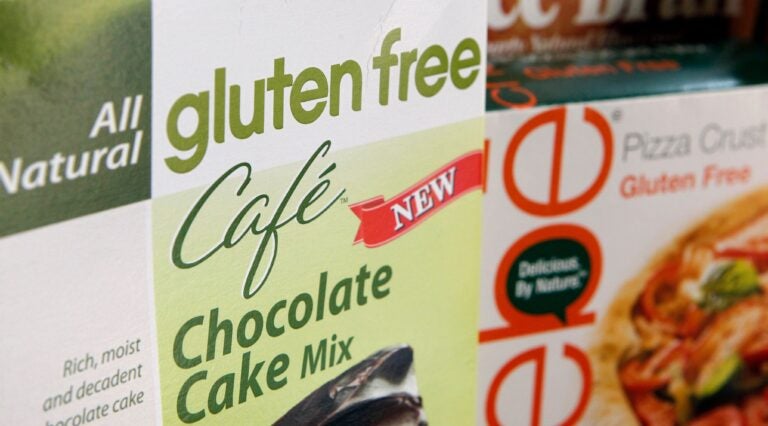
In this Aug. 2, 2013, file photo, a variety of foods labeled Gluten Free are displayed. (AP Photo/Jon Elswick, File)
From Philly and the Pa. suburbs to South Jersey and Delaware, what would you like WHYY News to cover? Let us know!
Hundreds of people stood in a line wrapping around the Greater Philadelphia Expo Center in Oaks, Pennsylvania, on Saturday, waiting to enter what organizers call the largest gluten-free food festival in the nation. Despite air quality alerts and the threat of severe thunderstorm, people of all ages arrived with wagons, backpacks and rolling coolers, ready to stock up on foods they often struggle to find elsewhere.
For people with celiac disease, gluten intolerance or other dietary restrictions, the Wicked Gluten Free Expo and Food Festival offers something that’s difficult to find in everyday life: the chance to sample and buy dozens of foods without scrutinizing ingredient labels or worrying about cross-contamination.
The Wicked Gluten Free Expo and Food Festival was founded by Abby Helman Kelly, who started hosting gluten-free food events in New England in 2016 after she was diagnosed with a gluten sensitivity. Their success led Kelly to expand them throughout the Northeast. Other expo locations in this year’s lineup include Massachusetts, New Jersey and Connecticut.
“My goal was to create a day where people who can’t have gluten can just enjoy the day and indulge without worry,” Kelly said.
Related Content
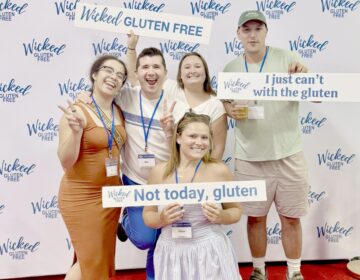
A ginormous gluten-free expo is headed to the Philly suburbs this weekend
Pasta, pizza, fried chicken, soft pretzels, pierogi, pancakes and more will all be for sale at the Wicked Gluten-Free Expo and Food Festival.
2 months ago
A gluten-free paradise
To mark the nation’s 250th anniversary, organizers opened the expo by cutting into a three-tier cake bearing the words “Freedom from gluten” written in icing. The vanilla and chocolate cake was baked by The Happy Mixer, a local gluten-free bakery, and distributed to attendees.
The bakery was one of more than 110 exhibitors inside the expo center. Vendors passed out complimentary samples and sold food products that can be difficult for people with dietary restrictions to find in grocery stores. The selection included gluten-free fried chicken, pierogies, empanadas and eclairs.
Some vendors were Philadelphia-based, while others traveled from across the country. They included national brands well-known within the gluten-free community, such as organic pasta maker Jovial Foods.
Attendees often plan their visits just as carefully. Kelly said people begin asking for the vendor list and floor plan if organizers do not release them early enough, and some travel from out of state.
“Some people will come and make a weekend of it. They’ll ask for the nearest hotel,” Kelly said.
The enthusiasm reflects how much the gluten-free market has expanded and diversified, said Meghan McKeon, registered dietician and senior director of education and communications at the Celiac Disease Foundation.
Manufacturers now use a wider variety of flour alternatives compared to years past and are increasingly mindful about fiber, sugar and salt.
“It’s been cool to see some of the innovation with the nut-based flowers and the bean-based products, because they just give such a better protein and fat profile,” McKeon said. “There are just so many more companies investing in gluten-free. I mean, we’ve seen Cheez-Its and Oreos, they’re huge for the community.”
Related Content
Centennial School District launches summer lunch bus
Bensalem Township School District’s summer lunch program inspired Centennial’s initiative.
2 months ago
‘Keeping everybody safe’
Unlike many food festivals, the Wicked Gluten Free Expo and Food Festival is entirely gluten-free and designed to be safe for people with celiac disease.
Celiac disease is an autoimmune disorder in which consuming gluten triggers an immune response that attacks the small intestine. Celiac disease is chronic, and repeated gluten consumption can prevent nutrient absorption in addition to causing stomach pain, vomiting, fatigue and other symptoms. The only treatment for celiac is a strict gluten-free diet.
Jessica Lebovits, a clinical outpatient dietitian at Columbia University’s Celiac Disease Center who also has celiac disease herself, said sometimes people have to work harder to ensure the foods they eat supply them with the necessary nutrients. For this reason, she does not recommend a gluten-free diet for people who don’t have a gluten intolerance.
“We encourage diversifying gluten-free whole grains, things like brown or wild rice, quinoa, buckwheat, millet, sorghum, amaranth, tuff — eating those foods, or eating breads, or pastas, or other starches made from those grains — to be able to get more of those nutrients in, including the vitamins and minerals, but also the fiber,” Lebovits said.
However, the effects of celiac don’t stop at the diet. McKeon said people can’t always cope with the emotional and social difficulties that can come with a gluten-free lifestyle.
“The emotional side of living with a restrictive diet goes beyond just ‘Eat this, not that,’” McKeon said. “Food is social. You are at risk for cross contact in restaurant settings. Sometimes family members don’t understand. School, work, living in senior living can be a challenge, because sometimes access to gluten-free food is not available.”
Kelly said celiac is widely misunderstood, perceived from many as less severe than it is.
“There’s still so many people who don’t understand,” Kelly said. “I think it’s gotten a little better because there’s just more of it, and then the more mainstream it becomes, the more people understand, but it’s medical. You could be out of work for three days.”
Because of this, Kelly said, the safety of attendees is the biggest priority.
“I do decline vendors, even big ones,” Kelly said. “If there’s even one little question, I say no, and I feel bad. I’m not judging. I’m just keeping everybody safe.”
Related Content
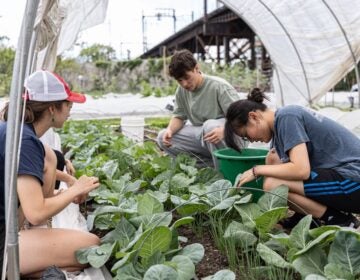
At Penn’s DumoLab, researchers work to solve multiple problems: how to keep food waste out of landfills, make healthier building materials and tackle climate change.
4 months ago
Listen 6:37‘A vacation day’
For many attendees, the expo is more than a chance to shop. It’s an opportunity to discover new products, meet people who understand their dietary restrictions and spend a day without worrying about what they can safely eat.
“It is very important, because we find out more places that are gluten-free, and we have more options — because it’s very hard to find places and foods to eat,” said attendee Julie Kessler, who traveled to the expo from the Lehigh Valley.
Founder Kelly said, above all, the expos are joyful days. She said she has seen attendees cry tears of happiness.
“It’s really gratifying. I love it,” she said. “I get thank yous, and the vendors tell me that we have the nicest attendees, because it’s almost like a vacation day. They look forward to it, and they come, and they’re tipping well, and they’re happy.”
Noah Quist, founder and owner of Three Gingers Jerky, has been attending the expos for years. Quist sells Lao-style beef jerky that doesn’t use soy sauce, a gluten-containing ingredient used in many beef jerky recipes. He originally didn’t think anything of it, but called his choice “one of the happiest mistakes of [his] whole journey” after realizing it made his product more accessible.
“We came, and we haven’t missed an event since,” Quist said. “They’re our biggest days of the year because I didn’t realize that in the jerky world, people use soy sauce. So many gluten-free people aren’t able to enjoy beef jerky, and now they can.”
Other vendors like Natoscha McKinnon, owner of Les Cookies Delight Bakery, created their products specifically around dietary restrictions. McKinnon and her kids have gluten intolerances, in addition to other allergies.
“We really enjoy what we do,” McKinnon said. “We enjoy the challenge because we customize all our baked goods to feed to fit people’s dietary needs. So we are baking everything from our basics to those who can’t have salt. We baked a wedding where between the bride and the groom, they had 20 different allergies. It’s just fun.”

Saturdays just got more interesting.
WHYY is your source for fact-based, in-depth journalism and information. As a nonprofit organization, we rely on financial support from readers like you. Please give today.
Dangerous trees force Rehoboth Beach Farmers’ Market to relocate after 20 years in Grove Park
City officials determined five trees needed to be immediately removed due to safety risk. In the meantime, the market has been relocated to a parking lot.
7 days ago
Listen 1:03
The Southeast Asian Market has returned to FDR Park. Here’s what to know
The beloved market of food and goods is open for the season. Here’s information on its hours, offerings and South Philadelphia history.
5 months ago

“Chances are, if you're eating mushrooms … they came from Pennsylvania,” said Gale Ferranto, a third-generation Kennett Square mushroom farmer.
12 months ago