

Penn researchers are turning food scraps into building materials — from pineapple peels to celery stalks
At Penn’s DumoLab, researchers work to solve multiple problems: how to keep food waste out of landfills, make healthier building materials and tackle climate change.

This story is part of the WHYY News Climate Desk, bringing you news and solutions for our changing region.
From the Poconos to the Jersey Shore to the mouth of the Delaware Bay, what do you want to know about climate change? What would you like us to cover? Get in touch.
Imagine living in a house made of pineapple and mango skins, where the scent would greet you as you enter and leave your home. And imagine that the materials used to construct your home were sourced from daily waste and did not contribute to increased carbon emissions. What’s more, the materials will not end up in a landfill or incinerator if the house were to be torn down.
This is the future that Laia Mogas-Soldevila, an assistant professor of architecture at the University of Pennsylvania, and her research assistant Yasaman Amirzehni don’t just dream of but are working to build at the Weitzman School of Design’s DumoLab.
“The biomaterials revolution is coming and we all need to be prepared to be able to deliver materials that are healthier, that can biodegrade naturally and then still perform the same way concrete performs, the same way technical ceramics perform,” Mogas-Soldevila said.
This “biomaterials revolution” begins on campus at the Hill House cafeteria, where each week workers employed by Penn Dining caterer Bon Appétit chop between 35 to 40 cases of pineapple for students who line up at a fruit salad bar.
“Working with DumoLabs to take fruit peels and turn them into sustainable building blocks is something that we’re really excited about,” said Shazad Khan, culinary director for Bon Appétit at Penn. “Having natural antioxidant properties from pineapples that can go into blocks that help to keep them mold-free, for example, or the natural insulation properties of melon skins that can go into these bricks to help create warmth, is something that we’re really excited about.”
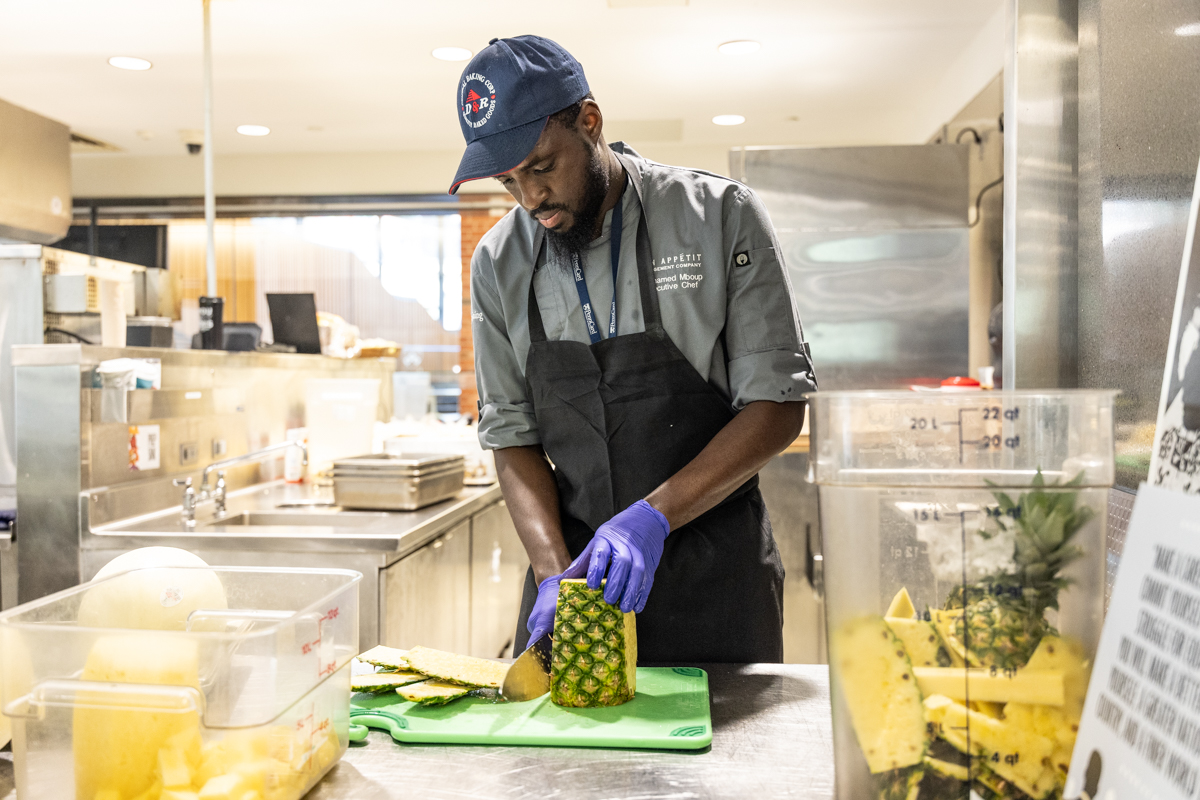
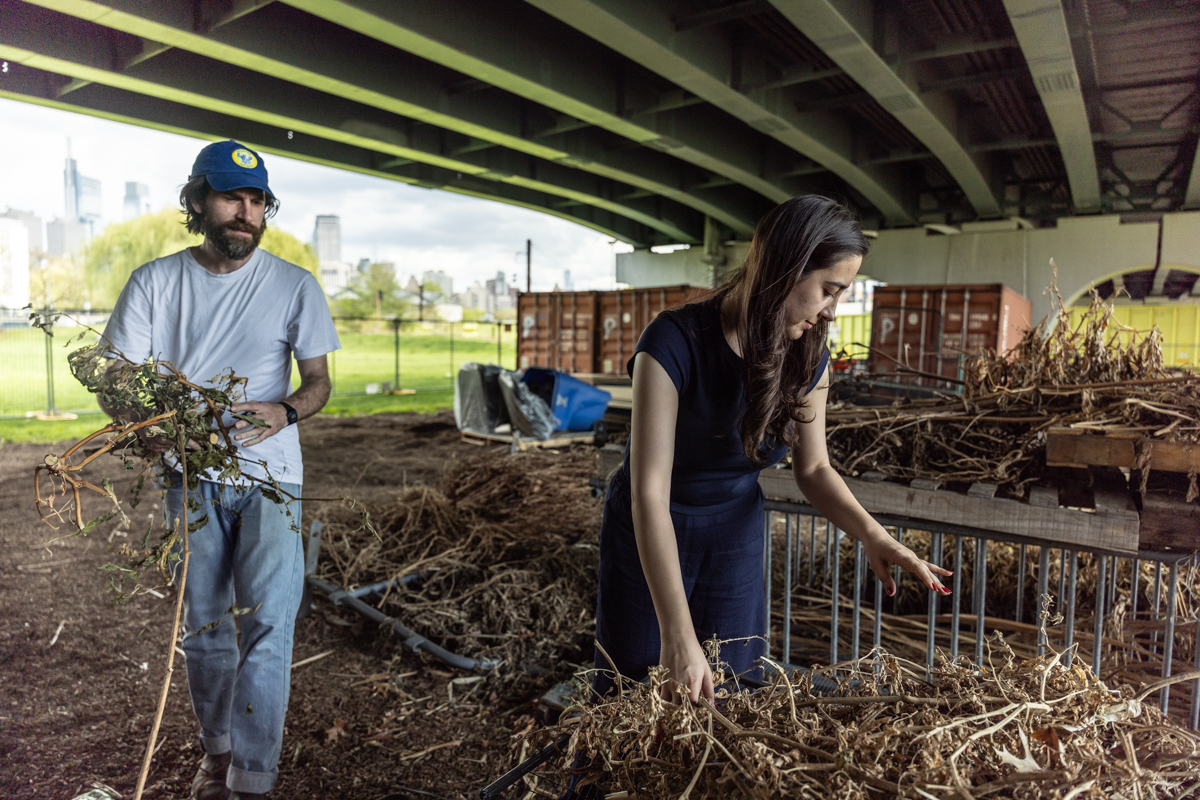
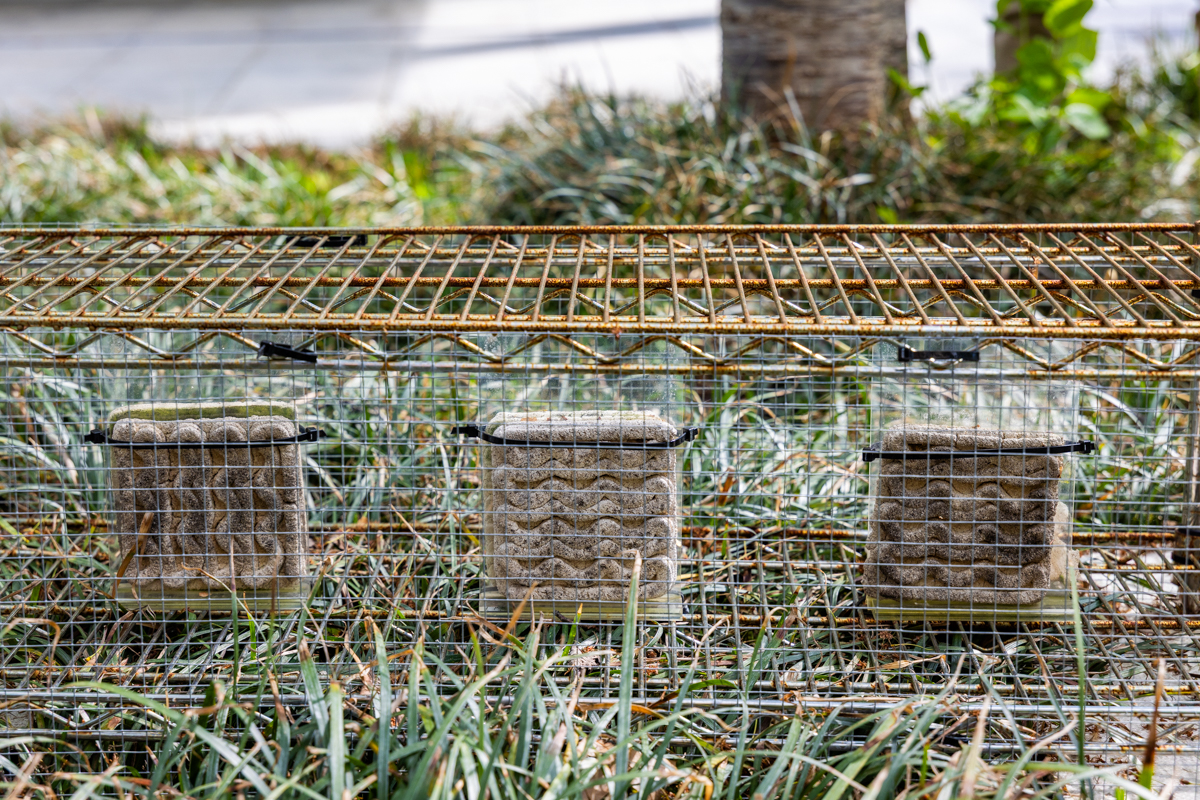
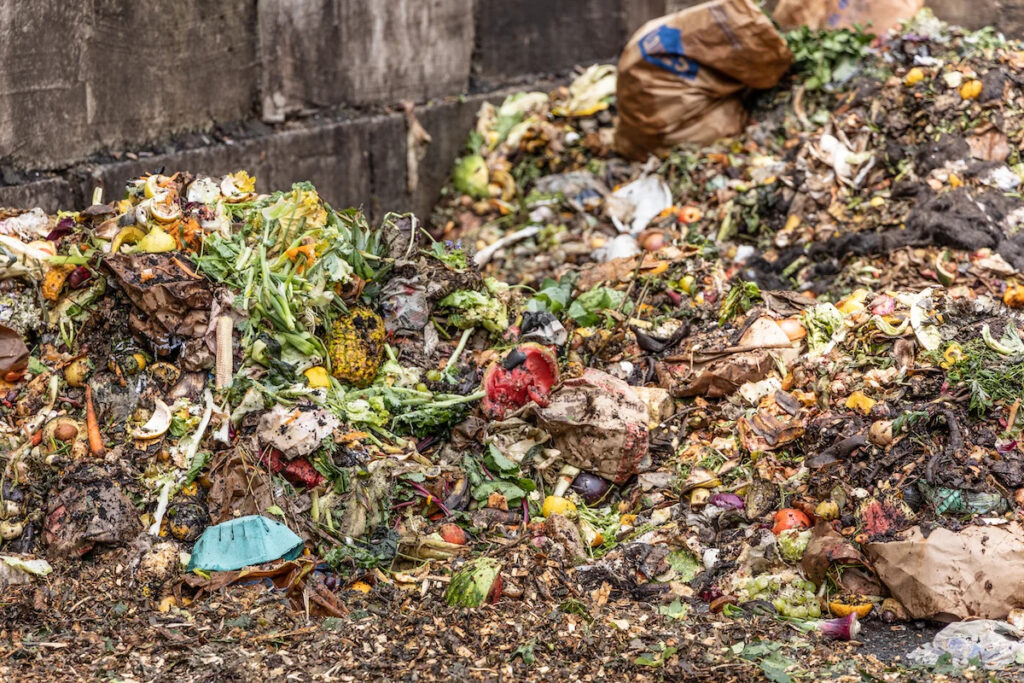
Khan said 92% of Penn Dining’s food waste gets composted. But instead of going into the compost bin, architectural designer Amirzehni collects the pineapple peels each week and takes them back to the lab to dry in a dehydrator.
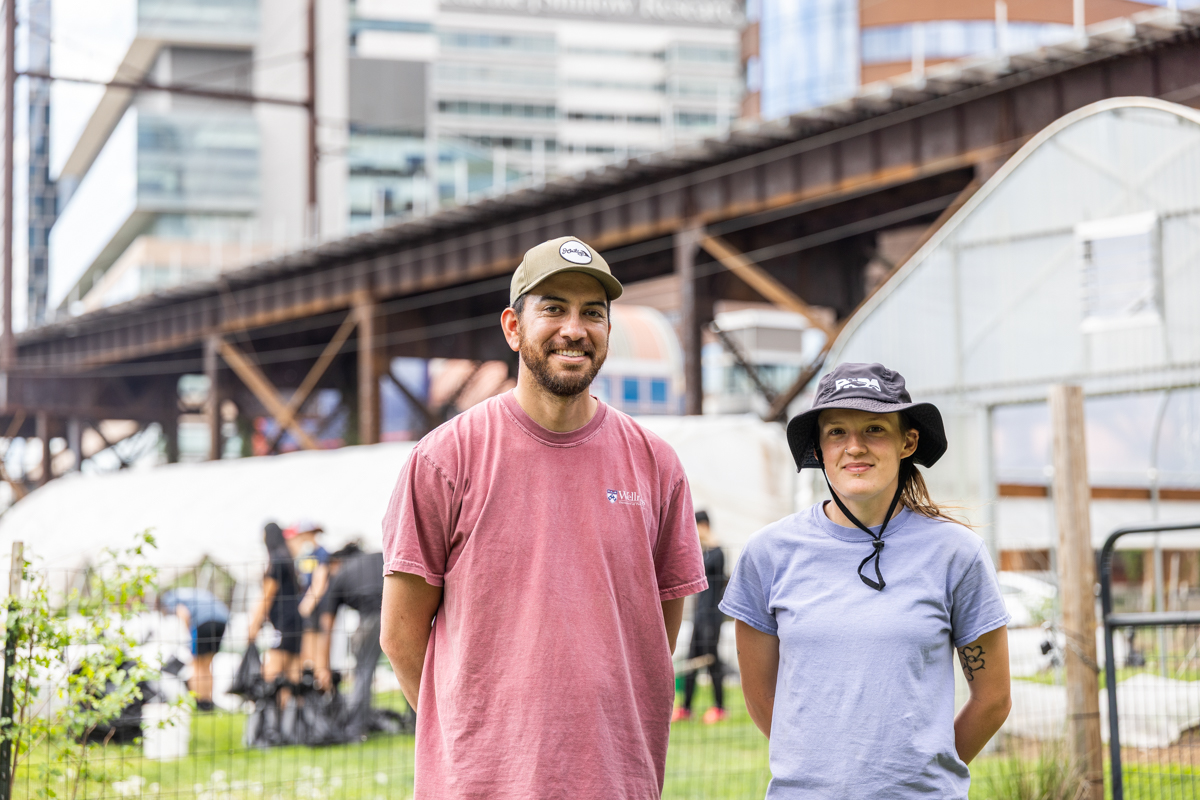
Amirzehni also collects the inedible parts of tomatoes, eggplants and sunflowers from the Penn Farm. Located on the southeastern edge of campus, below street level and wedged in between the Amtrak and CSX railroad tracks, the student-farmers dry their waste beneath the South Street Bridge before handing it over to the DumoLab.
The lab is overflowing with buckets of dried fruit and vegetable peels.
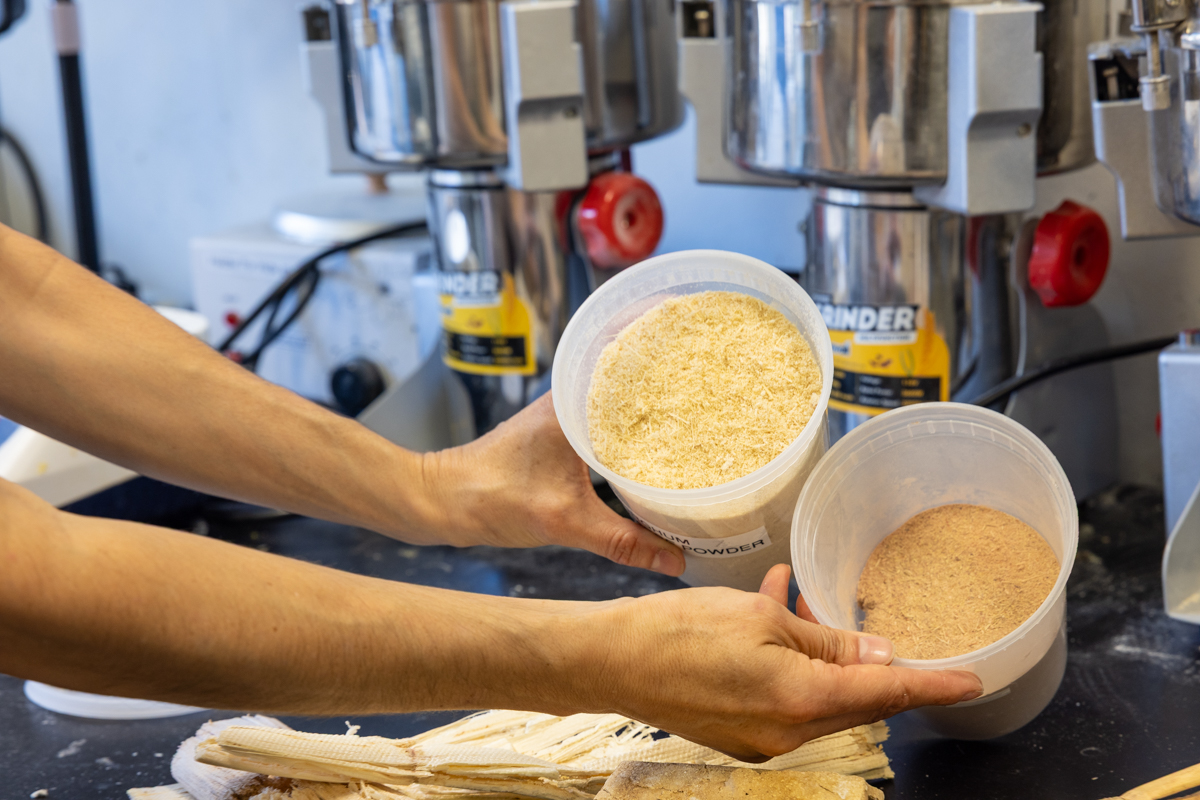
Amirzehni pulls down a bucket filled with flowers from the sorghum plant, and dried, discarded celery.
“Celery smells awesome, it’s really strong,” Amirzehni said.
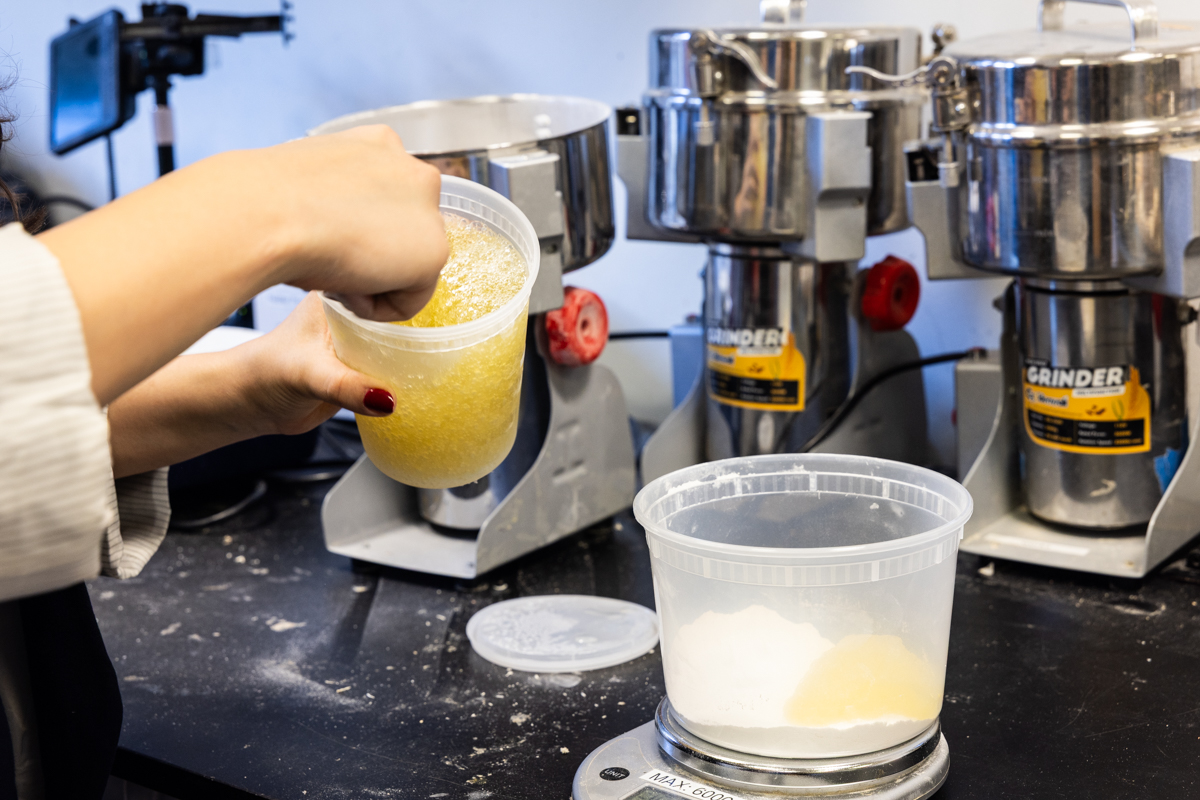
Amirhzehni also collects mango peels from street vendors, and eggshells from a pharmaceutical company. Once they are completely dried, she grinds them together into a fine powder. The eggshells will add strength to the mixture of vegetable fibers. They source shrimp shells from the fishing industry to make into a gelatinous binder that gets combined with the powdered food scraps.
Related Content
A Warminster food bank is turning spoiled produce into farm-fresh eggs. Here’s how
Unfit for pantry shelves, hundreds of pounds of produce are redirected to a Jamison farm, where the chickens’ “salad bar” curbs waste, cuts costs and helps fight hunger.
6 months ago
Listen 2:40Keeping food scraps and construction waste out of the landfill
In Philadelphia, food waste accounts for about 17% of the city’s total waste stream, meaning it ends up in a landfill or incinerator.
But at the DumoLab, researchers are aiming to solve multiple problems at once: how to keep food waste out of the landfills and incinerators, make healthier building materials and tackle climate change.
It’s all part of what is known as the “circular economy,” which is not simply about recycling — it’s about designing attractive and functional products that reuse and refurbish materials and keep as much stuff as possible out of the waste stream. It’s looking at what we now consider waste, and instead, seeing a valuable resource.
About 61 million tons of construction and demolition materials like concrete and asphalt were sent to Pennsylvania landfills and incinerators in 2025 — about 7.6% of the total waste collected.
The construction industry also consumes about 32% of global energy and accounts for 34% of worldwide carbon dioxide emissions, according to the United Nations. Concrete, steel, aluminum and plastics are responsible for a large amount of greenhouse gases, primarily because it takes a lot of fossil fuel energy to produce them.
But at the DumoLab grinding is the main source of energy usage. The resulting composite does not need to be fired or cured and goes right into a mold or 3D printer.
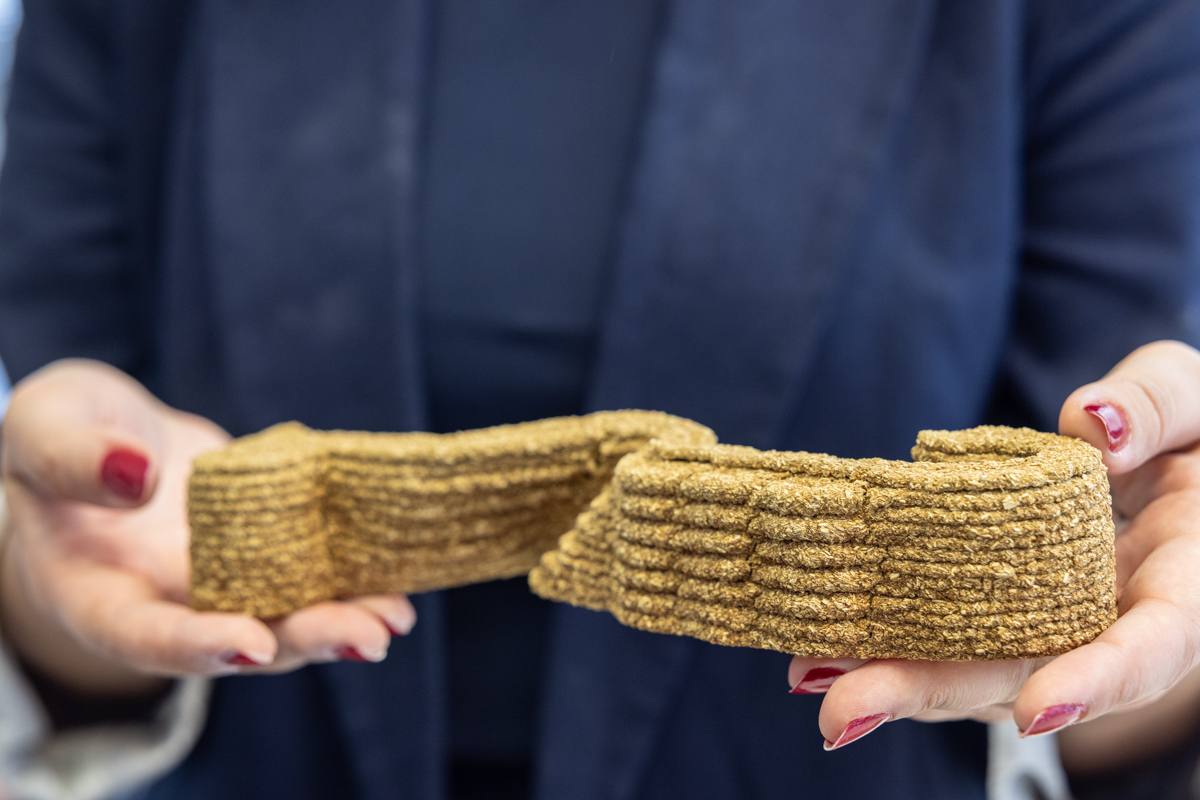
“Then the last part of the process is to coat this with natural waxes or natural oils,” Mogas-Soldevila said.
Mogas-Soldevila and Amirzheni show the completed tiles that continue to smell like pineapple.
Related Content
Composting and feeding food waste to animals have big climate benefits, study finds
A study by researchers at the University of Pennsylvania found composting and feeding food waste to animals would cut carbon emissions.
1 year ago
Listen 1:14Why building materials are so unhealthy
In addition to climate emissions, modern building materials have wider impacts on the environment.
“They’re also responsible for toxic emissions,” said Alison Mears, co-founder of the Healthy Materials Lab at the New School’s Parson’s School of Design in New York.
Mears said after World War II there was an explosion of new construction and innovation in synthetic chemicals that were composed of byproducts of the fossil fuel industry.
“Petrochemicals are cheap and abundant and have an amazing range of attributes that make them extraordinary in terms of what you could do with them,” Mears said. “So that was a kind of brave new world for chemists.”
Mears said none of our building materials, unlike food or pharmaceuticals, are regulated. But she said blood tests reveal microplastics and toxic PFAS chemicals, which people can be exposed to by spending time indoors.
“So wherever you are right now, if you look around and you look at the floor, and you look at the walls, you look at the furniture you’re sitting on,” she said, “you may have a wood floor, that may have a finish, you may have a vinyl floor that doesn’t have a finish, but it’s basically a plastic floor. You may have a carpet that’s made up of a combination of different fibers that have different chemical content. All of those things that are surrounding you have a petrochemical profile.”
Mears said architects and designers have become more aware of the potential health impacts of these materials over the past decade because they are not inert but lead to off-gassing and leach smaller particles that can be absorbed through the skin or through breathing and are linked to a number of health impacts.
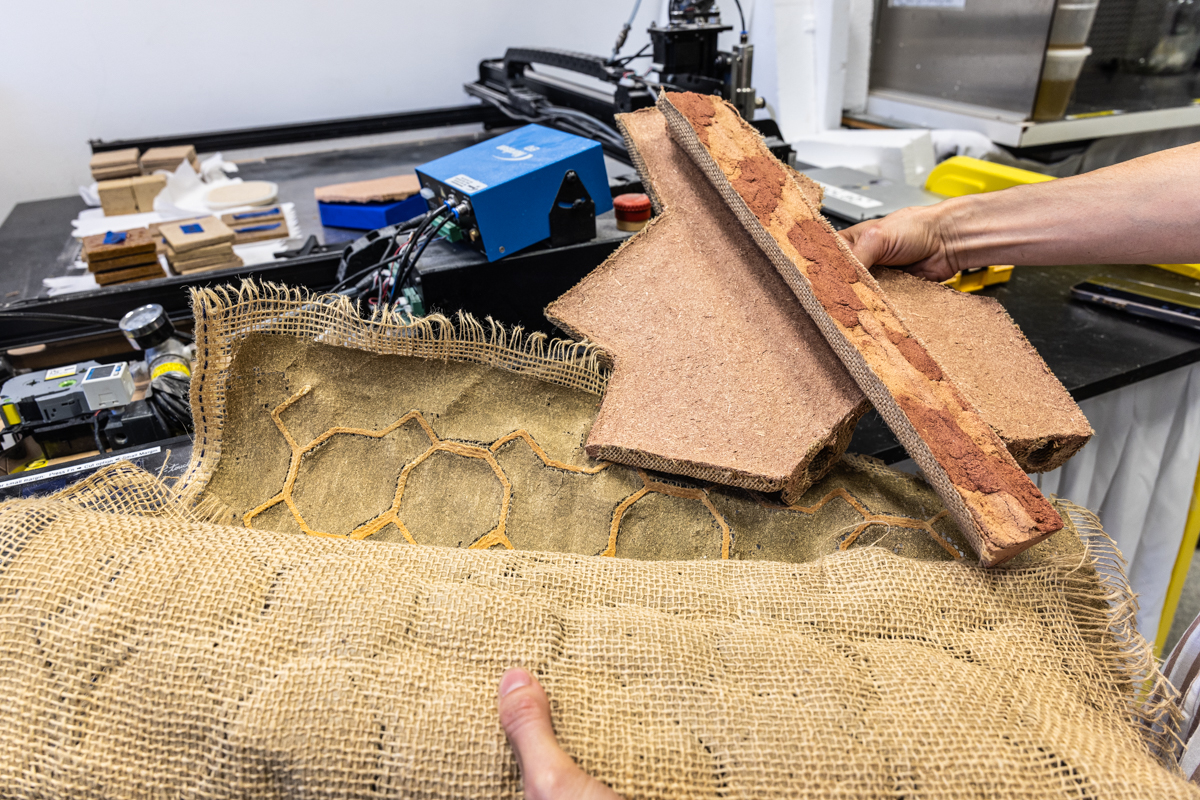
But researchers at the DumoLab said none of their experimental building materials would be toxic.
“And when rain washes off of these materials, it [sends] nutrients instead of nasty chemicals into the ground,” Mogas-Soldevila added.
Related Content
The trash strike was a breeze for Philly’s zero-waste enthusiasts
Composting, recycling and reuse make for tiny trash bags and no stink.
1 year ago
Measuring up against traditional materials
Right now, the team is experimenting and testing these natural materials against architectural and engineering standards to see if their durability and strength can stand up to more common materials like concrete.
“That’s why we want as much waste as possible because different plants are more porous, more fibrous, better at flexibility, better at compression,” she said.
Many of these natural materials are already used in biomedicine. But in those applications they need to be soft and squishy to make sure our bodies absorb them, Mogas-Soldevila said. Building materials, however, need to be hard and have some degree of flexibility.
While the lab is in Penn’s fine arts building, the work is interdisciplinary — merging engineering, chemistry, physics, biology and problem-solving design into what they see as the future of buildings.
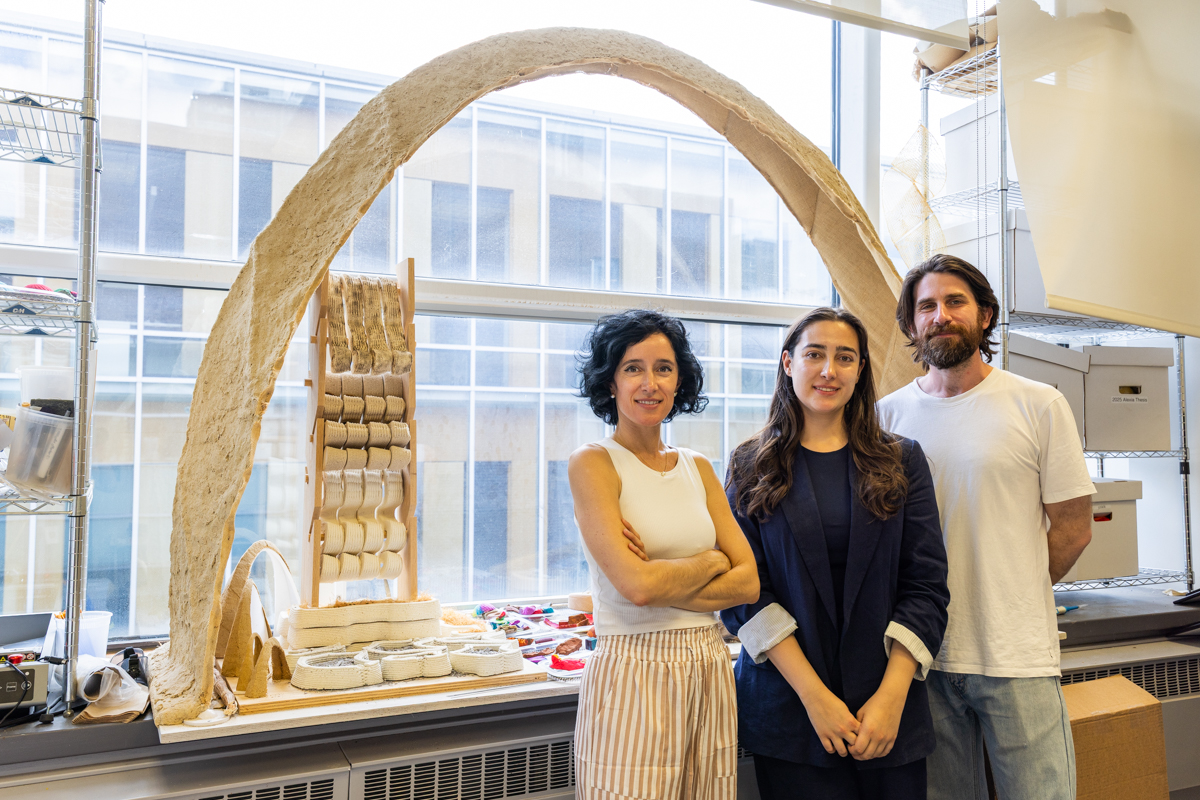
Mogas-Soldevila proudly points to another experiment, an arch made of shrimp shells, sand and flax fibers. This model, which she calls a shell because it can act as an enclosure, is about 4 feet high at the top and 6 feet from either end.
“It’s half a centimeter thick, but it’s as strong as a thicker concrete shell and very thin, and that’s why we were excited,” Mogas-Soldevila said. “Of course, it’s calculated to be that thin. So there’s a lot of structural optimization coming in because we try to use benign materials but also the least amount of them.”
The key, she said, is figuring out how to make these materials not based on fossil fuels strong and thin, without being brittle.
“Imagine you’re making an epoxy fiberglass helmet,” she said. “To make a shrimp shell flax helmet, you need to make it thicker, but it will protect you the same as the carbon fiber one.”
While a thin carbon fiber helmet and a bulkier natural fiber helmet may have the same level of safety, one will end up in a landfill, while the other could decompose naturally.
Mogas-Soldevila said it’s inevitable that the future of buildings will be made from refurbished waste products in part because of what’s known as “end of life.”
“The end of life is very problematic,” she said. “We cannot separate concrete from rebar at the end of life. Here our rebar is fiber. And that’s why we can get bending. That’s how we can make a beam out of shrimp and straw. Because we have a straw that’s very good at bending and we have shrimp shells that are very good at binding the straw to itself. So now we have a bending compressive material, which is what concrete and rebar does.”
Right now, experiments like these are in the very early stages. Manufacturers will only invest in these types of biodegradable materials if they have to pay for the disposal of their own waste, said Michael Grant, director of communications at Penn’s Weitzman School of Design.
“At some point, developers will be held accountable for life cycles, for [their] waste,” Grant said. “But until there is financial liability for waste, there will never be enough incentive to invest sufficiently in biomaterials.”
Grant said he’s confident that day will come.
“It will happen as landfills fill and cities can no longer afford to burn waste,” he said.
The question is: Can these products be scaled up?
Mears said she sees a future in agricultural waste, things like straw, because it’s so prevalent.
“That’s where some of this really interesting building product development is happening, using that kind of material,” Mears said. “You can start to see scale there and adoption in the use of products that are made from those kinds of what we might have called waste products, but now are resources.”
Mears says right now, there are many academic labs working on similar products, but they are also in initial phases.
“I think some places are starting to think about how they scale up, even if it’s at a residential kind of scale, which is very small scale, but that is the hope,” she said.
“That future is coming,” Mogas-Soldevila said. “We already have straw bale housing that has been brought into the modern era. We are all looking at Danish algae roofs and how we can modernize them. So, it’s coming.”
Mogas-Soldevila said there’s no need to invent something new to solve many of our climate and environmental problems because the answers lie all around us in nature. She is focused on looking to our food waste to build the future.

Get daily updates from WHYY News!
WHYY is your source for fact-based, in-depth journalism and information. As a nonprofit organization, we rely on financial support from readers like you. Please give today.
Part of the series
A network of air quality monitors grows in a formerly redlined area of West Philadelphia
The network will provide residents of formerly redlined areas of West Philly and Harrisburg real-time info about the air they’re breathing.
19 hours ago
Listen 1:07
In Philadelphia’s Eastwick neighborhood, plans for a temporary solution to flooding hit a snag
The issue with temporary HESCO-style flood barriers comes after a plan for a levee in Eastwick was deemed not viable.
2 days ago
Listen 1:07
Anglers warned to not eat PFAS contaminated fish from the Wissahickon watershed
Environmental regulators found high levels of PFAS chemicals in fish tissue sampled from the Wissahickon Creek and its tributaries.
5 days ago
Listen 1:04