
How services, housing gaps and policy made Georgetown, Delaware a focal point for homelessness
A new study sheds light on why homelessness is concentrated in Sussex County’s Georgetown and what leaders say is needed to address it.
Listen 1:40
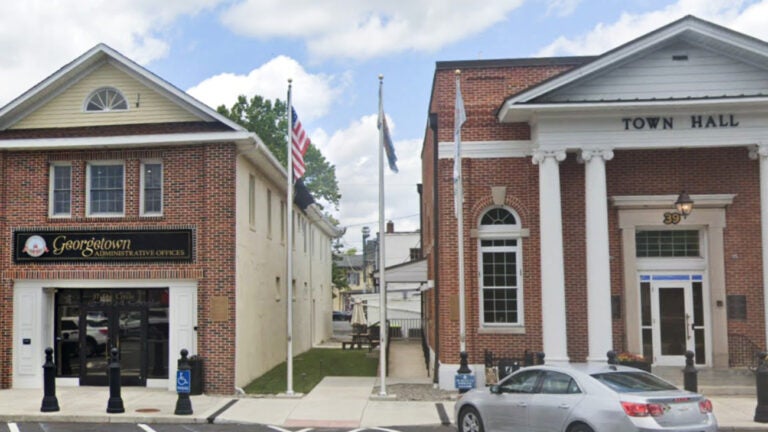
File: Georgetown, Delaware (Google Maps)
Georgetown has increasingly become a focal point for homelessness in southern Delaware, particularly within Sussex County’s rural landscape. The town’s role as the county seat, and the concentration of services that come with it, has shaped why people experiencing homelessness are more visible there than in surrounding municipalities.
A recent study surveying 247 people between October 2024 and May 2025 estimates that between 1% to 2% of Georgetown’s population may be experiencing homelessness, a rate significantly higher than that of similarly sized towns. The data was collected through sustained street outreach efforts largely in Georgetown and minimal additional outreach in the coastal and western side of Sussex County.
A glimpse into the data
Stephen Metraux, a professor of public policy at the University of Delaware who analyzed the survey data, said the findings confirm what service providers have long observed on the ground.
“Georgetown’s really gotten slammed with homelessness, as homelessness in Sussex has increased,” he said. “Georgetown did become kind of a hub, kind of more of a regional hub than a magnet.”
While more than 200 people initially engaged with the survey, many opted out before completing it, making the final dataset smaller than the total number of people contacted. Even so, Metraux said the results were striking, particularly looking at Georgetown’s population.
“Based on that data, we’ve got conservatively between 100 and 200 people on the streets at a given time in that survey database,” he said. “Of course, that survey database misses people. When you figure in people that she’s missed, you’re talking about 200 or 300 people, which is kind of the estimate that people are using for homelessness in Georgetown,” he added.
With Georgetown’s population at about 8,098 people as of 2024, according to the U.S. Census Bureau, Metraux said that estimate places homelessness at roughly 2%, a figure that stands out even when compared to major cities.
“And you do a comparison with the city of Philadelphia or any like larger cities, and a comparable percentage there is less than 1%,” he said. “You have a small town that’s slammed by homelessness right now and that was surprising.”
The data also shows that people experiencing homelessness in Georgetown are often long term. More than half of respondents reported being unhoused for over a year, a trend Metraux said is closely tied to a lack of housing availability and affordability.
“In Sussex, you have most of the housing construction at the higher end, you have zoning that makes it much harder to build a kind of multifamily housing,” he said. “Even lower-end housing, wages haven’t kept up with rising rents.”
An aging unhoused population is another growing concern. About 16% of respondents reported being homeless for more than 10 years, a pattern Metraux said reflects broader national trends.
“That’s not just in Delaware, but that’s nationwide,” he said. “A lot of them are receiving disability benefits, but those benefits are not enough to have sustainable housing unless you have some kind of a housing subsidy along with that.”
Related Content
Tiny homes in Georgetown, Delaware aim to redefine ‘affordability’
A 20-home project is just the beginning. The Little Living housing effort is expanding, with eyes set on Milford.
1 year ago
Listen 1:23A hub by design
Georgetown’s role as Sussex County’s seat has long made it a gathering point for services and, in turn, for people experiencing crisis.
“The municipality that ends up being the county seat … tends to be the focal point for the courts, for the justice system, for the Sussex Correctional [Institution], for mental health facilities, for rehabilitation facilities, state service centers,” said Judson Malone, executive director of Springboard Delaware. “So those drive people to be nearby because that’s where the services are.”
But Malone said the presence of services also exposes serious gaps, particularly when people are discharged from institutions without stable housing plans or aftercare.
When mental health facility Sun Behavior opened, “they already were reporting out of 90 some beds, about 30 of them were homeless people,” he said.
“And when they are discharged, they don’t have any aftercare program,” he added. “The prison will release people at really odd hours. They’ll release people at midnight. So, they had no place to go. They’re homeless and it’s the middle of the night and they’re left to just walk up the street to the nearest halfway house or wherever they can find.”
“Institutionally, we do have a real problem with the institutions that treat the homeless. When the treatment is over, they have no other option than to release them back into homelessness.”
Metraux echoed those concerns, noting a shortage of recovery housing in Sussex County.
“There is a need for more longer-term recovery housing, so not like permanent housing, but housing where you can continue your sobriety,” Metraux said.
Malone and Metraux stressed that the burden of addressing homelessness cannot fall on municipalities alone.
“None of the municipalities have the financial wherewithal to carry a heavy social service role and pay for it. The counties might have the wherewithal, but they very rigorously avoid any role in response to homelessness,” Malone said. “So, the state service center, the prison, the courts, the state patrol, those are all state institutions, but they operate at the local level. They’re the only ones that can fund stable housing for people coming out of treatment or out of incarceration.”
Related Content

A 2,000-square-foot community center is under construction with a kitchen, meeting rooms and office spaces to support residents in transition.
2 years ago
Listen 1:28What has Georgetown done?
As homelessness has become more visible, tensions over how Georgetown has responded have increasingly played out in public spaces, from town council meetings to social media. Residents from surrounding communities often point to the county seat as bearing responsibility for addressing the issue.
Town Manager Gene Dvornik pointed to the creation of the Georgetown Navigation Center, formerly known as the Pallet Village, as one of the town’s earliest efforts to provide stability and services for people experiencing homelessness.
More recently, the town has focused on addressing housing availability through zoning changes aimed at affordability.
“We just enacted, in the end of last year, a modification to our residential zoning code to allow for cottage community developments,” he said, adding that the goal is to “produce those at a more affordable rate for someone who is looking for a place to live.”
In the middle of 2025, Georgetown also formed a housing-focused advisory body to better understand gaps in services and potential solutions.
“The supportive housing issues committee initially was focused on transitional type housing and some of the issues that were perceived related to Oxford houses and those types of things,” Dvornik said. “They have concluded their portion that’s on supportive housing and they’ve now focused on what are some of the issues that are related to homelessness.”
For Metraux, the findings are a step in the right direction, but also emphasize the need for a regional response, including expanded case management and street outreach, more housing options ranging from temporary to permanent, improved data collection and mandatory discharge planning.

Get daily updates from WHYY News!
WHYY is your source for fact-based, in-depth journalism and information. As a nonprofit organization, we rely on financial support from readers like you. Please give today.
Part of the series

Part of the series


Operation SEAs the Day to honor veterans and their families in Bethany Beach next week
Since 2013, the charity has hosted veterans and their families in the Sussex County resort town free of charge. Families are also honored at an annual parade.
5 days ago

Sussex County Land Trust celebrates preserving 88-acre farm in Lewes
The Ard Na Gréine farm was owned by the same family in Lewes for decades. Now, it will be protected from development and, eventually, made open for public recreation.
3 weeks ago
Listen 0:59
In New Jersey, the Rescue Mission of Trenton is helping to instill hope and change lives
After completing a sober living program, a man who was unhoused and addicted to drugs is now working as a peer recovery specialist.
4 weeks ago
Listen 1:06