

Did DeSean Jackson instill ‘tough guy’ football culture at Delaware State that contributed to a brutal locker room attack?
A lawsuit claims that freshman Malachi Biggs was dropped on his face during an altercation and suffered a fractured jaw and severe injuries to his teeth and chin.
Listen 1:56
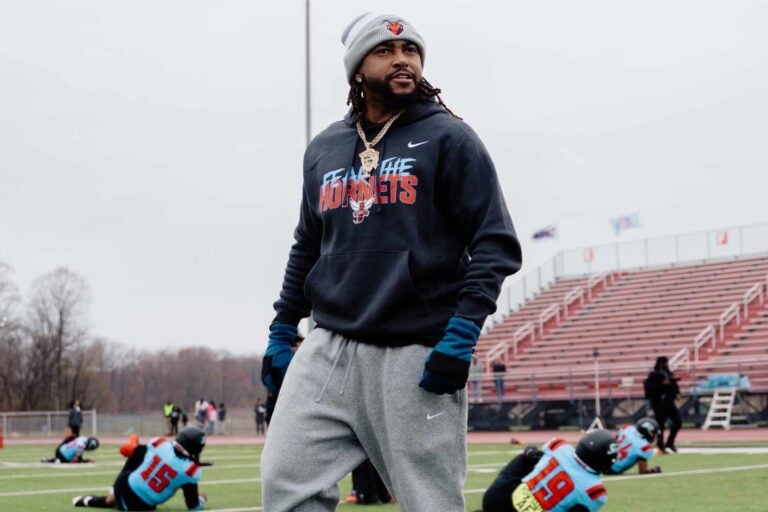
Jackson denied the essence of the allegations in a social media post but did not address the alleged attack by Hebert. (Delaware State University)
What are journalists missing from the state of Delaware? What would you most like WHYY News to cover? Let us know.
When former Philadelphia Eagles star wide receiver DeSean Jackson became Delaware State University’s head football coach last year, he promised a winning culture defined by physical play, discipline and a “dog mentality.”
The California native, who had never been a head coach at any level, began by recruiting several standout players and a coach from his home state, creating a West Coast-to-Delaware pipeline.
Then Jackson got down to business at the Dover campus, where the Hornets hadn’t had a winning season since 2012 and had gone 2-21 the previous two years.
The team immediately thrived under Jackson. They went 8-4 and made it to the championship game of the Mid-Eastern Athletic Conference. Hopes are high for the coming season.
But last week, as the Hornets concluded their spring practices, a player who says he suffered serious injuries in a bloody locker room altercation with a teammate last season filed a lawsuit that accused Jackson of instilling a “tough guy” philosophy and a “gang-associated mentality” among the players.
The lawsuit also accused Jackson of bringing in players, such as California native and starting defensive back Anthony Hebert, who posed a “serious risk of harm” to other players.
Malachi Biggs claims in the 62–page Superior Court filing that, three days before the MEAC championship game in November, Hebert put him in a “chokehold” and ignored his attempts to “tap out.” Instead, after Biggs lost consciousness, the lawsuit claims that Hebert dropped him to the hard locker room floor.
Biggs landed on his face. The fall shattered his jaw, ripped his chin open, severed a tongue ligament and caused “irreparable damage to at least one dozen teeth,” the lawsuit said. Biggs has already undergone “numerous, painful surgeries,” bone grafting, tooth extractions and other invasive dental procedures, and his injuries will require years of additional treatment, the lawsuit said.
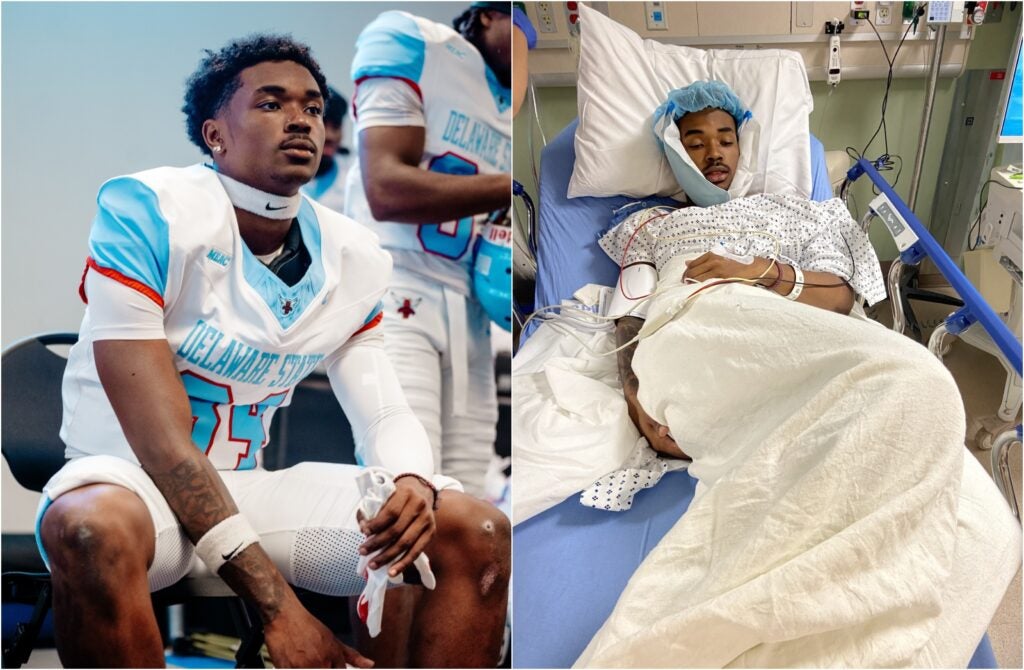
Biggs, who is represented by Morgen & Morgan, one of the nation’s largest personal injury firms, seeks unspecified compensatory and punitive damages from Delaware State, Jackson, Hebert and two other football team officials.
The lawsuit charges negligence against the university, Jackson, football operations director Jane Hicks and assistant coach Travis Clark. Clark coaches the team’s safeties, the position played by both Hebert and Biggs.
Clark has been a mentor to Jackson since his childhood and gave him his first coaching job in 2024 — as his offensive coordinator at a high school in Long Beach, California, the coastal town where Jackson first shone years before as a speedy scholastic receiver and deep threat.
The lawsuit also accuses the university of negligence in the training and supervision of the football staff, charging that administrators knew or should have known that Jackson, Clark and Hicks “were unfit, incompetent, careless, or otherwise posed unreasonable risks of harm” to Biggs and other players.
The football staff “created and promoted an unsafe environment in the locker room by permitting and utilizing gang-related language, promoting a violent culture — either overtly or through acts of omission, failing to properly discipline violent player behavior, and allowing dangerous acts of bullying and assault under the guise of ‘horseplay,’” the lawsuit said.
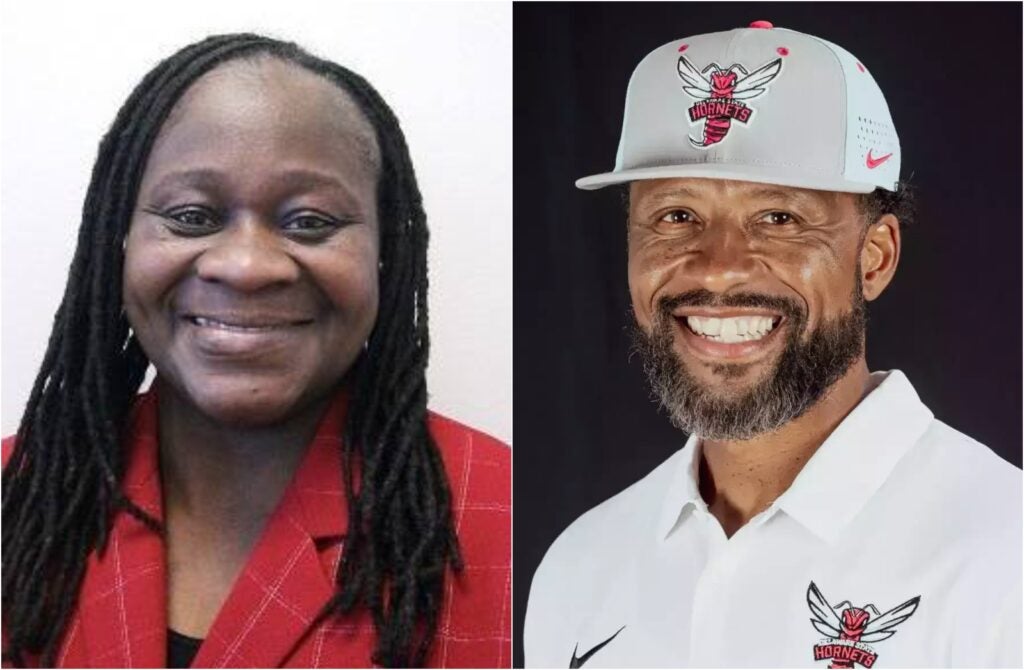
Delaware State President Tony Allen, who trumpeted his hiring of Jackson to revive the moribund football program, did not respond to an inquiry from WHYY News about the allegations.
“The university does not comment on pending litigation,” school spokesman Carlos Holmes said in a statement emailed to WHYY News.
Efforts to reach Jackson were unsuccessful. But in a statement that Jackson posted on social media, he denied the essence of the allegations without addressing the confrontation between Hebert and Biggs.
“I take the safety, wellbeing, and development of every student-athlete in the Delaware State University football program seriously,” Jackson’s statement said. “I have never fostered or encouraged hazing, bullying, or any violent environment, and that has never been the culture I have worked to build,” Jackson wrote.
“Because this matter is the subject to pending litigation, I will not comment further. My focus has always been on creating a positive, respectful place for student-athletes to train, compete, grow, and pursue their college dreams.”
The lawsuit also accuses Hebert of battery and reckless and wanton conduct. Attorney Georgia Pham, a former Delaware prosecutor who represents Biggs, said her client reported the incident to university police after being injured and hospitalized, but no criminal charges were filed.
After the alleged assault, the lawsuit said that Jackson put Hebert on the staff as a coach or graduate assistant. The team website doesn’t list Hebert as a coach, however.
Hebert, who uses the handle “Abear” — the pronunciation of his last name — on the social media platform X, could not be reached.
Holmes did not respond to questions about Hebert’s status at the university.
Related Content
‘It’s all gas, no brakes’: Delaware fully sanctions high school girls wrestling
The number of girls competing has nearly tripled over three seasons. Next year, the sport will have its first official state championships.
5 months ago
Listen 1:43

‘Something like this happening is egregious’
Jackson, who was an All-American at the University of California, had a 15-year NFL career that included three Pro Bowl appearances.
An undeniable star who played with a distinct swagger, Jackson scored 66 touchdowns, including an NFL-record 26 touchdowns of at least 60 yards. He played eight seasons for the Eagles, and retired after the 2022 season.
But as a college head coach, Pham said in an interview, Jackson and his staff “failed Malachi and other players on the team by not providing any supervision in the locker room at a time that there had been issues already on the team,” including violent fights.
“This is something that never should have happened and that ultimately changed the trajectory of Malachi’s entire life,” Pham said. “There are indications that there has been a fostering of a kind of a ‘tough guy, don’t disrespect us, don’t let people disrespect you’ culture and perhaps some favoritism towards certain players, whether they were starting players or were from similar areas in California to members of the coaching staff.”
Pham said she could not cite any specific previous incidents of violence on the team but said she would seek to document any that occurred during the discovery process.
The bottom line, Pham said, is that “the school owes the responsibility to its young men on the team to hire someone who’s appropriate to lead them.”
“Ultimately, something like this happening is egregious and should never have happened. The family wants to make sure this never happens again,” she said.
‘Severe injuries to his head, face, mouth, tongue, and teeth’
The violent clash pitting Hebert against Biggs and another player mentioned in the complaint took place on the morning of Nov. 19 — three days before the Hornets hosted the MEAC title game against South Carolina State, the lawsuit said.
Biggs arrived before 6:30 a.m. to get some treatment from the trainer in advance of the defensive squad’s practice. The freshman from North Carolina was a backup safety.
Hebert, a starting safety, was in the locker room when Biggs entered. At least two other players were already there or arrived shortly after Biggs, the lawsuit said.
It wasn’t long before Hebert, who is 6 feet, 1 inch tall and weighs 205 pounds, allegedly confronted another player about a post on Instagram because it referred to Hebert as “buddy.”
Hebert grabbed the other, identified player and put him in a chokehold, the lawsuit said. Then he then approached Biggs — who is one inch shorter and 20 pounds lighter than Hebert — and began choking him, the lawsuit said.
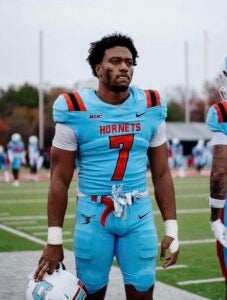
Hebert allegedly told Biggs to “tap out” and he would stop, but then ignored numerous attempts by Biggs to “tap out” or free himself, “eventually rendering [Biggs] unconscious and dropping him to the ground, head or face first.”
Crashing to the ground caused “severe and permanent injuries to his head, face, mouth, tongue, and teeth,” the lawsuit said.
When Biggs regained consciousness, he went to the training room to seek help, and a trainer called an ambulance. Biggs was taken to the emergency department at Bayhealth Hospital, Kent Campus, where he was diagnosed with “multiple severe jaw fractures and a deep laceration to his chin,” among other injuries, the lawsuit said.
While doctors were diagnosing Biggs and providing emergency treatment, Jackson spoke to the team about “the assault” that morning, the lawsuit said. Afterward, Hebert sent Biggs a text message, “acknowledging he assaulted” him, the lawsuit said.
The hospital released Biggs the next day, with instructions to follow up with an oral and maxillofacial surgeon at Christiana Hospital near Newark. The doctor recommended surgery, and Biggs decided to return home to be with his family and get further treatment at the University of North Carolina Medical Center.
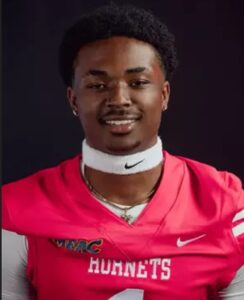
Back on the Dover campus, however, Jackson, Clark and Hicks didn’t discipline Hebert for allegedly attacking two players and seriously injuring Biggs, the lawsuit said.
Hebert played that Saturday, recording seven solo tackles in the hard-fought 28-17 loss that ended the Hornets’ season. For the year, Hebert had 48 tackles, including 40 solos, finishing second on the team, according to the university’s football website.
Meanwhile, starting on Dec. 1, Biggs began undergoing a series of facial and dental surgeries, and had a metal plate put in his chin. His most recent surgery was April 10, the lawsuit said.
Biggs hasn’t returned to school and will need ongoing dental work and surgeries for another three years, the lawsuit said.
Pham said Biggs faces a painful and uncertain future, even as he harbors hopes of returning to college and playing the sport he loves again.
“As a young person, this is a hard thing to grasp that perhaps your dreams have been taken from you,” Pham said. “And one of the things that we’re working through with Malachi now is really having realistic expectations for what the future may look like.”

Get daily updates from WHYY News!
WHYY is your source for fact-based, in-depth journalism and information. As a nonprofit organization, we rely on financial support from readers like you. Please give today.
Part of the series


Se acusa a los hombres de robar a un influencer en internet y de dejar tras de sí para los investigadores un rastro de publicaciones en redes sociales y pagos digitales.
9 minutes ago

ACLU de Delaware está solicitando a los líderes estatales que establezcan normas a nivel estatal que regulen cuándo la policía puede colaborar con ICE y compartir información.
1 week ago

Street shootings have dropped but remain a persistent problem. The mayor created an office to coordinate services and prevent more bloodshed.
1 week ago
Listen 1:20