As Delaware’s Venezuelan population grows through shifting immigration policy, community organizations provide support and belonging
Casa de Venezuela Delaware is helping families find resources, rebuild trust and create a sense of belonging.
Listen 1:26
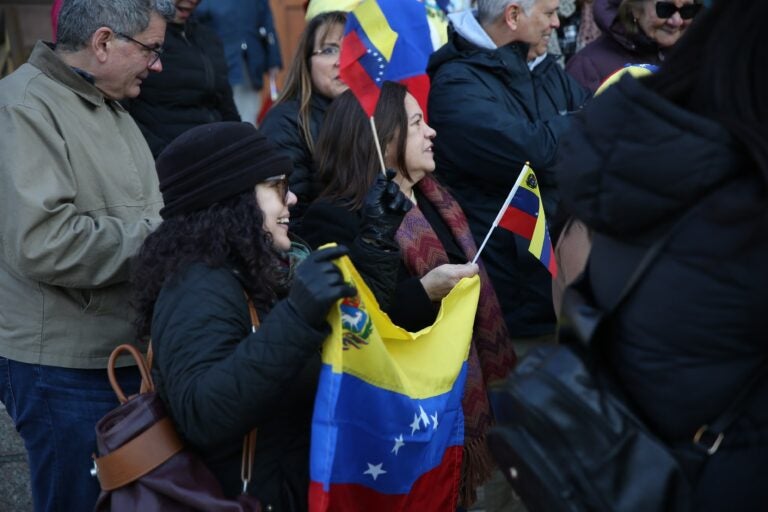
File - Members of the Philadelphia region's Venezuelan community came together on Sunday, Jan. 4, 2026, to celebrate the capture of Venezuelan President Nicolás Maduro. (Cory Sharber/WHYY)
What are journalists missing from the state of Delaware? What would you most like WHYY News to cover? Let us know.
The Venezuelan population in Delaware is steadily growing — but recent shifts in immigration policy are creating new uncertainties, leaving many without work permits and increasingly turning to community organizations for support.
Venezuelans are among the smallest, yet fastest-growing, Latino groups in the United States. Nationwide, the population has climbed to more than 1.2 million people, with nearly 600,000 holding temporary protected status, asylum or other forms of humanitarian relief.
As the numbers steadily rise, so does the need for connection, resources and a sense of belonging. Rossana Arteaga-Lopenza, president of Casa de Venezuela Delaware, said that need is deeply shaped by years of political and economic turmoil.
“Los venezolanos hemos sufrido una crisis política que nos ha obligado a salir de Venezuela”, dijo Rossana Arteaga-Lopenza, la presidenta de Casa de Venezuela Delaware. “Con esa crisis política, una crisis económica y una crisis humanitaria en donde muchos venezolanos han tenido que salir de Venezuela. Somos prácticamente 9 millones de venezolanos fuera del país.”
“We Venezuelans have suffered a political crisis that has forced us to leave Venezuela,” Arteaga-Lopenza said. “With that political crisis came an economic crisis and a humanitarian crisis, which has forced many Venezuelans to leave. There are practically 9 million Venezuelans living outside the country.”
For many, leaving Venezuela has meant more than migration. It has meant rebuilding trust, identity and community from the ground up.
“Es muy difícil hacer comunidad, el venezolano ha sido muy golpeado”, ella dijo. “Ha sido una experiencia difícil porque el venezolano no confía en los sistemas, porque los sistemas nos han golpeado duro. Hacer comunidad con una comunidad golpeada es muy difícil.”
“It’s very difficult to build community,” Arteaga-Lopenza said. “Venezuelans don’t trust the systems, because the systems have hit us hard.”
That reality is what led community leaders and advocates to formally establish Casa de Venezuela Delaware in 2023, inspired by similar efforts in Philadelphia.
“Una de las cosas que nosotros hemos venido haciendo en la organización ha sido literalmente promover la cultura venezolana en el estado de Delaware porque nos dimos cuenta que a medida que crecía la crisis en Venezuela, la crisis humanitaria, pues había muchos más venezolanos en el área, pero venezolanos sin representación”, ella dijo.
“One of the things we have been doing in the organization has literally been promoting Venezuelan culture in the state of Delaware, because we realized that as the [humanitarian] crisis in Venezuela grew, … there were many more Venezuelans in the area — but Venezuelans without representation,” she said.
Casa de Venezuela Delaware’s mission centers on visibility and dignity, Arteaga-Lopenza said — uplifting Venezuelan culture, sharing often untold stories and creating space for education and conversation around the realities their community faces. But the work extends beyond cultural preservation. The organization also serves as a bridge between families and resources they may not otherwise know about or have access to.
“Nosotros como servicios, más bien nosotros somos la mano que ayuda el venezolano a buscar servicios en otras organizaciones que son más grandes, como La Plaza, como La Esperanza, como LACC y como otro servicio dentro de los colegios y otros servicios dentro del sistema de salud”, ella dijo.
“We, as a service provider, are more like a helping hand for Venezuelans seeking services in larger organizations, such as La Plaza, La Esperanza, LACC and other services within schools and the health system,” she said.
At the same time, the organization is working to reshape public perception — pushing back against harmful stereotypes that many Venezuelans say they encounter with increasing frequency.
“Es que es una necesidad de pertenencia. Cuando tú eres un inmigrante, todos necesitamos pertenecer”, dijo Arteaga-Lopenza. “Y es muy difícil pertenecer cuando a tu comunidad, a cuando a tu gentilicio, lo criminalizan.”
“It’s about the need to belong. When you’re an immigrant, we all need to belong,” Arteaga-Lopenza said. “And it’s very difficult to belong when your community, when your nationality, is criminalized.”
“Entonces el trabajo de Casa de Venezuela ha sido prácticamente decir, nosotros no somos unos criminales, nosotros somos buena gente, somos responsables, somos trabajadores fuertes, somos profesionales, nos estamos enfocando en nuestra familia”, ella anido.
“So the work of Casa de Venezuela has been practically to say we are not criminals, we are good people, we are responsible, we are hard workers, we are professionals, we are focusing on our family,” she said.
That sense of belonging also translates into practical support — from conversational English classes to resume-building assistance — helping community members navigate everyday life in a new country.
Related Content
‘Mixed emotions’: U.S. strikes in Venezuela, capture of Maduro leave Philly region conflicted
Delaware Valley activists and lawmakers see potential for justice and danger following the U.S. military action.
3 months ago
Now, much of the organization’s work is shaped by shifting immigration policies. Advocates say many Venezuelans who arrived legally under temporary protected status are now facing uncertainty after changes to the program.
“We have many Venezuelans in the state of Delaware where their TPS has been taken away. And because of that, they don’t have a work permit anymore,” she said, noting that fleeing political repression and threats to safety can be grounds for humanitarian protection.
In response, leaders are working to bring the community together and raise awareness. On April 16, the organization will host a statewide conversation focused on the Venezuelan experience — from immigration challenges to the country’s political and economic realities.
“Many people have heard of Venezuelans as criminals in the news. Then we also heard about Venezuela when [President] Nicolás Maduro was taken militarily by the administration. And then we hear about a lot of Venezuelans resources,” she said, highlighting the natural richness of their country. “We are the biggest oil reserve in the world.”
Casa de Venezuela Delaware operates entirely through volunteer efforts, without federal funding — relying instead on community support and donations to sustain its work. For its leaders, the goal is simple but urgent: to ensure Venezuelans in Delaware are seen, supported and, above all, able to belong.

Get daily updates from WHYY News!
WHYY is your source for fact-based, in-depth journalism and information. As a nonprofit organization, we rely on financial support from readers like you. Please give today.
Part of the series
Passions run high on whether and where to reerect Christopher Columbus statue in Wilmington
City officials took down the statue of the Italian explorer, fearing it would be damaged, during the local and national racial unrest in 2020.
4 weeks ago
Listen 1:59
The Delaware River and Bay Authority said it was legally required to approve the lease. But Delaware and New Jersey governors were pressured to reject it.
1 month ago
Listen 1:01
Wilmington basketball tournament returns for its 8th year, raising money for mental health support
The two-day SL24 Basketball Classic returns to the Chase Fieldhouse to honor Sean Locke, raise funds for mental health programs and encourage open conversations.
2 months ago
Listen 1:33