Delaware’s proposal to raise taxes on tobacco could disproportionately affect low-income residents, policy experts argue
Legislation filed in the Delaware House last year to increase tobacco prices failed to get a committee hearing.
Listen 0:57
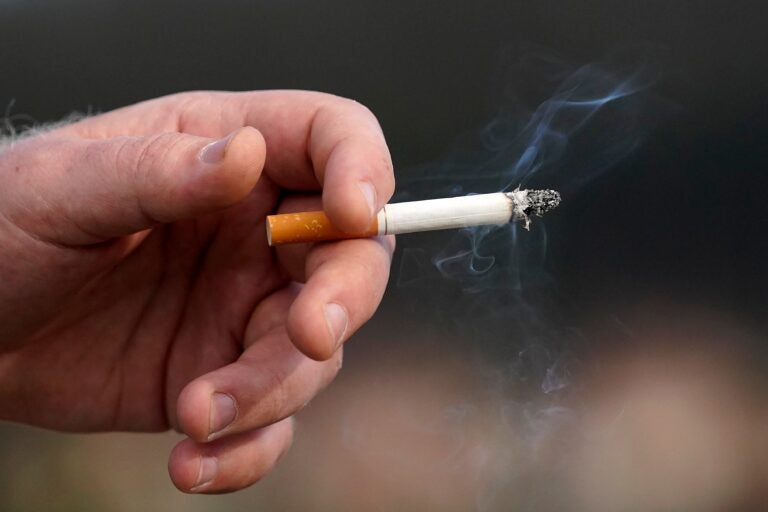
FILE - A person holds a lit cigarette. (AP Photo/Jeff Chiu, File)
What are journalists missing from the state of Delaware? What would you most like WHYY News to cover? Let us know.
Delaware Gov. Matt Meyer has a plan to raise state revenue in the next fiscal year by hiking certain taxes and fees. But some question if those increases are the best way to balance the budget.
Meyer’s recommended budget would spend $6.9 billion in the fiscal year 2027 budget. His administration said they would work to fill a more than $500 million gap in the budget between money the state takes in and what it spends with a $160 million new state revenue package.
Under his income package, the state would rake in $81 million more money by increasing some business formation fees, raise the cap on money generated from abandoned assets and take in another $18.9 million in higher tobacco fees.
Some organizations, like the American Lung Association, American Heart Association and the Campaign for Tobacco-Free Kids, have cheered the move to raise tobacco prices. But some tax experts say that tobacco taxes aren’t ideal for raising state revenue because they are regressive and rely on a shrinking consumer base.
Related Content
Meyer’s recommended budget would "modernize" business formation fees and raise cigarette taxes to add state revenue.
2 months ago
Excise taxes versus other types of taxes
Adam Hoffer is director of excise tax policy at the Tax Foundation, a nonpartisan tax policy nonprofit organization.
He said excise taxes are different from broad funding sources like income taxes, sales taxes and property taxes, because they are specialty charges put on a targeted set of goods.
Tobacco, alcohol and fuel have been historically known as the “big three” excise taxes, but it has widened over recent years to include recreational marijuana products and sports betting.
Hoffer and other tax policy experts say one of the concerns with states relying on excise taxes is that they generate the most amount of money from the people who can least afford it.
“Almost all products that receive an excise tax are more heavily consumed by lower-income Americans,” he said. “So when we tax them, those taxes are regressive.”
Aleks Casper, director of advocacy for the American Lung Association, said they endorse states using tax increases for so-called “sin” products like tobacco, in the hopes it will drive people to change their behavior. She said they are not concerned that the price increase would hit lower-income Delawareans.
“If you look at the history of where tobacco and tobacco companies have historically marketed and targeted, it is many times those low-income communities that already suffered disproportionately from smoking-caused disease, disability and death,” she said.
She said her organization is focused on public health benefits, not on the possible revenue generating aspect of raising tobacco costs. Meyer said on WHYY’s and Delaware Public Media’s “Ask Governor Meyer” call-in show last week that he believes the state would save money if higher prices cause fewer people to smoke.
“The more people that use tobacco, the worse it is for our health care system and it increases the cost of health care,” he said.
But Hoffer said he doesn’t believe using regressive taxation to force behavior change is effective.
“If you’re trying to improve the lives, especially of lower-income households, then regressive taxes, by their definition, make that really hard to accomplish,” he said. “Because you’re going to make a lot of those households worse off because you’re taxing them more heavily.”
Hoffer said tobacco tax revenue can also be unreliable to fund an entire state government because the number of smokers in Delaware and across the U.S. has been dwindling for the past several years.
“Over the past 60 years, we’ve seen fewer people smoke each and every year,” Hoffer said. “This is an overwhelming win for public health and [the] health of American consumers, but as states have become more and more reliant on cigarette tax revenue, then they start facing bigger and bigger challenges, because it’s a shrinking tax base.”
In fiscal year 2025, Delaware collected $87.5 million in cigarette taxes, compared with $92.4 million in fiscal 24.
Last year, Meyer proposed making the state’s income tax brackets more progressive by making people earning more than $600,000 a year pay a higher rate than someone making $60,000. But legislation attempting to do that failed to garner the necessary political support in the General Assembly.
Related Content

Delaware bill would decriminalize smoking marijuana in public
Smoking marijuana in public can lead to a criminal charge and up to five days in prison. The proposal would make it a civil violation subject to a fine.
3 months ago
Listen 1:57Cigarette taxes would go up by $1.50 under Meyer’s proposal
In the governor’s recommended budget, Delaware cigarette taxes would go from $2.10 set in 2017 to $3.60. Moist snuff would go from 92 cents an ounce to $1.23, electronic cigarettes would go from 5 cents to 10 cents per milliliter and other wholesale tobacco products would rise 10%.
Delaware Secretary of Finance Michael Smith said last month that the proposal expands the state’s definition of taxable tobacco products to include in modern forms of nicotine consumption.
“There are alternative, more modern forms of nicotine consumption now that are included in our definition of the tobacco tax,” Smith said. “So the bill addresses that, as well as nicotine pouches and things like that.”
If state lawmakers approved the proposed tobacco increases, Delaware would be the second-highest neighboring state for cigarette taxes, according to the American Lung Association. Maryland is $5, New Jersey is $3 and Pennsylvania is $2.60.
State Rep. Jeffrey Spiegelman, R-Clayton, said his support will hinge on how Delaware ranks with those nearby states.
“You know, Delaware, you’re never more than a half an hour away from another state where you can go and buy these things, tobacco, alcohol, whatever it is,” he said. “So if we’re going to then tax ourselves out of competitiveness with the surrounding states, then the tax itself will have an opposite effect of raising revenue, if that’s really the purpose of the tobacco tax.”
Some state lawmakers say passing increased tobacco taxes are more politically feasible than raising prices on alcohol, pointing out that passing legislation allowing wine to be shipped to Delawearans’ homes took 25 years.
Delaware has the least stiff alcohol taxes when compared to Maryland, Pennsylvania and New Jersey, according to the Tax Foundation. Delaware sits nearly $1 below Maryland at $4.50 per gallon. Maryland is at $5.46 a gallon, New Jersey’s $5.50 a gallon and Pennsylvania is $7.48 per gallon.
Johnny Perez-Gonzalez contributed to this story.

Get daily updates from WHYY News!
WHYY is your source for fact-based, in-depth journalism and information. As a nonprofit organization, we rely on financial support from readers like you. Please give today.
Part of the series

Jobs for Delaware Graduates hired Nicole Poore in 2014. Watchdog groups say lawmakers shouldn’t run agencies that get taxpayer money.
11 hours ago
Listen 4:36
The effort includes multilingual resources outlining what to do if approached by federal agents, including the right to remain silent, refuse searches and ask for a lawyer.
5 days ago
Listen 0:59
Mike Houghton was a former Delaware Economic and Financial Advisory Council chairman and longtime member before being fired Wednesday.
2 weeks ago