

‘La migra llevó a mi papa’: How immigration enforcement is affecting Delaware students long before the school bell rings
For many students, immigration fear doesn’t stop at home. Educators and researchers say it’s reshaping learning, attendance and well-being.
Listen 2:23
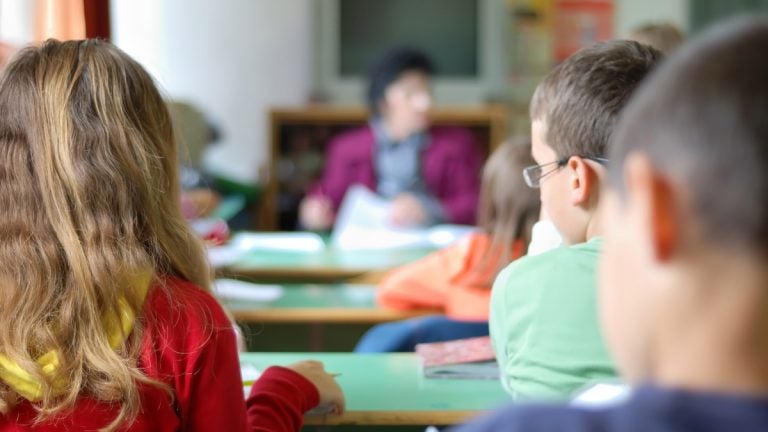
FILE - Children sit in a classroom. (Zurijeta/Bigstock)
What are journalists missing from the state of Delaware? What would you most like WHYY News to cover? Let us know.
Before a child ever opens a textbook, their day may already be heavy.
For students who are children of immigrant parents, learning often happens with a quiet but constant weight in the back of their mind — fear that a parent may not be home when the school day ends. It’s an anxiety that can be triggered by a simple knock at the door, or the stress of carrying adult worries in a child’s body. Homework becomes difficult when the home turns chaotic.
Classrooms feel distant when a student is numb. For some, the fear is hypothetical; for others, it becomes real when a parent is detained or deported, abruptly reshaping their family, their routines and their future.
What teachers are seeing on the ground
In a viral video shared on TikTok, Lindsay Perez, a second-grade immersion teacher in the Indian River School District, refers to an instance where one of her students was crying on the playground after her father was detained by immigration agents, saying “that was my breaking point as a teacher.”
In the video, she says that the child had been struggling, whether it was her being late or absent from class or handing in unfinished homework. After she learned about her father’s detainment, she writes in a caption in the video “now it all makes sense.”
In an interview with WHYY, Perez recalled the moment, which happened during recess when another student approached her to tell her that a classmate was crying. She immediately stepped in to see what was wrong, only to learn that the child’s parent had been detained by U.S. Immigration and Customs Enforcement.
“I was like ‘What’s wrong?’ and she told me in Spanish, ‘La migra se llevo a mi papá,’” she said, which translates to ‘Immigration took my dad away,’ as her teaching partner helped comfort the child.
“Reflecting on that moment and later that day, we were kind of looking through her folder and you could just see how much her family has been affected by it because her papers were still in her book bag,” she added. “Her papers were in her folder. She was just down, she wasn’t really talkative. I mean, she wasn’t really coming to school, she was late.”
Perez said the experience changed how she and her teaching partner approached their classroom. Shortly after, they began putting stronger systems in place to check in with students more intentionally — both emotionally and mentally.
“Being mindful and j trying to make connections with the kids and trying to ask them ‘How are you doing? On a scale of like 1 to 10, how are you feeling?’ And just trying to, like, make it an effort maybe each day to try to or maybe each week to try to check up on a child,” she said.
For Perez, the moment served as a reminder of the role teachers play beyond academics.
“We’re like their caretakers … because they’re with us for half of their day and it’s just like they’re one of ours,” she said. “For all of us teachers who get so busy with the life of teaching, we sometimes forget to look into these kids and their lives, just trying each day to be like a listening ear for them.”
Fear, family separation and ‘ambiguous loss’
Educators say these experiences don’t always look like crises on the surface. Instead, they show up in silence. Missed assignments. Absences. A child staring past the whiteboard, mentally somewhere else.
That response is not a lack of motivation, it’s grief, said Brittany Zakszeski, an assistant professor at the University of Delaware.
“When a parent is deported, there is this sudden family separation. And that type of separation or even the fear that it could happen creates this level of stress for children and youth and it often leads to something called ambiguous loss,” Zakszeski said. “All of that makes learning much, much harder. Ambiguous loss is this idea that a parent is alive but unavailable.”
Ambiguous loss is central to understanding why education becomes so difficult for these students.
“That pain, that stress response commonly shows up in school behavior, in disengagement, in withdrawal. We are very likely to see students in classrooms withdrawing, struggling to concentrate or even avoiding school entirely, not showing up to school,” she said. “This really shouldn’t be interpreted as a lack of motivation or disinterest. It’s actually a very protective response to uncertainty and to grief in the student’s life.”
She emphasized that grief in children rarely mirrors what adults expect.
“This grief shows up through behavior. It shows up through academic performance and it even shows up through not showing up to school,” she said.
Related Content

Older kids face the steepest challenges in Delaware’s foster care system to find housing, jobs and transportation as they age out.
3 months ago
Listen 3:41A modest but measurable decline in academic performance
What educators and experts have been observing is increasingly reflected in research.
A 2025 study by David Figlio and Umut Ozek examined the academic effects of a surge in interior immigration enforcement using student-level data from Florida — a state with one of the largest and most diverse populations of foreign-born students in the country.
The study found that the enforcement surge led to modestly sized but measurable declines in academic performance among Spanish-speaking students, including foreign-born children and U.S.-born children of immigrant parents.
According to the study, the negative effects were stronger for lower-performing students than for higher-performing students, somewhat stronger for girls than for boys and concentrated in middle and high schools rather than elementary schools.
The authors emphasized that these academic changes were not random, but aligned with stress-related disruptions — particularly for students already facing academic challenges.
The findings build on a small but growing body of evidence. In the only other known study of the recent enforcement period, Thomas Dee found a marked reduction in daily attendance rates across five school districts in California’s Central Valley following nearby immigration raids that began in January 2025. That study, however, did not examine test scores or student behavior and relied on attendance data rather than individual student records.
The research suggests that fear alone –– without a detention ever occurring –– can alter a student’s educational outcomes, echoing what Zakszeski sees in schools.
“It’s the fear alone and not the active deportation that has been linked to these long-term effects for students in terms of their well-being and in terms of their educational outcomes,” Zakszeski said. “So those drops in attendance, those drops in engagement, dips in academic performance, there’s research that shows that those are not temporary and that those, you know, can really alter a student’s educational trajectory.”
What support can look like in a classroom
For Zakszeski, meaningful support begins with how teachers see their students –– not just as students, but as people to understand. She said the most effective response is not rooted in immigration status, but in awareness, connection and care.
“What teachers need to be doing is attending to their students, getting to know their students and being available to provide effective support that is focused on signs of stress, grief and safety needs, not necessarily the legal status,” she said.
“What we know it boils down to is stable caregiving, in terms of teachers caring for their students and schools as well,” she said.
Schools need to provide better social emotional learning opportunities and mental health literacy for students, too, Zakszeski added.
“More targeted and intensive mental health supports for students who are requiring more than what the general population of students require,” she said.
She emphasized that grief tied to immigration enforcement often looks different in children than it does in adults, making it easy for warning signs to be misunderstood or overlooked. Behavioral changes, she said, should be viewed as signals.
Beyond academics, Zakszeski noted that the long-term consequences of unaddressed stress can follow students well outside the classroom — shaping attendance patterns, engagement, graduation outcomes and even future employment. But she also pointed to interventions already in place in many schools, including small group supports and one-on-one mentorship programs that offer students consistent adult connection through daily check-ins.
As more educators enter the profession, she said, many are beginning to recognize that student mental health is no longer peripheral to teaching — it is central to it. And while schools cannot control immigration policy, they can offer something enduring: a space where students feel seen, supported and safe enough to keep learning.

Get daily updates from WHYY News!
WHYY is your source for fact-based, in-depth journalism and information. As a nonprofit organization, we rely on financial support from readers like you. Please give today.
Part of the series

Trump administration investigates Great Valley School District over transgender sports policies
The U.S. Department of Education’s probe into the Chester County school district is one of 18 new investigations against educational institutions across the country.
1 month ago
Listen 0:57
The revamped school funding formula targets more money to students with higher needs to achieve better academic outcomes.
1 month ago
Para muchos estudiantes, el miedo a la inmigración no se limita a casa. Educadores e investigadores afirman que está transformando el aprendizaje y el bienestar.
2 months ago