

‘We can’t go down the same path’: Delaware educators, civil rights leaders blast state’s proposed school accountability plan
Educators say the plan opens old wounds from a previous effort where the money went to outside consultants instead of teachers’ classrooms.
Listen 1:04
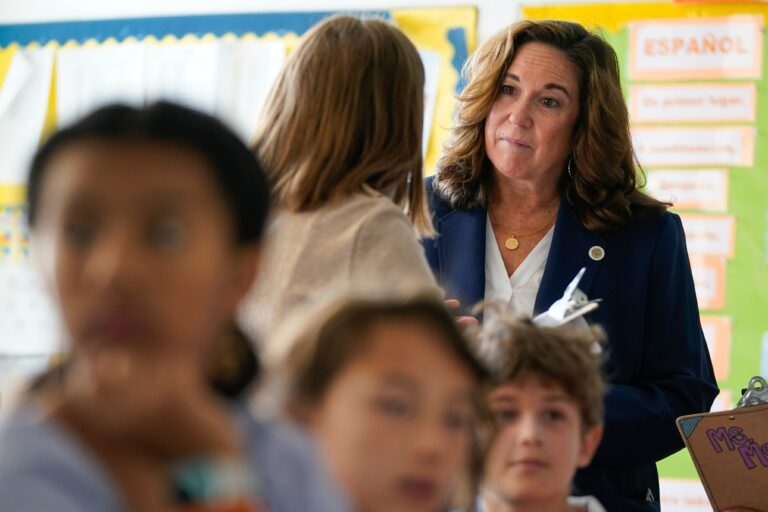
File - Delaware Secretary of Education Cynthia "Cindy" Marten, formerly the U.S. deputy secretary, meets with a student while visiting a classroom in Washington, Thursday, May 25, 2023. (AP Photo/Pablo Martinez Monsivais)
What are journalists missing from the state of Delaware? What would you most like WHYY News to cover? Let us know.
The Delaware Department of Education’s plan to improve low-performing schools is drawing scrutiny from some educators, civil rights groups and state lawmakers.
Education Secretary Cindy Marten’s draft proposal includes a five-tiered system where schools would receive increasing levels of state support, and education officials could take over a low-performing school by Delaware as a last resort.
It comes as the state is working to revamp the current school funding formula to try to boost student performances, especially targeting low-income students, multilingual learners and students with disabilities.
The plan lays out statewide goals for 2028, including increasing third grade reading proficiency from 38% to 53%, raising eighth grade math proficiency from 26% to 35% and decreasing chronic absenteeism from 15% to 13%.
Mike Brinkner, executive director of the American Civil Liberties Union of Delaware, said he questions rolling out an accountability plan before all the money that is needed to make access to a quality education equitable across the state has been invested.
“Right now, we are just not at a place where these schools have gotten the resources that they need, and then it becomes a situation where people who don’t have shoelaces are told, ‘Well, why didn’t you pull yourself up by your own bootstraps?’” he said. “They don’t have the resources to actually do that and we as a state have not followed through and held ourselves accountable to providing those school districts with those resources.”
The ACLU was one of several groups who sued the state in 2018, alleging the state was persistently underfunding low-income students, multilingual learners and children with disabilities. The parties settled in 2020.
A report issued as part of the court settlement found that Delaware needed to add $600 million to $1 billion to achieve educational equity. The state committed $100 million in the fiscal year 2027 budget.
Related Content
Delaware lawmakers advance school funding overhaul amid pressure from civil rights leaders
Civil rights activists say state leaders need to give multilingual learners more resources or face immediate legal action.
7 months ago
Listen 1:06Department of Education floats student retention for third graders
Education officials have also raised the possibility that students who cannot read at grade level by third grade could be held back.
According to Reading Rockets, a national public media literacy initiative, 14 states and the District of Columbia have adopted mandatory retention policies for children who are not reading proficiently by the third grade.
The idea is controversial, with some arguing it helps students be more successful academically and others asserting it can hurt kids’ cognitive and emotional development.
Lawmaker voices concern about ‘unintended harm’
Some educators have slammed the state’s draft plan by pointing out the similarities to a failed effort more than a decade ago to turnaround six low-performing Wilmington schools within the Red Clay and Christina school districts.
Former Gov. Jack Markell’s administration used $119 million in federal funding from the federal accountability program Race to the Top for the priority schools initiative. As part of that push, state officials demanded that the Christina and Red Clay Consolidated school districts fire principals and teachers to reapply for their jobs.
Related Content

A new report shows multilingual learners make up nearly 19,000 of Delaware's students, but teacher shortages and outdated systems leave key gaps.
1 year ago
Listen 1:23Battle scars remain
Maureen McGurk has taught in the Brandywine School District for 18 years. She said much of the money never found its way into classrooms and instead went to outside consultants while teachers were blamed for a lack of progress.
“We can’t go down the same path that we’ve tried before that hasn’t worked,” she said. “Test scores started going down when we started using those kinds of accountability measures to evaluate how students were doing and the decisions were taken away from districts locally and teachers at their buildings.”
Delaware State Education Association President Tameka Mays said some of her members are concerned that the history will repeat itself.
“Many of our educators are frustrated that funding that is meant to be for our classrooms — especially with the hybrid formula rolling out next year — could potentially be diverted to DOE or consultants or for-profit organizations, instead of going directly into the classroom,” she said.
Education Secretary Marten maintains her proposal is different from the priority school model.
“I understand why earlier accountability efforts in Delaware are shaping how people react to this proposal initially,” she said. “We need to learn from that history. We are not trying to recreate it.”
Despite Marten’s reassurances, some worry that this is a rehash of previous top-down policies like Race To the Top and its predecessor, No Child Left Behind.
State Sen. Laura Sturgeon, D-Brandywine Hundred, is the chair of the Public Education Funding Commission and a retired teacher. She said she believes the idea has already done unintended harm to educators, who she said “feel, once again, unheard and undervalued.”
“The mere placement of a state takeover or DOE receivership at the top of a hierarchy of interventions implies a belief that even after schools implement every available support, educators themselves must be doing something wrong,” she said. “Something only the DOE or outside contractors can fix, and I reject that assumption wholeheartedly.”
Marten has emphasized that the accountability plan she has introduced is a draft and said she wants to hear from stakeholders before final recommendations are adopted.
The Department of Education is accepting feedback through Nov. 1.

Never miss a moment with the WHYY Listen App!


WHYY is your source for fact-based, in-depth journalism and information. As a nonprofit organization, we rely on financial support from readers like you. Please give today.
Central Bucks school board holds public hearings on termination of superintendent, principal
The administrators were placed on leave earlier this year following abuse allegations in a special education classroom at Jamison Elementary School.
1 year ago
New certificate program aims to reduce Delaware’s ‘severe shortages’ of special education teachers
To help alleviate the shortage of special educators, the U.S. Dept. of Education awarded a Del. State professor a grant to develop a special education certification.
3 years ago
Youngest Delaware students with special needs get new funding help
New funding requirements will help Delaware students younger than third grade get the extra help they need to start their school careers.
5 years ago