

‘It’s reprehensible’: Delaware Gov. Meyer, advocates blast state police over stalled Clean Slate rollout
Pennsylvania automatically seals millions of criminal records a year, while Delaware State Police insist on manual reviews of eligible cases.
Listen 1:40
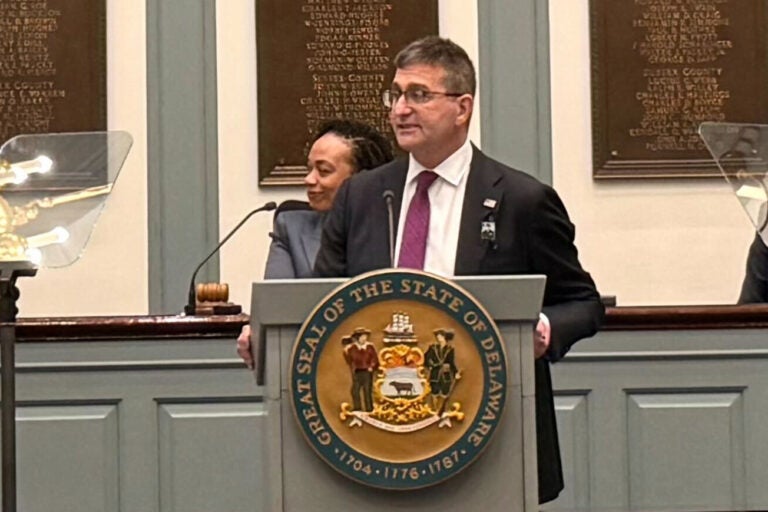
Gov. Matt Meyer delivers his State of the State address, outlining priorities on education, health care, housing and other key issues facing Delaware. (Johnny Pérez-González/WHYY)
What are journalists missing from the state of Delaware? What would you most like WHYY News to cover? Let us know.
Delaware Pastor Tony Neal said he turned his life around in the early 1990s after leaving prison. But his criminal record prevented him from being allowed to attend his son’s U.S. Air Force graduation ceremony in 2014.
“That was hurtful,” the Georgetown resident said. “One of the greatest moments of my life [and] because of my past, it seemed like my kids had to pay for it, and I just felt it wasn’t right.”
A criminal record can be a barrier in many areas, including employment, housing and education. The 2021 Clean Slate Act aimed to give Delawareans a second chance by automatically expunging low-level offenses from their records. The goal was to expand access to jobs and living wages so families could rise out of poverty.

But the promise of Delaware’s Clean Slate Act has yet to be realized almost a year and a half later because state police have not automated the process, leaving hundreds of thousands of individuals unable to move on from their pasts. This is while a similar law in Pennsylvania clears millions of cases annually. The situation has outraged criminal justice reform advocates, civil rights groups and even Delaware Gov. Matt Meyer.
“It’s reprehensible that in 2021 we passed a law to automatically expunge records, and here we are in 2026 talking about how it still hasn’t gotten done,” Meyer said last week on “Ask Governor Meyer,” a call-in show hosted by WHYY and Delaware Public Media.
Delaware advocates lament lack of progress
The Clean Slate Initiative is a national bipartisan effort to pass record-sealing laws in all 50 states and in Congress. Thirteen states and the District of Columbia have passed versions of it, with Pennsylvania being the first state, with implementation starting in 2019. Delaware passed it two years later.
The Delaware Department of Safety and Homeland Security had three years to prepare for the law’s implementation in August 2024, including developing the processes to automatically expunge records on a monthly basis. Delaware expunges or destroys the records, while Pennsylvania seals them from public view. While some documents are destroyed, Delaware does keep an official electronic record.
The Delaware Criminal Justice Information System estimated that 290,980 adults with 594,537 cases would immediately be eligible, according to the bill’s fiscal note.
Charges eligible for a free automatic expungement include marijuana possession, underage drinking, some misdemeanors and a few felonies. Some offenses can be removed immediately, and others require a waiting period.
Delaware has cleared fewer than 19,000 cases since August 2024, with other states far outpacing that rate. Pennsylvania sealed over 34 million cases in its first year.
That’s because the Delaware State Bureau of Identification, where criminal history information is centrally stored, is manually reviewing each case that has been identified as eligible for automatic expungement. That’s leading to just a fraction of eligible cases being approved.
Related Content

An Arizona consulting firm is connected to at least 19 applicants using a state social equity program. They have since had their conditional marijuana licenses denied.
5 months ago
Listen 1:27John Reynolds, deputy policy and advocacy director for the American Civil Liberties Union of Delaware, said it will take 20 years at this point to clear existing eligible cases.
“Delaware, instead, has not followed the best practices established in Pennsylvania, and has instead had state police decide that they want to manually check every eligible record to confirm its eligibility, which has resulted in an extremely slow implementation,” he said.
In a statement, Delaware State Police spokesperson Tyler Wright argued they were meeting the requirements of the law and defended the manual review as a matter of public safety. He said the list from the Delaware Criminal Justice Information System also includes ineligible records, requiring the extra scrutiny.
Reynolds disputed Wright’s assertion that law enforcement is in compliance. He said the centralized state database has the necessary algorithms to identify eligible records.
“The state is erecting unnecessary barriers to individuals being able to fully participate in their lives and access the economic, academic, housing and other related resources that are often denied to people solely due to the existence of a record,” he said.

Pennsylvania gives millions a second chance through Clean Slate
Pennsylvania has so far sealed nearly 57.5 million cases. Soon, that number may include Doris, a 52-year-old Philadelphia resident.
Doris said staff at Community Legal Services of Philadelphia told her that her prior convictions are eligible to be sealed through the state’s Clean Slate Act. WHYY News agreed to the legal group’s request not to use clients’ last names or pictures.
Offenses that can be shielded under Pennsylvania’s law include petty crimes, lower-level misdemeanors and some felony drug offenses. Individuals must go a period of time, from five to 10 years, depending on the crime, without a new conviction before becoming eligible for the free process.
Doris, who is currently unemployed, said if she can get her convictions removed, she can renew her certified nursing assistant license.
“Without that coming off my record, I’m not even eligible to get into the class,” she said. “The schools and the little organizations that run the classes, even the Red Cross, have to run a background check.”
Related Content

Delaware proposal would direct courts to send text reminders to defendants about hearings
Automatic text messages could reduce missed court appearances and the need for judges to issue bench warrants.
5 months ago
Listen 1:00Jamie Gullen, a managing attorney with Community Legal Services, said the success of the state’s automatic record-clearing process comes from having all related agencies committed and on the same page.
“Pennsylvania is a large state. We have a lot of criminal records in our databases,” she said. “So to make this work at scale, it just wouldn’t have been feasible to do it on a manual, heavy level that involves reviewing paper files, destroying paper files. Things like that just would have made it impossible for the bill to actually work and function at this scale.”

Delaware Gov. Matt Meyer’s office says leadership critical to solving impasse
That kind of cooperation of agencies is lacking right now in Delaware, Meyer’s office said.
“That kind of coordination, it doesn’t just happen on its own,” said Matthew Rosen, the governor’s director of research during a recent virtual discussion of the Clean Slate Act hosted by the nonprofit Tide Shift Justice Project. “It requires clear ownership and leadership. And as we delve into this issue, we realize this leadership needs to come from the governor’s office.”
Reynolds and other criminal justice advocates say they are hopeful that Meyer’s office becoming more involved with the issue will bring necessary change, but they also wish it had come sooner into his first term.
“I think we need to continue to demand what was promised to be delivered in August of 2024 to be delivered today,” Reynolds said. “Until that happens, people should remain upset, disappointed and continue to demand that the records of 290,000 plus people be cleared so they can move forward with their lives, support themselves and their families.”
Editor’s note: This story has been updated to include a response from Delaware State Police.

Get daily updates from WHYY News!
WHYY is your source for fact-based, in-depth journalism and information. As a nonprofit organization, we rely on financial support from readers like you. Please give today.
Part of the series

James Spadola changed parties last year, igniting a debate over whether he should be removed from office.
2 days ago
Listen 0:50
How Air Force enlistee in Delaware allegedly used Snapchat to recruit, rape 15-year-old girl
Authorities say the mobile app messages soon turned sexual, leading to an overnight drive to Dover and child rape charges.
2 days ago
Listen 2:17
Los tiroteos en la vía pública han disminuido, pero siguen siendo un problema persistente. El alcalde creó una oficina para coordinar los servicios.
2 weeks ago