

With 470 children in Delaware’s foster care system, teens wait the longest for homes and many age out without stability
Older kids face the steepest challenges in Delaware’s foster care system to find housing, jobs and transportation as they age out.
Listen 3:41
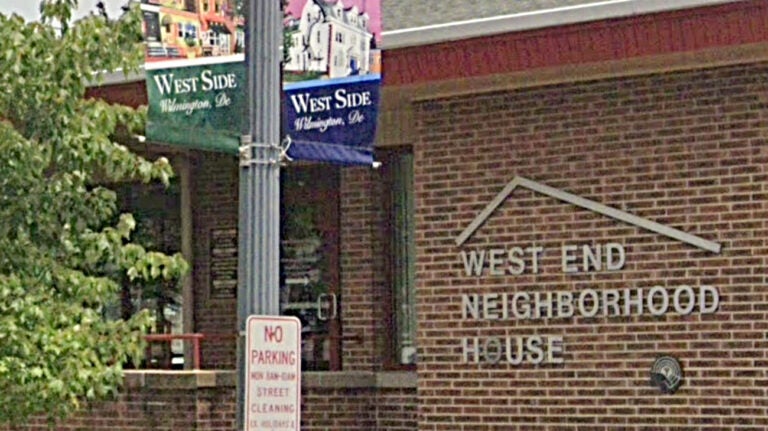
File - West End Neighborhood House in Wilmington, Delaware, which offers young people housing, case management and guidance. (Google Maps)
WHYY Pop-Up Newsroom and Foster Care Resource Fair
Join WHYY News at West End Neighborhood House in Wilmington on Tuesday, Dec. 2, to learn about foster care and adoption opportunities in Delaware.
As Delaware’s foster care system stretches thin across three counties, a quiet crisis is unfolding in homes, courtrooms, hospitals and state offices. Babies with nowhere else to go enter the system. Teenagers linger in temporary placements, hoping for someone who chooses them. And for youth who age out, adulthood begins before stability ever arrives.
At the center is a system doing everything it can — and still not enough — as the need grows, especially in Sussex County, where finding foster homes has become one of the state’s steepest challenges.
Statewide, about 470 children are currently in foster care, with their demographics reflecting the diversity of the state itself. According to the Division of Family Services, that includes four Asian children, 39 Hispanic children, 168 white children and 298 Black children. Each child enters the system for a different reason, and each one begins a journey shaped by where — and with whom — they are placed.
That placement can look different from child to child, said Trenee Parker, director of the Division of Family Services.
“Most people are probably most familiar with what I will call a traditional foster home. Individuals in the community who go through the training program,” she said. “We also have some settings that are called congregate care or group care settings. We have contracts with three different agencies across the state that provide more of a group care, not an individual foster home type of setting. Then we also have some individuals that are not traditional foster parents, but are relatives or nonrelatives … and they provide services for those children as well.”
But Delaware’s greatest need is not simply more homes — it’s the specific homes many children require. Those needs span from medical conditions that require specialized caregiving skills, to developmental or intellectual disabilities, and behavioral health challenges.
“What we are trying to do right now is engage the community; to have families who are interested in providing services to teenagers, to sibling groups because when we have children who experience foster care, we like to try to keep them with their siblings,” she said.
The shortage is particularly acute for one group: teenagers.
Parker said the agency is urgently trying to find families willing to take them in.
“Teenagers are a population that we need more families for,” she said. “Teenagers oftentimes have experienced more trauma before they enter the foster care system. So, making sure that they have what they need is an area where we’re trying to really prioritize.”
Supporting teens also means keeping them close to what feels familiar — their schools, communities and routines. That becomes harder when homes are sparse, especially downstate.
“We want to make sure that they are ideally served in their communities. We don’t like children from, let’s say, New Castle County to have to be in Kent or Sussex County,” she said, noting that keeping kids in their own counties allows them to remain in their schools and extracurriculars.
That scarcity is most visible in Sussex County, where the distance between a child and a potential foster home can stretch far beyond geography — into cultural connection, language and community familiarity.
“Our goal is to make sure that we have a good representation of families who do look like the families that we serve throughout the state,” Parker said.
Related Content
West End Neighborhood House is opening Sussex County’s first supportive housing program for foster kids aging out of the system.
1 year ago
Listen 1:18The agencies filling the gaps
As the state works to expand its pool of foster families, partner agencies step in to fill the gaps. Nemours Children’s Hospital, Child Inc., Pressley Ridge, Children & Families First and West End Neighborhood House anchor different parts of the system — from medical care and emergency shelter to therapeutic foster homes and independent living for teens preparing for adulthood.
Children & Families First is one of the partners receiving calls daily. Their staff recruit, train and support families across all three counties. Program manager Theresa Broome sees the strain up close: a little more than 50 children in need of care, around 35 foster families available and 16 more currently training.
While the agency prepares caregivers, older youth remain the hardest to place.
“We find that when families come to our agency interested in becoming either foster or adoptive parents, they feel like they can have a better impact with younger children,” she said. “Oftentimes families will say, ‘I’d rather help a young child because I could give more years to them.’”
Pressley Ridge is seeing similar trends.
“For our Delaware location, we’re receiving an uptick in younger children and the placement of, when I say young, I mean newborn up to six months to a year old,” said Cha Tanya Lankford, the executive director for Maryland and Delaware treatment foster care at Pressley Ridge. “The highest need though is our teen population. We’re seeing teens anywhere from 13 to 17 years old.”
Both agencies point to trauma, behavioral challenges and sometimes court involvement as reasons teens need more intensive support — not less. That’s why training is rigorous.
“Presley Ridge has one of the first, if not the only, evidence-based pre-service curriculum. So, those parents go through initial training before they are even open or certified for at least 30 to 40 hours of training,” Lankford said. “They are trained in treatment and foster care. So making sure that they are delivering those therapeutic interventions that our model really stands upon.”
Children & Families First offers similar preparation.
“Our training prior to becoming a resource parent is over 50 hours. It’s a combination of an online platform named Foster Parent College and a pre-service program called Parent Resource Information Development and Education and it’s through the child welfare League of America,” Broome said. “We offer two to three trainings a month once families are open and caring for kids. And somebody’s always available on the phone, whether it’s during business hours or after hours. We do have an after hours line.”
But even with strong training programs, the number of foster families willing to take in older youth remains limited, pushing many teens toward the next phase of the system: aging out.
Related Content

Editor’s Note: WHYY launches ‘Caring for Kids,’ a civic news exercise on foster care, adoption
“I don’t think that we’re doing nearly enough for foster youth in our city. There’s so much more that can be done,” said Philadelphia City Councilmember Cindy Bass.
9 months ago
Aging out into uncertainty
For teens who never find a permanent home, the foster care system doesn’t end as much as it expires. At age 18, they legally become adults and the safety net that carried them through childhood begins to fall away.
That transition is where West End Neighborhood House steps in. Their Lifeline program supports young people long before and long after they age out, offering housing, case management and guidance.
“We serve youth between the ages of 16 to 23 that are active in foster care and those who have aged out of the foster care system,” said Stacy Shamburger, program director for West End’s Lifeline program. “Right now, we have about, I believe, 56 youth that are in and out of foster care on our case load.”
“We also serve unaccompanied youth, which are youth who are still homeless and facing challenges. They just never made it into the foster care system. And so then we served about 234 of those youths last year alone,” she added.
Shamburger said the greatest challenges fall on young adults who must navigate housing, employment and transportation with limited support.
“We know the whole country’s in a housing crisis, and it’s just unaffordable at this point,” she said. “18 to 23 year olds are struggling a lot more as far as being able to find housing and employment … For them, even if they can find roommates, there’s not a lot of private landlords that are willing to rent to 18- and 19-year-olds.”
That’s why West End expanded its Lifeline housing program with a new home in Sussex County, where the need is vast and transportation barriers are steep.
Other supports come through policy. Delaware’s Tuition Waiver Program opens doors to Delaware State University, the University of Delaware and Delaware Technical Community College.
“Students who attend the University of Delaware and Del. State, they also are able to live on campus free of charge and have year-round access to meal plans,” Parker said. “Housing insecurity and food insecurity are something that we have been able to get rid of for those populations while they are earning education, while they’re working towards degrees, and leaving without student loan debt, which is really, really significant.”
Since the program launched in 2022, about 40 students have received the waiver and five have graduated, state officials who oversee the program said.
For youth not pursuing a four-year degree, adult education programs at Sussex Tech and Dawn Career Institute provide alternative pathways into careers.
But across every part of the system — foster care, transitional programs and adulthood — leaders emphasize that the government alone cannot meet the need.
Parker puts it plainly: “Maybe you want to help a youth play travel baseball, so you sponsor them to be able to do that. Or you know of a youth who wants to play drums, so you reach out and sponsor them having drum lessons. There’s a number of ways that individuals can support our youth … because it does take a village to make sure that our youth are going to be okay and that they move forward.”
Related Content

Young adults who have been in the state’s custody can attend three in-state colleges with no worries about the formidable cost of higher education.
9 months ago
Listen 2:05
Get daily updates from WHYY News!
WHYY is your source for fact-based, in-depth journalism and information. As a nonprofit organization, we rely on financial support from readers like you. Please give today.
Part of the series

Caring for Kids
WHYY News explores foster care and adoption in our region and how communities may come together to support children.
Part of the series


Dangerous trees force Rehoboth Beach Farmers’ Market to relocate after 20 years in Grove Park
City officials determined five trees needed to be immediately removed due to safety risk. In the meantime, the market has been relocated to a parking lot.
1 week ago
Listen 1:03
Sussex County Land Trust celebrates preserving 88-acre farm in Lewes
The Ard Na Gréine farm was owned by the same family in Lewes for decades. Now, it will be protected from development and, eventually, made open for public recreation.
2 weeks ago
Listen 0:59
Los puertorriqueños de todo Delaware celebraron la firma del Proyecto de Ley de la Cámara 290 y reflexionaron sobre la historia, la migración y el orgullo cultural.
2 months ago