

Delaware bans toxic firefighting foam used for fuel fires
The firefighting foam used to extinguish fuel fires has contaminated drinking water supplies nationwide.

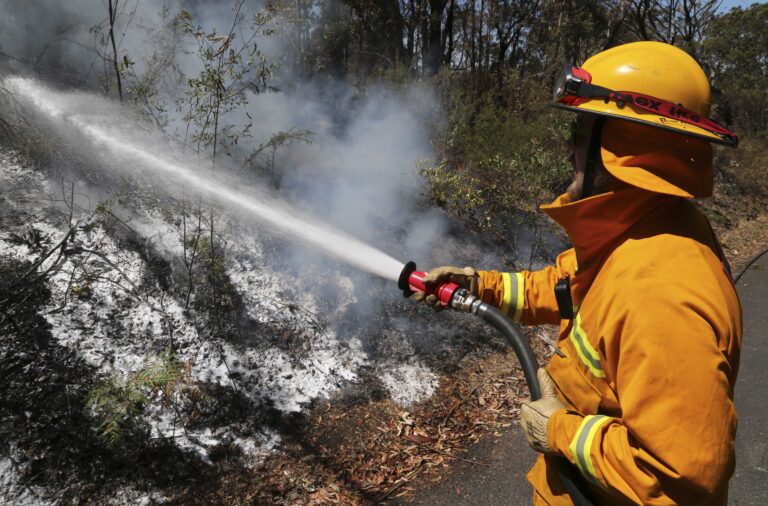
File - A firefighter sprays foam on smoldering bush to help reduce re-flash fires after a blaze swept through Faulcombridge, 53 miles west of Sydney, in Australia Thursday, Oct. 24, 2013. (AP Photo/Rob Griffith)
This story is part of the WHYY News Climate Desk, bringing you news and solutions for our changing region.
From the Poconos to the Jersey Shore to the mouth of the Delaware Bay, what do you want to know about climate change? What would you like us to cover? Get in touch.
Thousands of residents living near military bases in Delaware drank contaminated tap water for years, unaware they were ingesting toxic PFAS chemicals that are now linked to serious health problems.
Firefighters used foam containing so-called “forever chemicals” for decades in training exercises and to extinguish petroleum fires, including at military bases in New Castle and Dover. From there, PFAS ran off the runways and tarmac, seeping into local drinking water supplies.
At the time, emergency responders did not know about the potential dangers of PFAS, which can stay in the environment and in human bodies for years. Today, residents who live near the New Castle Air National Guard Base have high levels of PFAS in their blood, and millions of dollars were spent to remove the chemicals from the municipal water supply.
Delaware lawmakers hope to reduce people’s exposure to PFAS after Gov. Matt Meyer last month signed legislation banning firefighting foam that contains the toxic PFAS.
“We have a legacy of a lot of chemical contamination in Delaware, and PFAS is one of the contaminants that’s of concern,” said state Rep. Frank Burns, D-Newark, the bill’s sponsor. “One of the things we need to do is stop adding it to the environment, and that was why this legislation was important to get through, because when it’s used it ends up in the water.”
PFAS, which refers to hundreds of different compounds, are widely used in consumer products such as nonstick cookware and waterproof clothing. They have been linked to serious health problems, including some cancers, thyroid disease, developmental delays in children and other health conditions.
Health concerns have sparked numerous lawsuits against chemical manufacturers like DuPont, alleging that companies knew about the dangers of PFAS for decades without warning the public or environmental regulators.
Why was PFAS used in firefighting foam at Delaware airbases?
Aqueous film-forming foam, or AFFF, is one of the most effective fire-suppressing foams because it not only smothers fires but is also fuel-resistant.
“It prevents vapors from escaping, it creates a blanket over whatever is burning and smothers the fire. Using water would spread the fire and water doesn’t always penetrate,” said John Adams, president of the International Association of Firefighters Local 4417, which represents career firefighters and EMTs in New Castle County.
Primarily used for extinguishing liquid fuel fires, AFFF has been most frequently discharged at military bases and airports during practice drills and emergencies such as aircraft fires.
Related Content

Anglers warned to not eat PFAS contaminated fish from the Wissahickon watershed
Environmental regulators found high levels of PFAS chemicals in fish tissue sampled from the Wissahickon Creek and its tributaries.
3 days ago
Listen 1:04How firefighters and first responders were exposed to PFAS
Adams said when he became a firefighter about 40 years ago in Massachusetts, AFFF was the mainstay for putting out gasoline and oil-based fires, as well as forest fires. At the time, he was unaware of the dangers. After putting out a fire, firefighters were often directly exposed to the foam, Adams said.
“The foam’s on the hose,” he said. “You’re picking up the hose, not always having your firefighting gloves on. The firefighting gloves get soaked, so it’s already soaked through the gloves and into your skin.”
The foam was also left to contaminate the environment and potentially nearby water supplies.
“It runs off into the environment, runs off into street drains, and at the time, nobody knew that it was going to be a big issue,” Adams said.
The U.S. Department of Defense has already begun phasing out AFFF, and at least 16 states have banned its usage and several more have restricted the foam.
The legislation in Delaware bans firefighting foam beginning January 2028. However, every local fire department in the state, as well as the New Castle and Dover military bases, has exchanged their AFFF foam for an alternative to prepare for the state ban, said Chad Ingram, deputy director of the Delaware State Fire School. Ingram, who led the initiative, said firefighters now use a protein-based PFAS-free foam.
“Obviously, one of our chief concerns was we want to make sure that we are switching, No. 1 to a safe alternative, but we want to make sure that it’s still an effective alternative,” he said.
The PFAS-free foam is not as effective as AFFF, meaning emergency responders must apply more foam to extinguish fires. Ingram said firefighters typically applied another blanket of AFFF after 15 to 30 minutes. The new foam must be reapplied after about five to seven minutes, he said.
However, firefighters say they are willing to make the change to protect drinking water supplies and themselves. Cancer is the top cause of line-of-duty deaths among firefighters, and exposure to PFAS increases their risk.
“Our No. 1 priority is safety,” Ingram said. “We want to make sure that every single first responder in this state is safe. If this is one thing that we can do to make those folks that risk so much for us every day to be a little bit safer, this is a win-win.”
Firefighters are also exposed to PFAS when they wear personal protective gear. The Delaware legislation now requires companies that manufacture firefighting gear to include warning labels about PFAS. Ingram said it’s crucial that fire departments acquire toxic-free gear that also protects against fires and other hazards.
“Today, a firefighter may not use foam more than once or twice in their entire career, but they’re going to put that fire gear on, that PPE on, multiple times a day,” Ingram said. “I wanna make sure that we are equipping our first responders with the best quality materials, and as things continue to evolve, I just want to make sure that the new PFAS-free gear that’s coming out is encapsulating that firefighter as much as what we currently have.”
The legislation exempts the Delaware City Refinery from the ban for no more than 13 years and requires the facility to report each time it uses AFFF.

Get daily updates from WHYY News!
WHYY is your source for fact-based, in-depth journalism and information. As a nonprofit organization, we rely on financial support from readers like you. Please give today.
Part of the series
EPA announces rollback of climate pollution rules for power plants
The announcement is the latest in a back-and-forth between Democratic and Republican administrations over whether or not to limit power plants’ greenhouse gas pollution.
4 weeks ago

Pennsylvania’s first congressional race pits five-term incumbent Republican Brian Fitzpatrick against Democratic County Commissioner Bob Harvie.
1 month ago
Listen 1:15
Delaware lawmakers approve regulations for toxic PFAS chemicals
Regulations demanding Delaware water providers test for PFAS would take effect a year before federal requirements.
1 year ago
Listen 1:14