

Sen. McCormick, NIH director tour Penn medical sciences laboratory amid NIH funding crisis
The visit comes as questions swirl around the future of NIH funding. Sen. Dave McCormick said he would oppose any new cuts.
Listen 1:32
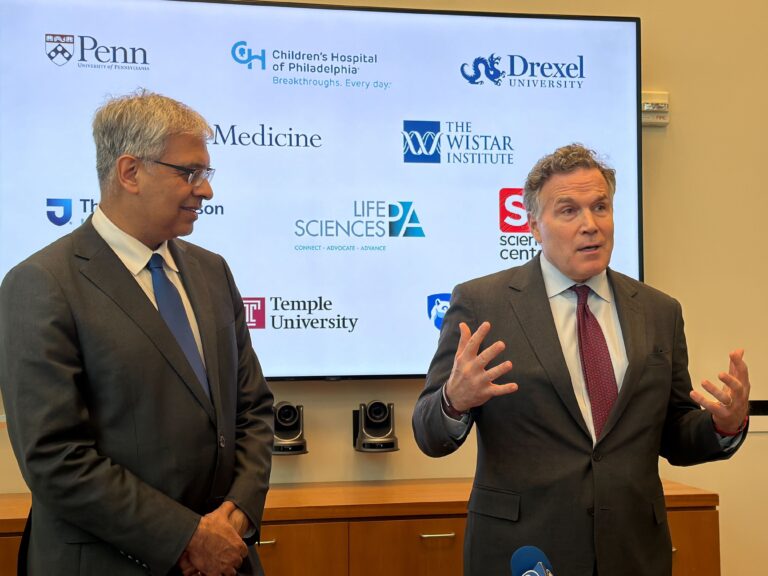
NIH director Jay Bhattacharya (left) listens as Sen. Dave McCormick, R-Pa., gives his reactions to new medical research after a tour of University of Pennsylvania's Perelman Center for Advanced Medicine Penn. (Carmen Russell-Sluchansky/WHYY)
From Philly and the Pa. suburbs to South Jersey and Delaware, what would you like WHYY News to cover? Let us know!
U.S. Sen. Dave McCormick, R-Pa., joined National Institutes of Health Director Dr. Jay Bhattacharya on Tuesday for a tour of Penn Medicine’s Perelman Center for Advanced Medicine, highlighting the role of federal research funding in developing new treatments and supporting Pennsylvania’s life sciences economy.
The visit included meetings with researchers, clinicians and industry leaders across Philadelphia’s biomedical sector.
McCormick and Bhattacharya also visited a CAR-T cell therapy laboratory at Penn, where they met with Dr. Carl June to discuss advances in personalized cancer treatment. The approach involves engineering a patient’s own immune cells to target and destroy cancer — a breakthrough pioneered at the university. They also heard from patients and families about the real-world impact of these innovations.
McCormick called it “remarkable.”
“When we look back on our parents or our grandparents, they died of a variety of things, many of which will not exist hopefully in our lifetimes because of the discovery made right here at Penn Medicine,” he said.
Bhattacharya said that he was impressed by his two-day tour of Pennsylvania’s medical research industry, which included a stop in Pittsburgh the day before.
“We met stroke victims who now have the real possibility of regaining their ability to walk and to use their arms again,” he said. “We met patients who are having their vision restored. And here we met patients who have been given a second lease on life from deadly cancer.”
The visit underscored the role of early federal research funding in laying the groundwork for those very cell and gene therapies. Statewide, Pennsylvania ranks among the top recipients of NIH funding, with billions of dollars supporting tens of thousands of research jobs and generating significant economic activity. According to information provided by the senator’s office, Pennsylvania ranks as the fourth largest recipient of NIH funding in the nation, receiving $2.27 billion last year. That support created more than 21,000 research jobs and generates $5.31 billion in annual economic activity.
“It’s a huge benefit to Pennsylvania and a benefit to the country that Pennsylvania is a big recipient of NIH funding,” McCormick said. “The impact to Pennsylvania is about $2.60 GDP of economic activity for every dollar of NIH funding we get. So it’s a real driver of innovation, but even more importantly, it’s saving lives in an incredible way because we have these remarkable institutions.”
Related Content

Iran war protesters in Philadelphia target McCormick, Fetterman, demanding end to conflict
Demonstrators said they are concerned about the human and financial costs of war overseas while Americans struggle at home.
2 weeks ago
Listen 1:08The future of NIH funding
The visit also comes as questions swirl around the future of NIH funding. A recent report indicated the president may propose a 20% reduction to the agency’s budget in 2027, though the White House has disputed that.
Tuesday, McCormick said he would oppose any new cuts, pointing to Congress’ recent move to increase NIH funding by 2% this fiscal year.
“I will be a strong advocate of maintaining and increasing NIH funding and reforming NIH, as the director has laid out, in a way that makes sure that those dollars have the highest impact for the country and for Pennsylvania,” he said.
A broader proposal to cut NIH funding by roughly 40% last year was ultimately rejected by Congress, with some Republicans, including McCormick, pushing back against that.
“I don’t agree with what the policy has been on this,” he said at the time. “We should probably increase the funding for NIH, not lessen it.”
During the press conference, Bhattacharya noted that NIH funding actually increased by 1% last year. However, some researchers have noted that the increase was less than inflation and increasing lab costs. Recent data suggests that gap and uncertainty among labs have already significantly impacted the research landscape.
An analysis by the American Association of Universities of NIH data found that the agency issued 66% fewer grant awards through February of fiscal year 2026 than during that same period in the prior three years. The monetary value of those awards has also declined by 54%. A national survey of scientists reported by STAT found that disruptions to NIH funding have led some labs to delay experiments, scale back projects and lay off researchers.
Bhattacharya said he expected that the “upheaval” was behind them and that the agency worked to “get all of the money out” to the “excellent science” done by “brilliant scientists.”
“And we achieved that,” he said. “This year, we’re a little bit behind things, so the government shut down, but we’re going to do the same thing. I’m fully confident that we will be able to identify excellent science. We get 100,000 proposals a year. The job is to find the 10,000 or so we have to fund.”
However, Dr. Ezekiel Emanuel, an oncologist who serves as vice provost for global initiatives at the University of Pennsylvania and chair of the Department of Medical Ethics and Health Policy, says that the situation is still causing too much uncertainty, which is turning away researchers.
“The most talented people have choices in their life,” he said, “They have choices of, I could go into biomedical research or I could do something else, go into finance, go into AI.”
Emanuel applauded McCormick’s pushing back against the president but added that Republican immigration policies are doing more damage to the talent pipeline.
“I absolutely admire the senator and I think his standing up as a Republican for biomedical research, for its importance, is absolutely pivotal,” he said. But “one of the things which has been great about the United States is year after year, we pull from all over the world. To stay the best in the world, you have to recruit the best in the world and we’ve told the rest of the world, ‘We don’t want you. Don’t come.’”

Never miss a moment with the WHYY Listen App!


WHYY is your source for fact-based, in-depth journalism and information. As a nonprofit organization, we rely on financial support from readers like you. Please give today.

Trump turns to critic of COVID mandates to run NIH
Early in the pandemic, Dr. Jay Bhattacharya, a Stanford health researcher, argued against lockdowns and focusing on people at highest risk.
1 year ago

Democrat Bob Casey concedes to Republican David McCormick in Pennsylvania Senate contest
A statewide recount is showing no signs of closing the gap and Casey's campaign has suffered repeated blows in court.
1 year ago

Court to Pa. counties: Stop counting misdated mail-in ballots, again
The Pennsylvania Supreme Court issued the latest — and likely final — ruling in the legal fight over mail-in ballots that may impact the results of the U.S. Senate election.
1 year ago
Listen 1:03