

A gastrointestinal illness outbreak hits a South Jersey elementary school. Public health experts urge caution ahead of the holidays
Cases are more common in the winter as people spend more time indoors and in settings like schools, long-term care facilities and daycares.
Listen 1:14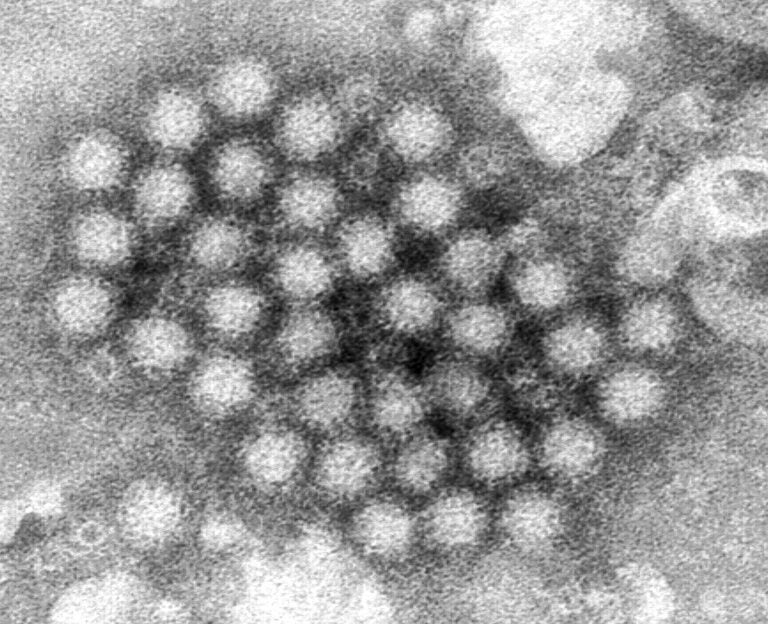
This electron microscope image provided by the Centers for Disease Control and Prevention shows a cluster of norovirus virions. (Charles D. Humphrey/CDC via AP)
From Philly and the Pa. suburbs to South Jersey and Delaware, what would you like WHYY News to cover? Let us know!
A recent outbreak of gastrointestinal illness at a South Jersey school has public health experts urging people to take precautions this winter and ahead of the holidays to avoid additional infections.
Camden County officials did not confirm the name of the school, but the outbreak is taking place at Central Elementary School in Haddonfield, according to a CBS report.
The exact number of affected students is unknown, but county officials say the school has reported an “unusual increase” in children with nausea, vomiting and other symptoms since Dec. 10.
The scope of the outbreak grew Friday when the school reported an uptick in illnesses to the county’s Department of Health and Human Services.
“Gastrointestinal illnesses can be highly contagious, so it is essential that families are aware of the signs and symptoms,” Virginia Betteridge, the department’s commissioner liaison, said in a statement.
Symptoms of gastrointestinal illness can also include diarrhea, stomach cramps, fever and fatigue. While most people can manage it and recover at home, others including young children, seniors and those with weakened immune symptoms are at risk of dehydration and other complications.
Gastrointestinal illnesses are typically caused by bacteria, parasites or viruses like norovirus, which can survive on high-touch surfaces like doorhandles, keyboards, phones and countertops for days or even weeks.
The risk of outbreaks in the winter and during holidays
Cases and outbreaks are more common in the winter as people spend more time indoors and in settings like schools, long-term care facilities and daycares, said Caryelle Lasher, director of the county’s Department of Health and Human Services.
Infections caused by norovirus usually spread when people come into contact with fecal matter and then ingest microscopic particles on their hands, on cups or utensils, or in food.
“And that can happen from people not washing their hands well or it can be spread through things contaminated by vomit,” she said. “That’s where we see these really quick spreading, intense outbreaks because it takes so little to make people sick.”
Schools are especially susceptible for outbreaks, Lasher said, “with young children who may not know to do a really thorough frequent hand washing after the use of the bathroom or before eating or preparing food.”
Related Content
These new 2026 health care laws are taking effect in Pa., N.J. and Del.
Bills on diagnostic breast cancer testing, GLP-1 medications, lead paint and breastfeeding were signed into law.
4 months ago
Children can then take the virus home and spread illness to more family members. This is a concern especially as people prepare to host holiday gatherings or events in the coming weeks, Lasher said.
People may not know that they can continue to spread norovirus for a short time even after they begin to feel better.
“Especially around the holiday season where we’re getting together and having gatherings where people are going to be sharing things like restrooms, which is a higher risk setting, or preparing food for large groups of people, they might still be shedding virus,” she said.
Anyone recovering from symptoms of gastrointestinal illness should wait until they are symptom-free for at least 48 hours before going back to school, work or social settings, Lasher said.
Cleaning protocols and surveillance efforts to identify new threats
The county health department is working with the affected local school district to enhance cleaning and sanitizing activities, including identifying any specific classrooms or areas with a higher concentration of ill students.
“So, if there’s a certain wing or class or group that has been affected more so than the rest, we’re going to really focus on some of the items that impact that group,” Lasher said.
At home, families will want to make sure that their cleaning supplies are effective against viruses like norovirus, which can be resistant to products that lack bleach, she said.
The county’s public health team partners with local health systems and other agencies to collect emergency room data and other surveillance information that can help catch outbreaks earlier and faster, Lasher said.
Those efforts also go into identifying new public health threats, she said, including new variants of known viruses like norovirus that could cause new symptoms or deepen the severity of illness.
“There’s always something new coming,” she said. “We just need to be prepared for it and work together to make sure we’re able to respond quickly.”

Get daily updates from WHYY News!
WHYY is your source for fact-based, in-depth journalism and information. As a nonprofit organization, we rely on financial support from readers like you. Please give today.
Virtua Health’s Hospital at Home program provides 24/7 monitoring and health care at home for stabilized patients, but the federal waiver program is set to expire on Jan. 30.
4 months ago
Listen 1:23
New South Jersey clinic opens to bridge health care gaps for people leaving jails and prisons
The Omega Physicians health clinic in Medford, New Jersey, provides primary care and specialty services like psychiatry and addiction treatment.
1 year ago
Listen 1:08
A contagious stomach bug is circulating in the Northeast. Here are the symptoms
The area currently has the highest positivity rate for norovirus, which causes vomiting, diarrhea and stomach cramps.
2 years ago