

‘Directly enslaving at least 26 people’: New report details Caesar Rodney’s slaveholding amid debate over statue’s fate
Wilmington took down the bronze memorial to the long-revered signer of the Declaration of Independence during racial unrest in 2020.
Listen 2:11
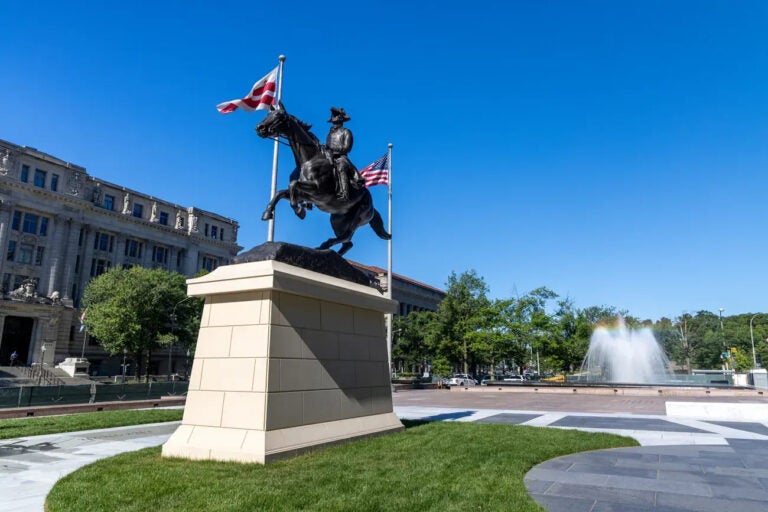
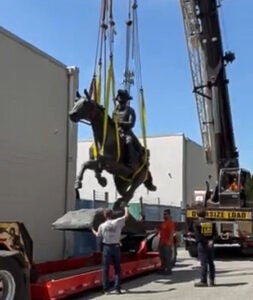
Caesar Rodney's statue is now in Washington, D.C.'s Freedom Plaza but its future is uncertain. (National Park Service)
What are journalists missing from the state of Delaware? What would you most like WHYY News to cover? Let us know.
The Black men, women and children who Delaware statesman Caesar Rodney owned had been aggravating him in the spring of 1776.
“From their past vile misbehavior they have no right to expect any favour or partiallity for them at my hands,” the plantation owner wrote to his brother after some of the enslaved people were worried they would be sold and their families torn apart.
Rodney, a wealthy lawmaker and militia leader, and future president of the Delaware colony, added in the letter that he’d “lost almost all affection or feeling for them.”
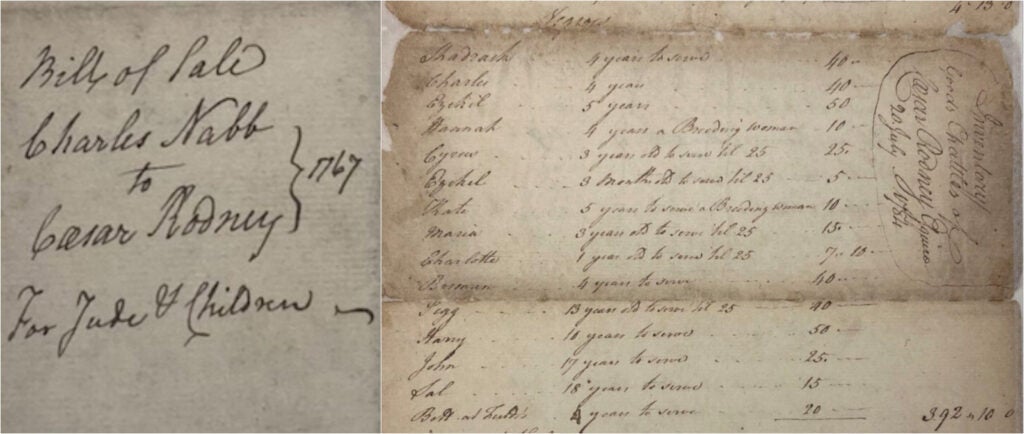
Three months later, that same man, who enslaved at least 26 Black people during his lifetime, signed the Declaration of Independence, whose foundational phrase and most memorable assertion was that “all men are created equal.”
Such was the contradiction at the heart of Rodney’s legacy. He has been lionized as a patriot and memorialized by a marble sculpture in the U.S. Capitol, but his wealth was derived from slave labor, according to a report the city of Wilmington released this week as Americans were concluding the country’s 250th birthday festivities.
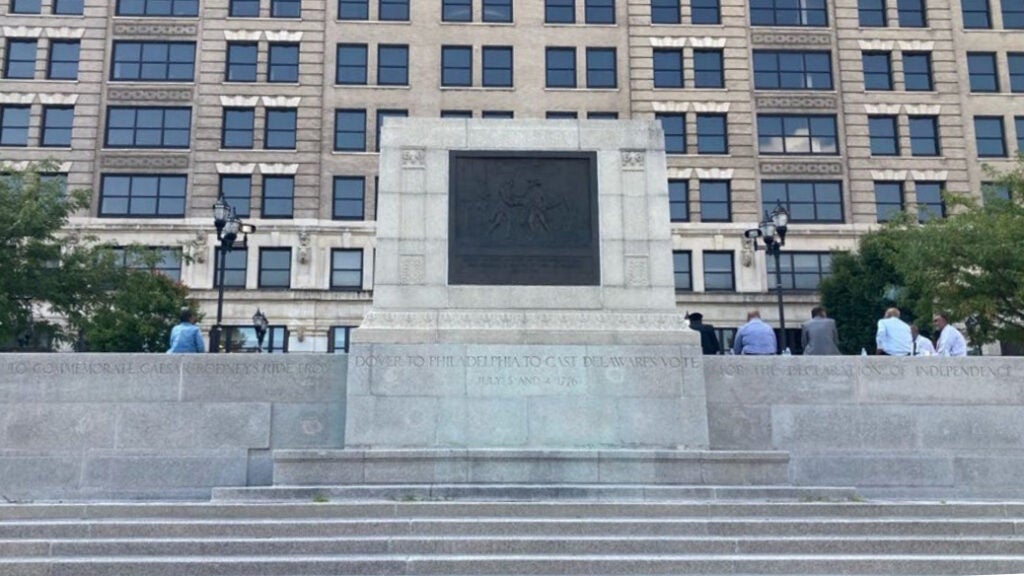
Late former Wilmington Mayor Mike Purzycki commissioned the report in 2024, nearly four years after he ordered downtown’s most iconic landmark — a towering bronze statue depicting Rodney riding his horse to Philadelphia to vote for freedom from Great Britain — taken down and put in protective storage.
Purzycki and other city leaders feared the statue could be damaged in the wake of racial unrest that engulfed Wilmington and other cities in June 2020 after a white Minneapolis police officer killed George Floyd, who was Black, during an arrest. Many protests targeted monuments to Confederate leaders and those who held people in slavery.
Purzycki made the move amid protesters’ complaints that Rodney was a major slaveholder — like fellow Founding Fathers George Washington, Thomas Jefferson and others — whose less-than-honorable practices had been whitewashed by the mythmakers of American history.
The decision elicited support but also criticism, even at the highest levels of the U.S. government. In October 2020, President Donald Trump pushed back with a proclamation for Rodney’s 292nd birthday that “the empty pedestal in Rodney Square in Wilmington is the end result of an extreme anti-American historical revisionism.”
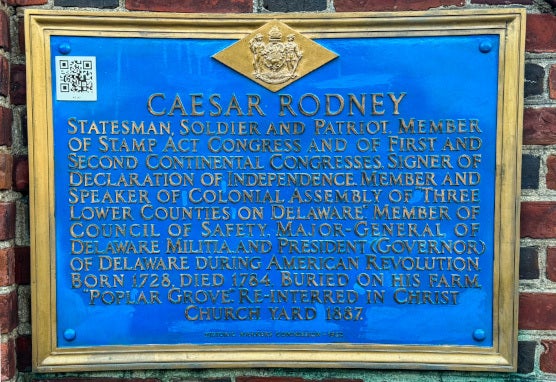
With opinions so varied on the subject, Purzycki also pledged to foster “an overdue discussion about the public display of historical figures and events.” Neither the city’s Rodney statue, Caesar Rodney High School nor citations in the state’s Historical Markers Program acknowledges Rodney’s slaveholding.
The mayor never moved the statue out of storage or convened the community conversation, but he and city planners envisioned a research project into Rodney’s ownership of human beings. In January 2024, Wilmington City Council approved a state grant to begin the $40,000 study. The city also paid part of the tab.
The aim was to “answer questions that might prove critical to any productive future public discourse about the statue, the man, and how to foreground the persons enslaved by Caesar Rodney,” the report says.
Purzycki, who left office in January 2025 and was succeeded by then-Gov. John Carney, died in May from leukemia. Carney’s office released the report Monday.
“The project revealed that Caesar Rodney, public servant, patriot, and advocate for the freedom to self-govern, participated in and benefited from a slaveholding society, directly enslaving at least 26 people in his lifetime, including children and families,” the report concluded.
“The frequently cited number of 200 persons enslaved by Rodney could not be documented by available primary sources. Also, the recent debate about Caesar Rodney as an abolitionist is not supported by primary documents nor by respected contemporary historians who have examined this notion over the past 30 years,” the report continued.
The report also identified the 26 people directly enslaved by Rodney by name, and counted 54 more owned by his parents, siblings, guardian and other close relatives, but said it’s likely there were more enslaved people who could not be traced.
The report was released just days after Rodney’s statue took center stage at a dedication ceremony for the renovated Freedom Plaza in Washington, D.C. The statue was taken out of storage and shipped to the nation’s capital in April for a six-month stay in advance of this year’s semiquincentennial celebrations.
Where will the statue of Caesar Rodney end up? Here's the video of it being taken out of storage in Delaware in April for a six-month stay in D.C.'s Freedom Plaza. pic.twitter.com/9S7wrtfHZS
— Cris Barrish (@BarrishCris) July 8, 2026
Beyond that timetable, the statue’s fate is uncertain.
Cerron Cade, Carney’s chief of staff, told lawmakers in a letter two weeks ago that Wilmington is currently in discussions with state and Kent County officials about moving the statue to Dover, the state capital.
“Relocating the statue to Dover — Rodney’s home community — during the 250th anniversary of his famous ride presents a meaningful opportunity to preserve this monument while ensuring it is interpreted in a setting that reflects the full complexity of his life and legacy,” Cade wrote.
Rodney bought mother, two children and two horses in 1767 deal
The report was prepared by Debra Martin, the city’s historic preservation planner, and public history consultant Nicole Belolan, who earned her master’s and doctoral degrees from the University of Delaware.
They combed through Rodney’s papers and other historical archives to paint what Martin calls an “honest” portrait of his slaveholding that stands in stark counterpoint with the romanticized version that has been perpetuated in history books and public spaces.

Rodney was born into an affluent slaveholding family whose vast plantation southeast of Dover covered nearly 850 acres — about 1.3 square miles.
The report notes that Rodney was 17 in 1745 when his father died and left him two enslaved people, Doll and Glasco, but likely there were others working on the plantation.
The first purchase tied directly to Rodney occurred 22 years later, when the 39-year-old Rodney ran the plantation and was also a member of Delaware’s colonial assembly, a militia commander and a lower court judge.
It was December 1767, when Rodney bought a woman named Jude and her two children — 5-year-old Ezekiel and an unidentified child whose age was also unknown — from a Maryland man who had recently moved to Kent County.
The purchase, for 150 British pounds, also included two black horses, the report said.
“Whether they wanted to be relocated or not is unknown. But their current and future enslavers did not give them an option,” the report said.
Ironically, that same year, Rodney proposed legislation to ban further importation of slaves into Delaware, but the bill was defeated 9-7.
Martin and Belolan suggested in interviews with WHYY News, however, that the motive for the proposed ban may have been economic in nature — to protect the value of people owned by Rodney and other slaveholders in Delaware.
“As much as we could find from much more contemporary people who were writing about this, it was an economic argument,” Martin said. “The people of Kent County, who did have an excess of enslaved persons, wanted to be able to keep their prices high. New Castle County was growing with farms and had a shortage of labor and wanted to obtain enslaved persons to work their land at bargain prices. So it just never passed because it was an economic argument.”
‘He was not an abolitionist’
The report pointed out that Rodney didn’t seek to abolish slavery itself — just the importation of more people from Africa for sale.
“Caesar Rodney enslaved people during his lifetime. He believed in and depended on slavery and enslavement for his livelihood,” the report said. “He was not an abolitionist who believed in what historian Peter Kolchin defined as ‘immediate and unconditional freeing of all slaves.’”
As for Jude and her two sons, it’s likely they “worked on one of Rodney’s farms or inside his home” until his death in 1784, at age 55, the report said.
His direct slaveholdings over his lifetime also included 23 other people, according to his will, a list his brother Thomas kept, and other letters, ledgers and bills of sale the researchers found.
Belolan said she found no evidence in Rodney’s writings or other documents that he had warm feelings for the enslaved people who worked his farm, where he primarily grew wheat and barley.
By the time Rodney died, Pennsylvania, Connecticut and Rhode Island had passed gradual abolition laws.
The reports noted that in the months prior to his death, Rodney sold a woman named Joice and her son Charles, but decreed under a legal process known as “manumission” that she must remain enslaved for four years and Charles to be kept enslaved until he turned 25.
In the process, Rodney also separated Joice from her children, Salle and Pegg.
Caesar Rodney also sold three others — Aron, Absolem and a person his brother referred to as a “very young child” — with the provision that they remain enslaved for several more years.
He did free some people “immediately” upon his death, but others on his plantation had to wait years for their freedom, the report said.
“We may never know why precisely Rodney chose to gradually manumit most of the people he enslaved,” the report said. “Perhaps it was a rational or at least not unexpected act within the context of the Enlightenment tendency to question racist and violent institutions such as slavery. That said, his separating a least one family calls into question the depth and nature of his interest in what enslaved people were entitled to.”
Related Content
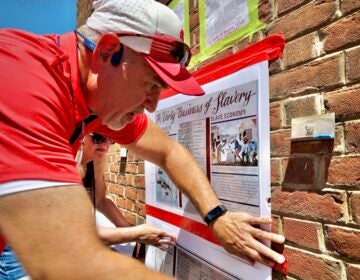
The exhibit remains half-restored as local leaders consider their next moves after a federal appeals court ruled in favor of the Trump administration.
2 months ago
Listen 1:25‘Understanding people’s full lives is more interesting’
The report raises questions about Rodney’s legacy and what should become of the statue that once loomed high over the downtown Wilmington public square that bears his name.
It also raises questions about what Americans should make of founders whose advocacy for liberty existed alongside their participation in slavery.
Belolan said that, for better or worse, such scrutiny gives a clearer picture of a person.
“This has been done for other white founders like him throughout the country who don’t have a super high profile and others who do have higher profiles,” she said. “I just think that the mythologizing is something we have to understand but we also need to understand how complicated their lives were in the past.”
“Also because it makes people more interesting. It makes the past way more interesting. Understanding people’s full characters and their lives is more interesting and helps us understand each other better too,” she added.
Martin agreed, saying Rodney was a complicated human — “like we all are. He’s a patriot, but he had beliefs that I don’t share. He’s a patriot and an enslaver.”
State Sen. Eric Buckson, R-Dover, who spearheaded the effort that landed the Rodney sculpture in Washington, D.C., in April and wants it to settle in Kent County, said the report simply tells what researchers found.
“There’s no way to make sense of this in 2026,” Buckson said. “There was a debate on if he owned 200 slaves and the factual data says that he doesn’t, but what if he only owned one? Would that make it okay? It wouldn’t. In 2026, it doesn’t make it okay.
“So I don’t want to run away from that at all. It’s difficult to comprehend the term ‘chattel’ and what that actually means and to think about a plantation and what that means, but you’ve got two options: You can run to the truth and tell it and talk about it. Or you can hide from it.”
Could statue’s future be in Kent County, or Washington, D.C.?
Buckson would prefer that Delaware officials decide to relocate the statue to the grassy mall across from Dover’s Legislative Hall. If that fails, he suggested the historic Dickinson plantation near where Rodney lived and enslaved people.
“If he comes back to Delaware, then there’s a greater conversation that needs to be had about displaying a statue of Caesar Rodney and how you include the full story,” Buckson said. “Slave ownership and all the way up through the ride [to Philadelphia] and anything in between.”
Should relocating the statue to Delaware not become feasible, Buckson said that it would look just fine where it is now — on Freedom Plaza in the nation’s capital.
“It’s potentially a display that could become permanent,” said Buckson, who attended last week’s dedication with a handful of other Delaware officials. “It might be an excellent option if we can’t get Delaware on board with where to locate him.”
Belolan said Delawareans and their political leaders must decide what’s best for the statue, and hopes her report helps them better understand Rodney himself.
“One of the things I’d want them to take away is that the founding generation is more than just the Caesar Rodneys,” she said. “It’s also all the people he enslaved — Charles, Peg, Betty, Boseman, Hannah — and then all the people his family enslaved.
“It’s a great thing that we are expanding the story, because if we don’t know the full scope of our history, I don’t think there’s any chance that we will shape a better future. And if we don’t know how complicated people were in the past, there’s no way we’re going to be able to talk to each other today to work for that better future.”

Get daily updates from WHYY News!
WHYY is your source for fact-based, in-depth journalism and information. As a nonprofit organization, we rely on financial support from readers like you. Please give today.
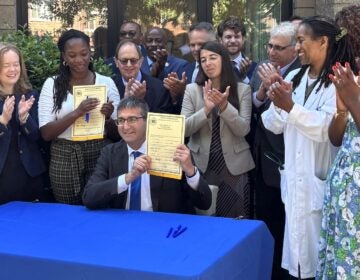
Delaware bans private equity hospital purchases, expands health care access
Senate Majority Leader Bryan Townsend says his legislation phases in price caps on hospitals and strengthens primary care access.
1 month ago
Listen 0:57
The effort includes multilingual resources outlining what to do if approached by federal agents, including the right to remain silent, refuse searches and ask for a lawyer.
5 months ago
Listen 0:59
Mike Houghton was a former Delaware Economic and Financial Advisory Council chairman and longtime member before being fired Wednesday.
5 months ago