

Report: Amtrak has little to do with NJ Transit’s reliability
The nonpartisan Garden State Initiative found that NJ Transit’s reliability has more to do with asset management.
Listen 1:09
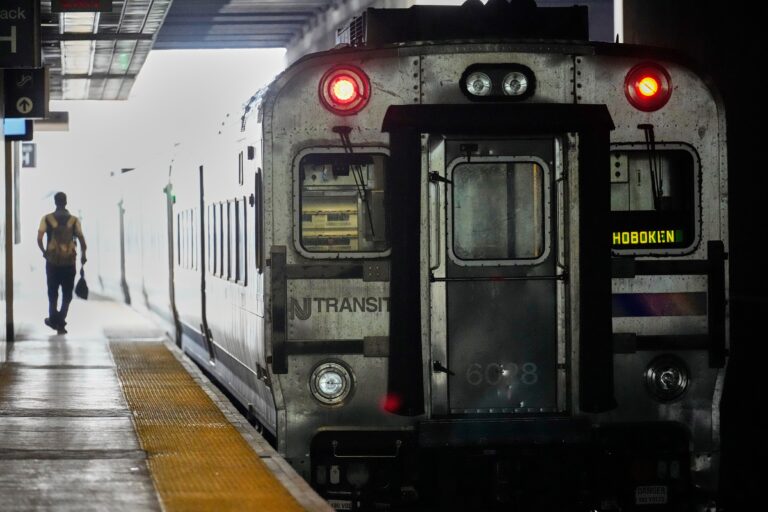
An NJ Transit train leaves the Secaucus Junction station in Secaucus, N.J., Wednesday, May 14, 2025. (AP Photo/Seth Wenig)
From Camden and Cherry Hill to Trenton and the Jersey Shore, what about life in New Jersey do you want WHYY News to cover? Let us know.
A report has found that NJ Transit’s reliability has little to do with Amtrak and that a bigger budget has not translated into a more consistent service.
The report from Garden State Initiative, a nonpartisan public policy research group, found that disruptions from Amtrak — which is responsible for the train signals, tracks and electrical infrastructure on the Northeast Corridor used by NJ Transit — have no relationship with NJ Transit’s reliability.
Danielle Zanzalari, a contributor to the Garden State Initiative who authored the report, said Amtrak’s faults are limited to “on-time performance measures.” But when it comes to the failure of the equipment, that is within the state agency’s control.
“We are not seeing Amtrak really to blame for that,” said Zanzalari, who is also an associate economics professor at Seton Hall University. “Just intuitively, it’s really about maintenance, replacement, the fleet assets, the age of [these] assets or any part of the rail car.”
A spokesperson for NJ Transit told WHYY News that the agency has not reviewed the report.
Reliability of NJ Transit declines as budget has increased
The report uses publicly available data from NJ Transit and compares it to other train services that serve the New York City area, due to the similarities in the carriers.
It found that although the agency’s operating budget increased from $2.39 billion in 2020 to $2.86 billion in 2024, service reliability deteriorated based on the number of miles a rail car travels before it fails.
When compared to Metro-North Railroad, which services passengers between New York and Connecticut, and the Long Island Railroad, NJ Transit rail cars travel the fewest miles between mechanical problems. In 2020, rail cars traveled roughly 89,000 miles between failures. By 2024, that distance had fallen to 55,000 miles, according to the report.
The data examined included the number of equipment failures and the general reasons, but more specific information about breakdowns is not disclosed.
Related Content
New Jersey American Water rates to increase by $4 per month on average
The new water rate will help the investor-owned utility pay for water and wastewater projects.
1 month ago
Listen 1:17How to make NJ Transit more reliable now
Metro-North, Boston’s Massachusetts Bay Transportation Authority and the Virginia Department of Rail and Public Transportation are examples the report uses to offer recommendations for NJ Transit. Those recommendations include basing investments on performance and not simply increasing appropriations, and using asset condition data to prioritize maintenance and replacement before reliability deteriorates.
Zanzalari suggests the agency develop an asset management system, similar to other rail systems, if they do not have one internally.
She added that the agency needs to be more transparent.
“This is not something that should seem obscure,” Zanzalari said. “Have some transparency, tell us all the issues that are going on, have some preventive maintenance scheduled, have some sort of targets that we’re aiming for and do it, and then report back to the public and tell us why it’s done or it’s not done.”
NJ Transit adopted a $3.5 billion budget for fiscal year 2027, the largest spending plan in its 47-year history.
A spokesperson for Gov. Mikie Sherrill said the administration is “committed to making NJ Transit more reliable, accountable and responsive” to riders, which includes “being honest about the challenges, whether they are within NJ Transit or created by Amtrak, facing the agency.”
“Executive Order 16, signed within the Governor’s first three months in office, has already driven direct action to improve NJ Transit operations, technology, and customer experience,” said governor spokesperson Isabella Creatura in a statement.
The first set of 374 new multilevel rail cars were delivered earlier this year. It has not been announced when they will go into service.

Get daily updates from WHYY News!
WHYY is your source for fact-based, in-depth journalism and information. As a nonprofit organization, we rely on financial support from readers like you. Please give today.
A railroad passengers group says the executive order does not get to the root of the problems causing delays and cancellations.
6 months ago
Listen 1:14
Judge orders Trump administration to restore funding for rail tunnel between New York and New Jersey
The Trump administration had halted $16 billion for the project, citing concerns about unconstitutional spending.
9 months ago
New Jersey Transit plans 15% fare increase starting on July 1
New Jersey Transit has been struggling with a significant drop in ridership since the COVID-19 pandemic began in early 2020.
3 years ago