West Philadelphia man shares his journey from poverty to Wall Street in bestselling book
Robinson, who now owns a real-estate business in Philadelphia, said his story is an example of “community-made” success.
Listen 2:16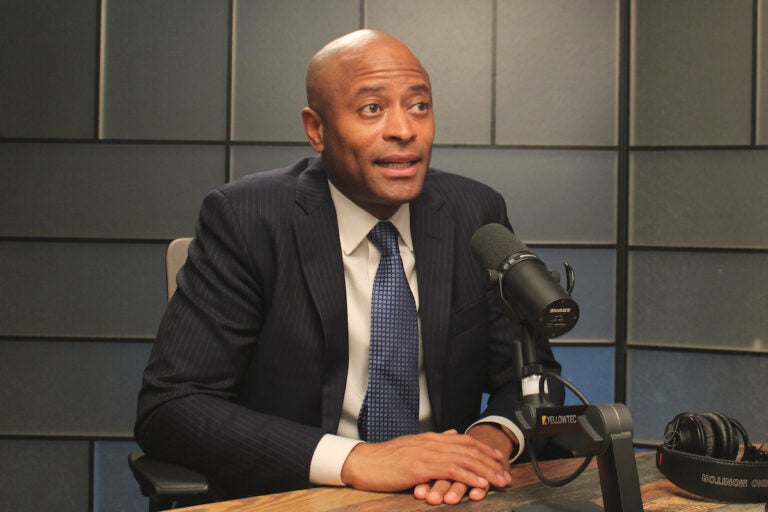
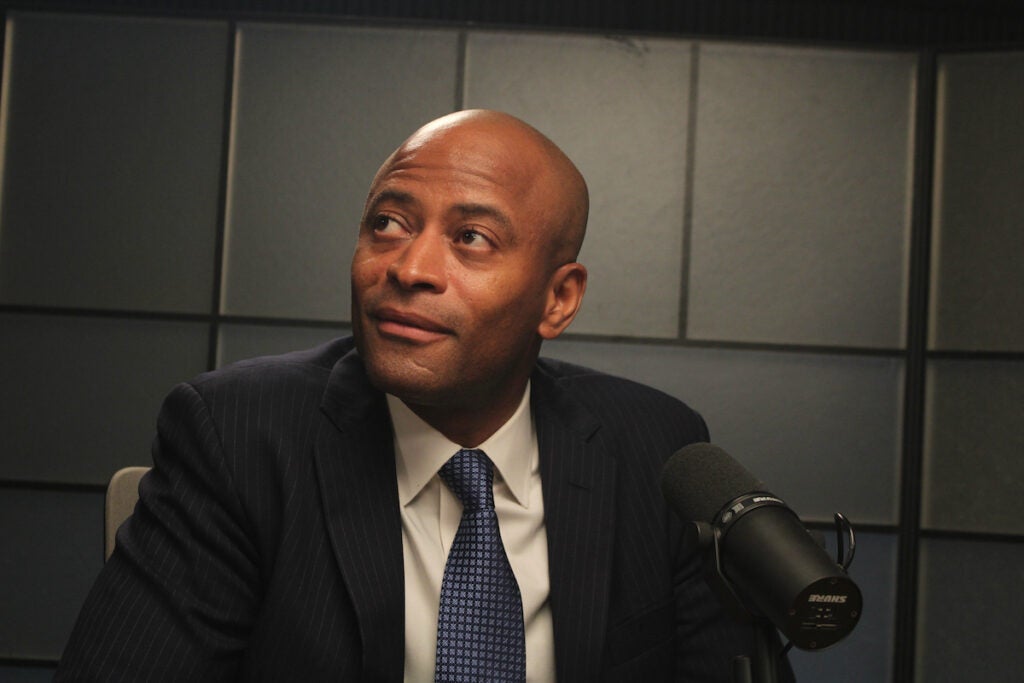
Kevin "KAYR" Robinson spoke with WHYY News about his bestselling debut book, “Can’t Break Me: How I Shifted My Mindset and Overcame the Odds,” co-authored with Elijah Anderson, a professor of sociology and African American studies at Yale University. (Emily Neil/WHYY)
From Delco to Chesco and Montco to Bucks, what about life in Philly’s suburbs do you want WHYY News to cover? Let us know!
Kevin “KAYR” Robinson took in the crowded room on an evening in May, at an event hosted by Philadelphia Young Playwrights, to celebrate the release of his bestselling debut book, “Can’t Break Me: How I Shifted My Mindset and Overcame the Odds.”
The book, which includes insights shaped by Elijah Anderson, a professor of sociology and African American studies at Yale University, was ranked No. 87 on USA Today’s Best-selling Booklist a month after its May 12 publication.
It was a “magical experience,” Robinson later told WHYY News, to see many of his loved ones and mentors — his “board of directors,” as he refers to them — gathered together to celebrate his story of achieving financial success on Wall Street after growing up in poverty in West Philadelphia.
One of those mentors, Robinson’s high school English teacher, Dina Portnoy, introduced Robinson by touting his writing and his personal accomplishments. But his story is also about forging networks of support, she said.
“[The book is] also about the way a community around him supported him, and the ways in which he found sustenance wherever he was,” Portnoy said.
‘It’s okay to be vulnerable’
Robinson was born in Philadelphia and grew up in “deep, abject poverty,” he said. He and his siblings, mother, and stepfather “moved around constantly,” he told WHYY News during a recent interview.
“We lived in North Philadelphia in a studio apartment, and we had a hot plate, no stove,” Robinson said. “We had a bathroom sheet, no bathroom door. We had a bathtub, no shower. 15 people competing for space with rats, roaches and flies in one bed.”
Robinson said he started drinking alcohol and smoking marijuana in fourth grade. But by the time he got to eighth grade, something changed.
Robinson’s stepfather urged him to achieve more.
“‘You don’t want to be like me,’” Robinson recalled his stepfather telling him. “You don’t want to be like some of your siblings. Do you really want to live on top of each other? And you got to do homework before the lights go off, because sometimes we don’t have electricity.’”
“Because he planted the seed, I decided to water it,” Robinson continued.
In his book, Robinson said he explains how he then shifted his mindset with discipline and long-term thinking to “go from survival to structure to stability, not just financially, but mentally and emotionally.”
That mindset shift is based on what Robinson calls the “three Ds”⸺ desire, discipline and determination.
Desire was the spark to start studying and doing well in school, he said, and explore other opportunities for learning. Discipline he cultivated through connecting with people who could support him.
“I found mentors to teach me how to become disciplined, where you have routines and ways of doing things, so that when the clapping stops, you keep doing it,” he said. “When no one else is cheering you on, you keep doing it.”
And when he inevitably was met with setbacks, Robinson said that he had to tap into and strengthen his determination.
In order to build a network of support, Robinson said that he had to “realize that nobody was coming to save me, that there was no blueprint, and no one was giving me answers.”
He “had to come to the realization that it’s okay to be vulnerable,” Robinson said, and he started asking for help.
“If I don’t know what discipline is, I want someone to teach me,” he said. “If I don’t know what multiplication is, I want to get a math tutor. And so, I think that is how you get unstuck, and you may actually have to go get professional therapy, you might have to get professional therapists or a minister, or what have you, but you have to start tackling those little things.”
Anderson, who provided feedback on the book, was also one of Robinson’s mentors.
Robinson was just 14 years old when the pair met through a program at University of Pennsylvania, where Anderson was teaching at the time. While there, Robinson participated in community projects and visited the campus. The exposure to higher education allowed him to imagine attending college, Robinson said.
“Once you see these new environments, you just start to learn from them, and you think that anything is possible,” he said. “And so, I think that early on having mentors like that really helped me start to say, ‘You know what? I can change what I’m doing.’”
Anderson said that he met Robinson at a pivotal time for the then-teenager.
“Back on the streets, school and doing well in school didn’t get you very much, in terms of the community,” Anderson said. “A lot of young people who did that were seen as square, and KAYR at 14 was kind of betwixt and between these worlds, and he and other young men joined us.”
Related Content
South Jersey woman turns health scare into dream bookstore in Bordentown
Austen’s Shelf is opening a permanent New Jersey bookstore as readers increasingly seek independent bookstores centered on community and connection.
2 months ago
Anderson said he often invited other Black leaders in business, academia and medicine to share their stories with KAYR and the other teenagers in the group.
“The idea was to make a connection between what they were doing at that moment in school and how school could pay off for them,” Anderson said. “In other words, we reinforced the idea of moving in the right direction.”
After changing his friends and seeking out nurturing environments, Robinson said he started seeing the effects.
At University City High School, Robinson became class president, captained the debate team and graduated as the valedictorian. He won a full scholarship to attend Bowdoin College in Maine, where he majored in history and started a journey that would lead to working as an investment banker on Wall Street.
‘Community-made’ success
In his memoir, Robinson describes how he built up his resume by securing internships and being accepted to the prestigious Tuck Business Bridge Program at Dartmouth College in New Hampshire. His mentors at Bowdoin College and in the companies where he worked supported him in securing a job at Goldman Sachs after graduation.
From there, Robinson worked at a hedge fund and ultimately left investment banking to start his own real estate company in Philadelphia.
All the while, Robinson continued to travel to Philadelphia to support his family members there, who were reeling from the sudden death of his sister. He supported his siblings and nieces and nephews financially, and helped take care of his sister’s four children after her death.
Robinson said the story he details in his memoir shows how he was able to continue to pursue success and support his family members, even while dealing with grief and hardships.
“I wrote my book, ‘Can’t Break Me,’ as a promise to myself and to anyone who have gone through loss, or feel stuck, or feel as though they’re being counted out ⸺ I wanted to just stress that your past may explain what happened to you, but do not, do not, whatever you do, do not let it define your future,” he said.
Now, Robinson has grown his real estate business, which started with one property in Cobbs Creek in 2009, to more than 100 rental units — and he has brought his family members on board to teach them real estate and build what he calls “transformational wealth.”
“I want people to shift the way they think and embrace the idea that we are community-made, and that if we want the world to change, don’t treat people the way you’re being treated, treat them better,” he said. “If we have more people treating others better, we all will live in a better society.”
Robinson said he also is looking now to build his legacy, and support future generations — including his own nieces and nephews, some of whom were at his book signing event in May.
“It inspires them to let them know it is possible that where you start in life does not determine where you end,” he said.
And young people are responding to that message, Robinson said, recalling a conversation with a teenager after a recent talk at Mercy Community Center in Philadelphia.
“He said, ‘You really think I can change my life? I’m in 10th grade, and I get Fs and Ds,’” Robinson said. “I said ‘Yes, and here is my information. Contact me once a week, and I’ll help you get through this.’ Because sometimes you just need someone to be present, someone to listen to you, and let you know, ‘Hey, look, I can see myself in you.’”
Robinson’s own journey continues by staying curious and being eager to pass on his knowledge and support, he said.
“I am not self-made, I’m community-made,” he said. “My community poured into me, created opportunities for me, opened doors for me, and I [will] never forget that. So the way I pay it forward is by realizing that I need to help other people. It’s not just about myself, and so that’s what keeps me wanting to learn more, wanting to be better, wanting to be healthy, to live longer.”
Editor’s note: This article has been updated to clarify Elijah Anderson’s role in shaping Kevin Robinson’s book.
-
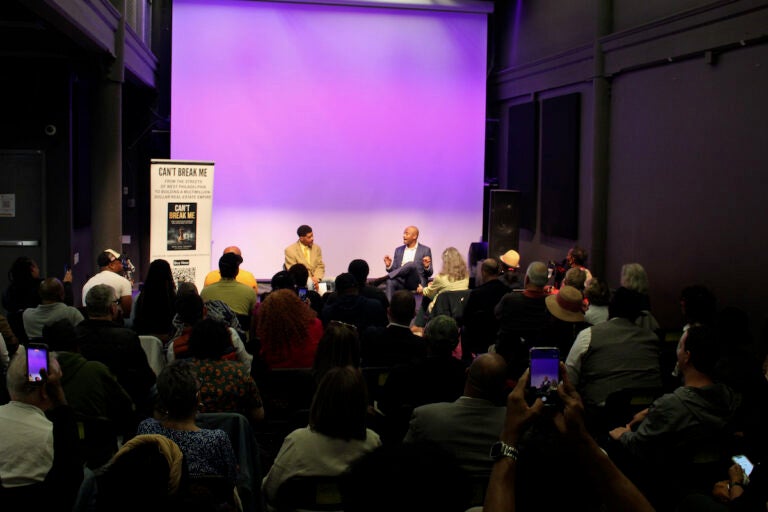
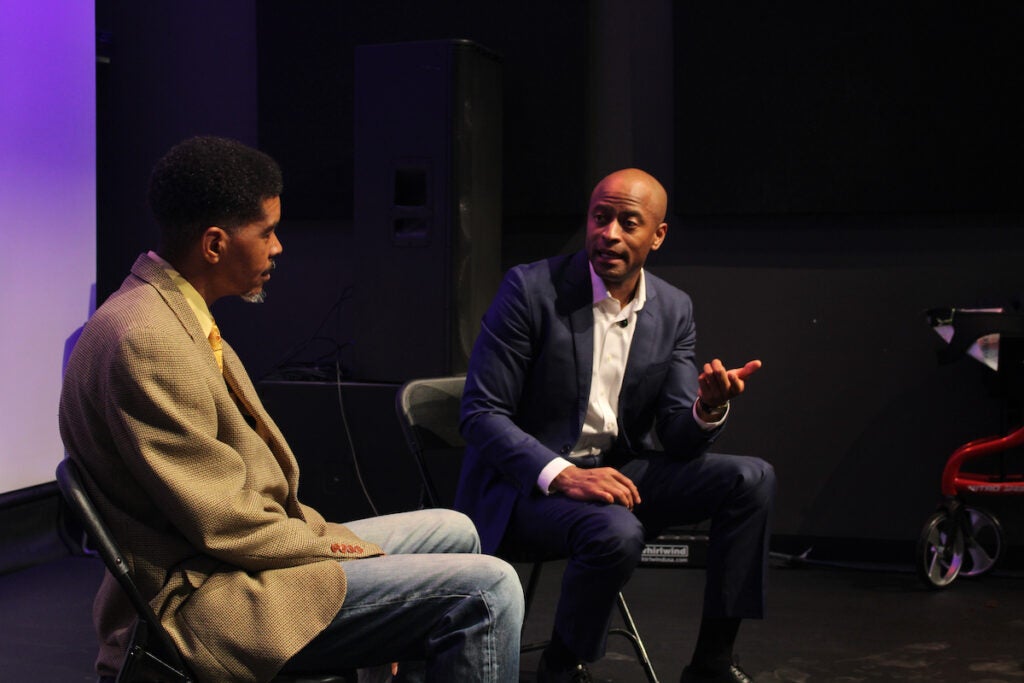
Kevin "KAYR" Robinson, right, talks about his bestselling memoir, "Can't Break Me," with author and journalist Omar Tyree, left, at a book-signing event hosted by Philadelphia Young Playwrights in Center City, Philadelphia, on May 13, 2026. (Emily Neil/WHYY) -
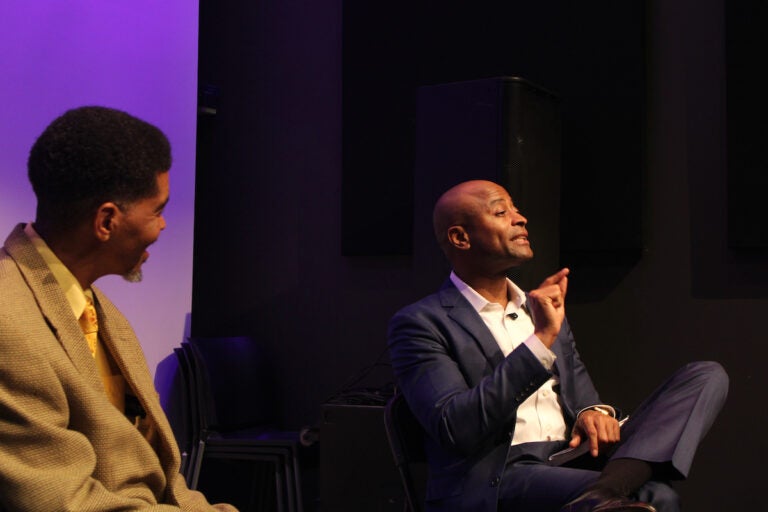
Kevin "KAYR" Robinson, right, talks about his bestselling memoir, "Can't Break Me," with author and journalist Omar Tyree, left, at a book-signing event hosted by Philadelphia Young Playwrights in Center City, Philadelphia, on May 13, 2026. (Emily Neil/WHYY) -
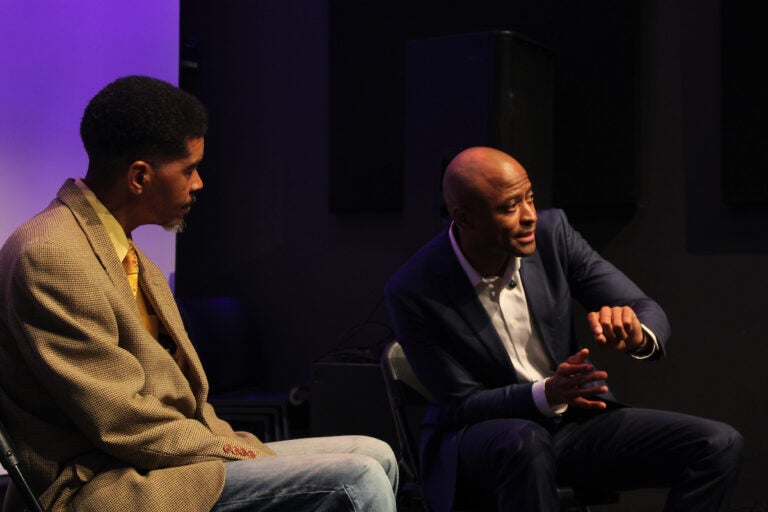
Kevin "KAYR" Robinson, right, talks about his bestselling memoir, "Can't Break Me," with author and journalist Omar Tyree, left, at a book-signing event hosted by Philadelphia Young Playwrights in Center City, Philadelphia, on May 13, 2026. (Emily Neil/WHYY) -
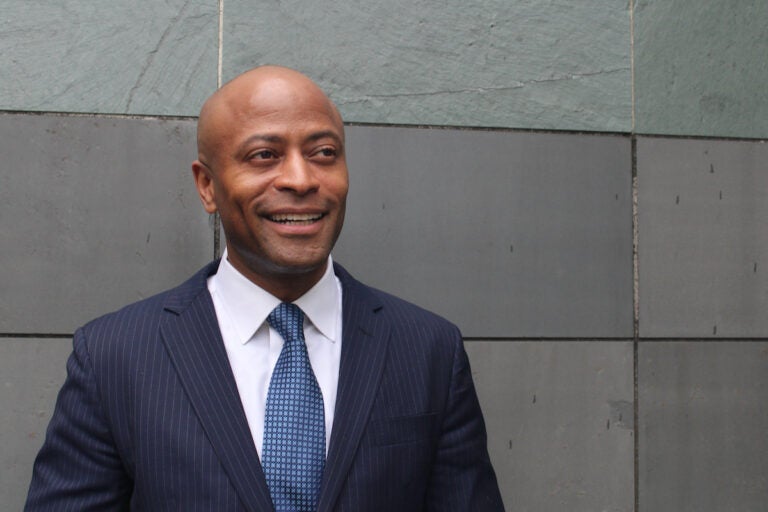
Kevin "KAYR" Robinson spoke with WHYY News about his bestselling debut book, “Can’t Break Me: How I Shifted My Mindset and Overcame the Odds,” co-authored with Elijah Anderson, a professor of sociology and African American studies at Yale University. (Emily Neil/WHYY)

Get daily updates from WHYY News!
WHYY is your source for fact-based, in-depth journalism and information. As a nonprofit organization, we rely on financial support from readers like you. Please give today.

The first Latina Supreme Court justice spoke with WHYY’s Cherri Gregg and answered fan-submitted questions throughout the event.
11 months ago
Listen 1:19
Hayden, both the first woman and first Black person to head the Library of Congress, was fired by President Donald Trump in May.
1 year ago
Listen 1:17
From Dolly Parton to MrBeast, James Patterson is always learning
One of the best-selling authors of all time sat down with Terry Gross for an onstage interview as WHYY gave him its annual Lifelong Learning Award.
1 year ago
Listen 1:35