

Should governments regulate unhealthy food like tobacco? Some Penn researchers say yes
This comes as more researchers, and even some lawyers and public officials, are comparing the harmful effects of ultra-processed food and tobacco.
Listen 2:57
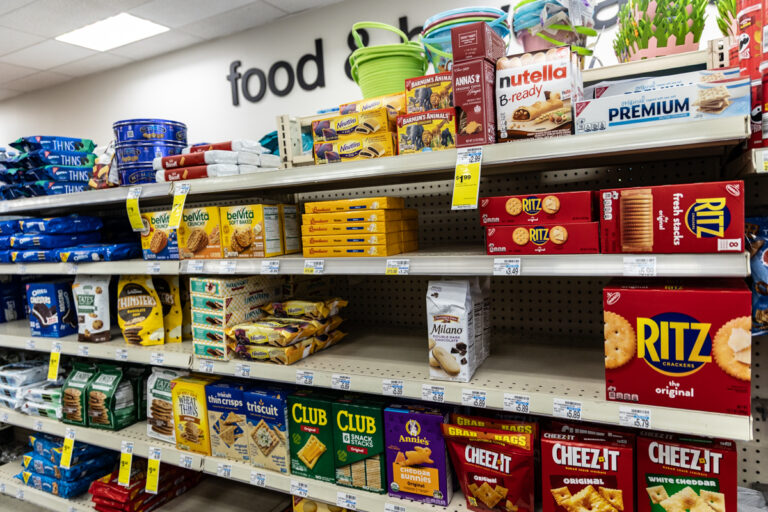
A CVS Pharmacy snack asile in Philadelphia (Kimberly Paynter/WHYY)
From Philly and the Pa. suburbs to South Jersey and Delaware, what would you like WHYY News to cover? Let us know!
Ultra-processed foods like chips, candy or cereal have come under a lot of scrutiny lately for their impact on people’s health. Two food policy researchers at the University of Pennsylvania argue that these products should be regulated like tobacco. They join a growing group of policy makers and researchers voicing grave concern about these foods.
“For tobacco, governments implemented this suite of complementary policies that worked together to reduce smoking prevalence and to improve health,” said Alyssa Moran, a policy researcher at the University of Pennsylvania’s Center for Food and Nutrition Policy. “And that’s exactly what we need for ultra-processed foods.”
Moran is one of the authors of the recent commentary for Journal of the American Medical Association Health Forum, a journal run by the American Medical Association.
“It’s unlikely that any single policy is going to make a meaningful dent in curbing disease or changing the quality of our diets. We really need this complementary suite of policies that work hand in hand to reduce exposure and reduce consumption,” she said.
Moran acknowledged that it feels normal to have access to ultra-processed food, but pointed out that people used to feel the same way about cigarettes.
“If you went into a hospital, doctors were smoking in the hallways and volunteers were distributing cigarettes to patients at the bedside,” she said. “This was like during my lifetime that this happened. And now we think about that as being just absolutely crazy.”
The most recent dietary guidelines from the Department of Health and Human Services also warn people to avoid highly processed food.
Some places already regulate ultra-processed foods. Philadelphia has had a tax on soda and other sugary drinks since 2017. Last year, California passed a law that requires schools to phase out ultra-processed food from lunches.
Some of these arguments are reaching courtrooms across the country. Last year, a Philadelphia judge ruled against a local teenager with diabetes and nonalcoholic fatty liver disease who had sued major food companies like Kraft and Coca-Cola. The judge ruled that he could not connect specific food products to his conditions. However, San Francisco’s city attorney also sued the same food companies, arguing these companies know their food make people sick but sell them anyway.
Related Content
Coca-Cola and a Secret Research Operation Meant to Exonerate Sugar
Coca-Cola’s rise to global brand domination, and how the company influenced our habits and perceptions along the way.
Air Date: October 28, 2025
Listen 28:52Food and nutrition researchers have long pointed out similarities between ultra-processed food and tobacco, said Christina Roberto, a health policy researcher at the University of Pennsylvania and co-author of the article arguing for regulating these foods like tobacco.
“Many of us have looked at the successes that tobacco control has achieved in an aspirational kind of way, like, well, maybe we could do something similar with food. But we felt like now was a good time to write the article we wrote because there’s so much conversation and attention focusing on ultra-processed foods right now,” she said.
In a statement, the Consumer Brands Association, which represents food companies, said that scientists do not agree on what is an ultra-processed food, and that the U.S. has “one of the safest and most highly regulated food systems in the world.”
Moran said there is a common framework that scientists use to identify different types of food: whole foods like fruit and vegetables, processed ingredients used for cooking like butter and salt, food that is processed for safety and preservation like cheese and canned food, and ultra-processed food like chips, soda and candy.
Policy ideas that change the food environment, such as limiting where stores can display ultra-processed foods, could also make a difference, said David Sarwer, a longtime obesity researcher and director of the Center for Obesity Research and Education at Temple University.
“From my perspective as a behaviorist, I think the idea of the placement of foods is really, really important,” he said. “This has been an issue that we’ve talked about in obesity interventions for a long, long time and I do think that stronger legislation around where foods can be placed, so we minimize that exposure, could actually be very, very helpful, not only I think for adults, but also for children.”
He added that other countries have more robust food policies to address obesity. The U.K. recently banned advertising for unhealthy foods online and on TV before 9 p.m. The U.K., France, Finland and Norway also all tax companies that sell sugary drinks.
On the other hand, Sarwer said there are still questions about how effective such policies are. He pointed out Philadelphia has had a soda tax for almost a decade now, but “we haven’t necessarily seen a robust body of evidence that said that it’s led to the improvement of the health and well-being of Philadelphians.”
“It may be unrealistic to think that in only 10 years, we would see an impact downstream on the health and well-being of people who live in Philadelphia. I hope … we get to that point where we see that evidence, but we’re not there quite yet,” he said.

Get daily updates from WHYY News!
WHYY is your source for fact-based, in-depth journalism and information. As a nonprofit organization, we rely on financial support from readers like you. Please give today.

Penn’s new living organ donor center aims to close gaps in transplant access
A majority of organ transplants are still done with deceased organ donations, but living organ donations can last longer.
4 years ago
Listen 1:18
CHOP, Penn Med collaborate to address children’s environmental health
A new regional center will develop programs to address asthma, lead and chemical exposure, and air pollution in Philadelphia and Chester.
5 years ago

Rise in telemedicine during the pandemic eliminated a historic racial health gap, study says
A Penn study shows pandemic-era telehealth eliminated inequity in the rate of Black patients making it to primary care appointments after hospitalization.
5 years ago