

Road salt remains in Pa., N.J. and Del. waterways months after winter storms, according to new data
Road salt applied during winter storms runs off into the groundwater and emerges in surface water streams months later. Advocates say roads can be made safe with less salt.
Listen 1:19
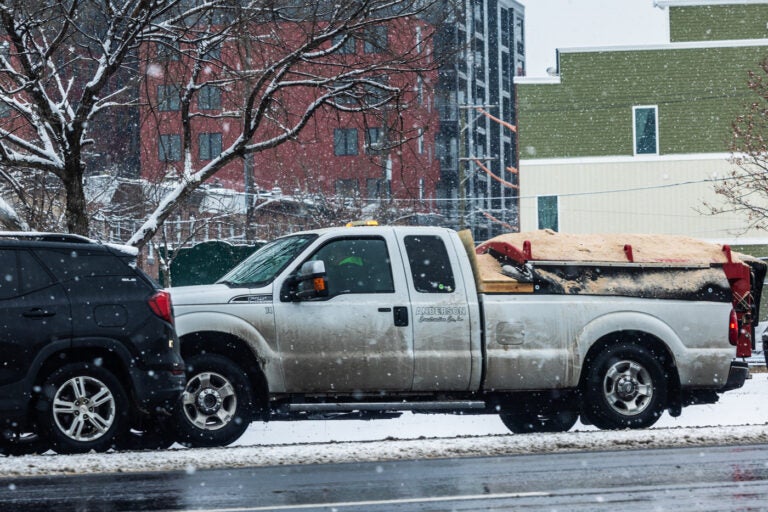
FILE - A truck laid salt on Philadelphia roads during a winter storm Jan. 6, 2025. (Kimberly Paynter/WHYY)
This story is part of the WHYY News Climate Desk, bringing you news and solutions for our changing region.
From the Poconos to the Jersey Shore to the mouth of the Delaware Bay, what do you want to know about climate change? What would you like us to cover? Get in touch.
Road salt used last winter, and possibly decades ago, is still contaminating waterways across the region. In many cases, the levels exceed federal standards for maintaining healthy aquatic life and safe drinking water, according to a recent citizen-science survey.
During the first two weeks of October, hundreds of volunteers fanned out across the region to test salt levels in 1,200 locations, mostly small streams. Led by Stroud Water Research Center, the citizen scientists, from dozens of partner groups, wanted to know how much of the road salt spread during past winter storms remains months, or even years later.
The results were stark. Of more than 700 locations sampled, 61% exceeded aquatic life thresholds set by the Environmental Protection Agency. Sixty-four “hotspots” had levels greater than 230 milligrams per liter, a guideline set by the EPA at which water begins to taste salty. Sixty percent of samples blew past the accepted healthy drinking water standard for those on a low-salt diet of 50 milligrams per liter.
The nationwide effort was coordinated locally by the Stroud Center in Chester County. Known as the “Fall Salt Snapshot,” it marked the first time this type of data was collected during several weeks in October, rather than the annual winter salt snapshot conducted in January. The winter snapshot has revealed some local waterways that were twice as salty as seawater.
“We’re addicted to what road salt gives us,” said John Jackson, a senior scientist at Stroud. “It’s cheap and it really makes it possible to drive fast and safely in the winter.”
But Jackson said environmental and health costs have not been part of the conversation.
“If we continue to use road salt at the rate we’re using it, then every winter we’re going to take freshwater out of the ground as a normal cycle and replace that fresh water with saltwater. That’s what we’ve been doing for 50 years. That’s why our streams are salty in July and August, September, October, November, December, before we ever apply any more salt.”
The amount of road salt used each year in the U.S. has doubled since 1975, according to Penn State, resulting in a current annual estimated use of 15-32 million metric tons of road salt.
Pennsylvania’s streams are often fed by groundwater more than rain water, making them vulnerable to damage by salt that has run off and accumulated in aquifers.
That salt depletes the oxygen in the waterways, which affects aquatic life, especially the insects that provide food for fish, like mayflies, stoneflies and caddisflies, said John Barbis, a board member of Valley Forge Trout Unlimited, which participated in the project.
“Most people perceive that when salt is applied to the road during a snowstorm or an ice storm, rain comes in, washes it down into the stream, and then that’s rushed out to a bigger stream, and then down to the ocean, and it disappears,” Barbis said.
“That’s only part of the story. What may be the bigger part of the story is that a lot of that salt gets deposited on the ground, and when the rain washes it, not necessarily into the stream but into puddles and other areas, and then that salt-laden water can soak into the earth, it now seeps down into the groundwater.”
Months, years or even decades later, that salty ground water will feed small streams.
Barbis pointed to data from some streams in the Exton area that are near large shopping centers.
“Those areas have salt concentrations that are probably three to four times above what we would normally expect from regular groundwater,” Barbis said.
Both Jackson and Barbis say their groups don’t advocate for the elimination of road salt.
“Because we need to get around, we need the roads safe after a snowstorm,” Barbis said. “But there are ways of applying salt, applying brine to the roads, doing it in a very judicious way, where we can limit how much salt is then transferred to the groundwater and then to the stream.”
Related Content

After first major snow of the season, Philly hunkers down for dangerously cold and icy conditions
While the snow has passed, high winds and below-freezing temps will create potentially dangerous conditions the next few days.
2 months ago
How to reduce the use of road salt
Jackson said there are ways to limit the use of road salt and maintain safety on the roads. He said both Maryland and New Hampshire have programs designed to reduce the use of salt, or use brine instead, which lessens the amount of salt that washes off into the groundwater. New Hampshire also has a program that provides limited liability protection from personal injury lawsuits if a company completes a certification program on how to use less salt.
“People are just terrified of being sued, so we have some private business owners who oversalt,” said Ryan Neuman, conservation director for the Tookany/Tacony-Frankford Watershed Partnership, which also participated in collecting data for the Fall Salt Snapshot.
Neuman said education regarding what is the correct amount of salt to use in order to keep the roads safe is important.
“It’s investments in new technologies and convincing people to use new technologies, which isn’t always the easiest thing to do,” Neuman said.
Porous pavement can also help reduce the amount of ice that collects on roadways and parking lots.
Jackson, with the Stroud Center, said roadways in the Adirondacks are now cleared with “live edge” plows, which conform to uneven surfaces and help reduce the amount of salt used.
Pennsylvania lawmakers are considering a new bill that would require PennDot and the Department of Environmental Protection to develop best practices for salting roadways, similar to Maryland’s protocols. Sponsored by Montgomery County State Rep. Joe Webster, the memo said salt also damages infrastructure by about $5 billion a year.
“The number I use is $100 worth of road salt causes about $3,000 in damage to the public infrastructure and to private-property vehicles,” Jackson said.
Jackson said one of the main goals of the project is to educate the participants, who then spread their results by word of mouth.
“It opens some people’s eyes,” Jackson said. “We still have a lot more to do on that front because there’s no one to blame. It’s gonna be a lot of individual choices by individual municipalities, individual landowners and people who are gonna have to start talking about this before we can really make a change.”

Get daily updates from WHYY News!
WHYY is your source for fact-based, in-depth journalism and information. As a nonprofit organization, we rely on financial support from readers like you. Please give today.
Part of the series
The remnants of Hurricane Ida caused millions of dollars in damage to homes and led to the deaths of four people in Bucks and Montgomery counties.
2 months ago
Listen 1:17
Breaking the Pa. budget impasse hinged on ditching a major climate initiative
The Regional Greenhouse Gas Initiative would have put a price on carbon. Opposed by Republicans, it was sacrificed by Democrats to get the budget deal done.
4 months ago
Chester County compressor station could be expanded under plans for revived pipeline project
Williams’ Northeast Supply Enhancement pipeline project would mean 10 miles of pipeline in Lancaster County and an expanded compressor station in Chester County.
4 months ago
Listen 1:19