
N.J. Gov. Sherrill wants to freeze rate hikes. Here’s what that means for your electricity bills
New Jersey customers’ electric bills increased by as much as 20% last summer. They could rise again this year.
Listen 1:04
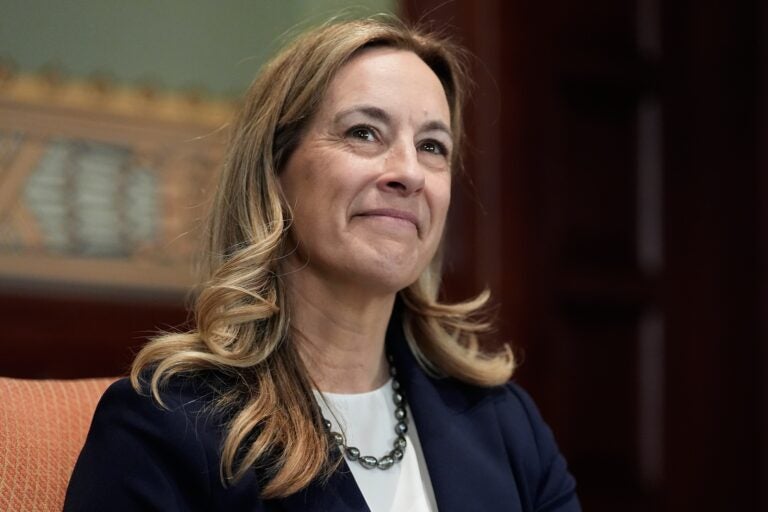
FILE - New Jersey Gov.-elect Mikie Sherrill attends a photo opportunity in the governor's office in Trenton, N.J., Wednesday, Nov. 5, 2025. (AP Photo/Seth Wenig)
From Camden and Cherry Hill to Trenton and the Jersey Shore, what about life in New Jersey do you want WHYY News to cover? Let us know.
New Jersey Gov. Mikie Sherrill says the state is in the middle of an electricity affordability emergency.
Between June 2023 and June 2025, the average electricity price for a New Jersey household rose by more than a third, according to Sherrill’s office. Without “serious intervention,” her executive order reads, prices will keep rising at an “extraordinary” pace.
“The current cost of electricity has reached the point of crisis for many residents and families, and requires bold action,” the order reads.
In the first of two orders meant to stem rising electricity bills, Sherrill directed state utility regulators to give all utility customers credits on their bills this year, consider slowing the pace of utility rate hikes and look for longer-term reforms that could reshape New Jersey’s energy system.
“[It’s] all about staunching the bleeding and giving ratepayers some short-term relief,” said Abe Silverman, an energy consultant and research scholar at Johns Hopkins University who previously worked as general counsel at the New Jersey Board of Public Utilities.
Related Content
N.J. Gov. Mikie Sherrill issues state of emergency on energy costs: Here’s what to know
Sherrill ordered state regulators to boost renewables and natural gas in light of rising electricity prices.
8 months ago
Listen 1:06What does Sherrill’s order mean for your electric bills?
The most obvious way Sherrill’s executive order will impact households’ electric bills is through credits that should appear on customers’ bills by July 1, similar to the $100 in credits state regulators issued last year.
Sherrill’s credits are intended to offset any increases to the cost of the electricity supply that will kick in this June.
Supply charges make up roughly half of a typical customer’s bill, Silverman said, and are determined by regional market forces, rather than state regulators. These charges reflect all the costs of supplying energy on the grid, including the cost of producing the electricity itself and the regional grid operator’s costs of ensuring that electricity generators will produce enough power to meet peak demand in the future, known as capacity costs. Capacity costs have recently spiked, in part due to electricity demand from data centers.
Supply prices change for New Jersey customers each June. This year’s price will be finalized after an auction next month, said Brian Lipman, director of the New Jersey Division of Rate Counsel. Lipman expects it will stay roughly flat or increase slightly.
Either way, the credits outlined in Sherrill’s order “should keep your bill flat,” Lipman said.
But if electricity supply prices spike unexpectedly, it’s possible that the Board of Public Utilities will not have enough funding available to offset them, Silverman said. Sherrill’s order directs the board to use similar funding to what the board used last year: proceeds from the Regional Greenhouse Gas Initiative cap-and-trade program and solar alternative compliance payments that are paid by electricity suppliers that don’t meet the state’s renewable energy standard.
Related Content

New Jersey lawmaker proposes surcharge on data centers using a lot of electricity
Assemblywoman Andrea Katz is sponsoring a bill that would impose a surcharge on data centers and use the money to modernize the region’s electrical grid.
11 months ago
Listen 0:52The state could pause electric distribution rate hikes — but it’s not clear how long that would last
In addition to supply charges, which utilities pass along to consumers without earning a profit, utilities charge customers for delivering electricity to their homes and building and maintaining grid infrastructure.
Since this is where the profit lies and utilities are afforded a monopoly, the companies have to periodically ask the Board of Public Utilities for permission to increase these delivery rates. Sherrill’s order directs the board to consider pausing these proceedings.
The board is currently considering a request from Rockland Electric Company in North Jersey to raise the typical household’s monthly bill by as much as $29. A spokesperson for the board did not answer questions about whether and for how long it plans to pause cases like this one by press time.
“The [Board of Public Utilities] often has a clock on which they have to act,” Silverman said. “It’s very difficult for them to just sit there and hold these [proceedings] in abeyance, but now they have the … governor telling them to do that.”
Silverman said the board will need to make “tough choices,” as it needs to balance the long-term need for grid maintenance and growth with the need to reduce short-term costs. He said Sherrill’s executive order shows the governor is prioritizing “immediate rate relief” for customers.
Lipman, who advocates for utility customers in rate cases before the board, said his office has not been told that the Rockland Electric rate case is on pause, so it is continuing to hire experts, issue discovery and prepare testimony.
“We’re moving forward as if the case is moving forward,” he said.
Lipman expects utilities to file other petitions with the board this year seeking smaller increases, usually no more than a few dollars on the typical customer’s monthly bill, to recover costs from replacing wires, hardening infrastructure or making energy-efficiency improvements.
“Those are the ones that I think are likely going to be paused or strung out a little bit more than they would have in the past,” Lipman said.
But Lipman worries such a pause could simply delay the bill hikes, essentially putting them “on the credit card.” He said the state would be “hard pressed legally” to deny the companies reimbursement for certain investments.
“So we’ll say to the utilities, ‘We won’t give you an increase in 2026, but we’ll give you either a bigger increase in 2027, or we’ll pay interest,” he said. “That’s what I’m really concerned about.”
Representatives for PSE&G, Atlantic City Electric and JCP&L all did not respond to questions about any bill increases they plan to seek approval for in the coming year. All three provided statements that acknowledged the need for energy affordability and indicated they are willing to work with Sherrill. Rockland Electric’s parent company, Consolidated Edison, did not respond to a request for comment.
Related Content
New Jersey American Water seeks $10 a month rate increase
The investor-owned utility said a rate increase would help fund major infrastructure projects.
8 months ago
Listen 1:00Questions remain about bigger structural reforms
Sherrill’s order also directs the Board of Public Utilities to study ways to fundamentally change the utilities’ business model to lower bills, and issue a report within six months.
Currently, utilities earn profits based on the amount they invest in infrastructure, Silverman said.
“For every dollar that the utility spends on building a new pole or wire, they make $1.10 in their rate base,” he said.
Under the order, the board must investigate making utility revenue models less dependent on infrastructure spending and more dependent on the utility’s performance, for example, on how quickly the utility connects new power generators to the grid.
The board must also consider ways to reduce utilities’ return on equity or buy grid infrastructure from utilities using state bonds, which Silverman said would result in ratepayers paying less in interest for that infrastructure.
“Ratepayers immediately benefit,” Silverman said.
But Lipman worries that too much structural change could backfire. He said while New Jersey’s current utility model may not be perfect, it “works really well” for both ratepayers and utilities. Changes that erode utility profits on their wires, poles and substations could reduce the incentive for them to make these investments in New Jersey, he said.
“Other states, quite frankly, are more utility-friendly than we are, and I’m concerned that that’s where the capital’s going to go,” he said.
Lipman said he’s not certain whether Sherrill’s order will ultimately freeze electricity bills.
“We really need to be careful how we implement it,” he said.

Get daily updates from WHYY News!
WHYY is your source for fact-based, in-depth journalism and information. As a nonprofit organization, we rely on financial support from readers like you. Please give today.
Lindenwold council reverses ‘one camera at a time’ policy for meetings after resident sues
Alfosno Penna filed suit in July against Lindenwold Borough Council over the policy approved in January.
4 weeks ago
Listen 0:59
Under Trump, immigration arrests surge in Pennsylvania, Delaware and New Jersey
New Jersey and Pennsylvania rank among the 10 states with the most immigration arrests during the first 14 months of President Donald Trump’s second term.
2 months ago
Listen 1:43
Agreement reached in New Jersey state budget ahead of July 1 deadline, Democrats announce
The $60.7 billion spending plan includes more money for the Stay NJ property tax relief program than the governor originally requested.
3 months ago