

A rare Keith Haring mural in Point Breeze may join Philly’s historic register
The “We the Youth” artwork revives a long-running debate among preservationists over whether murals should be protected as historic landmarks.
Listen 0:54
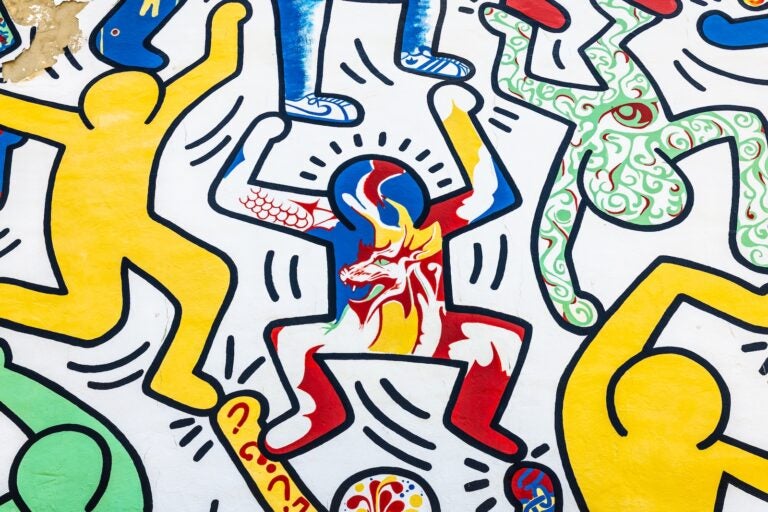
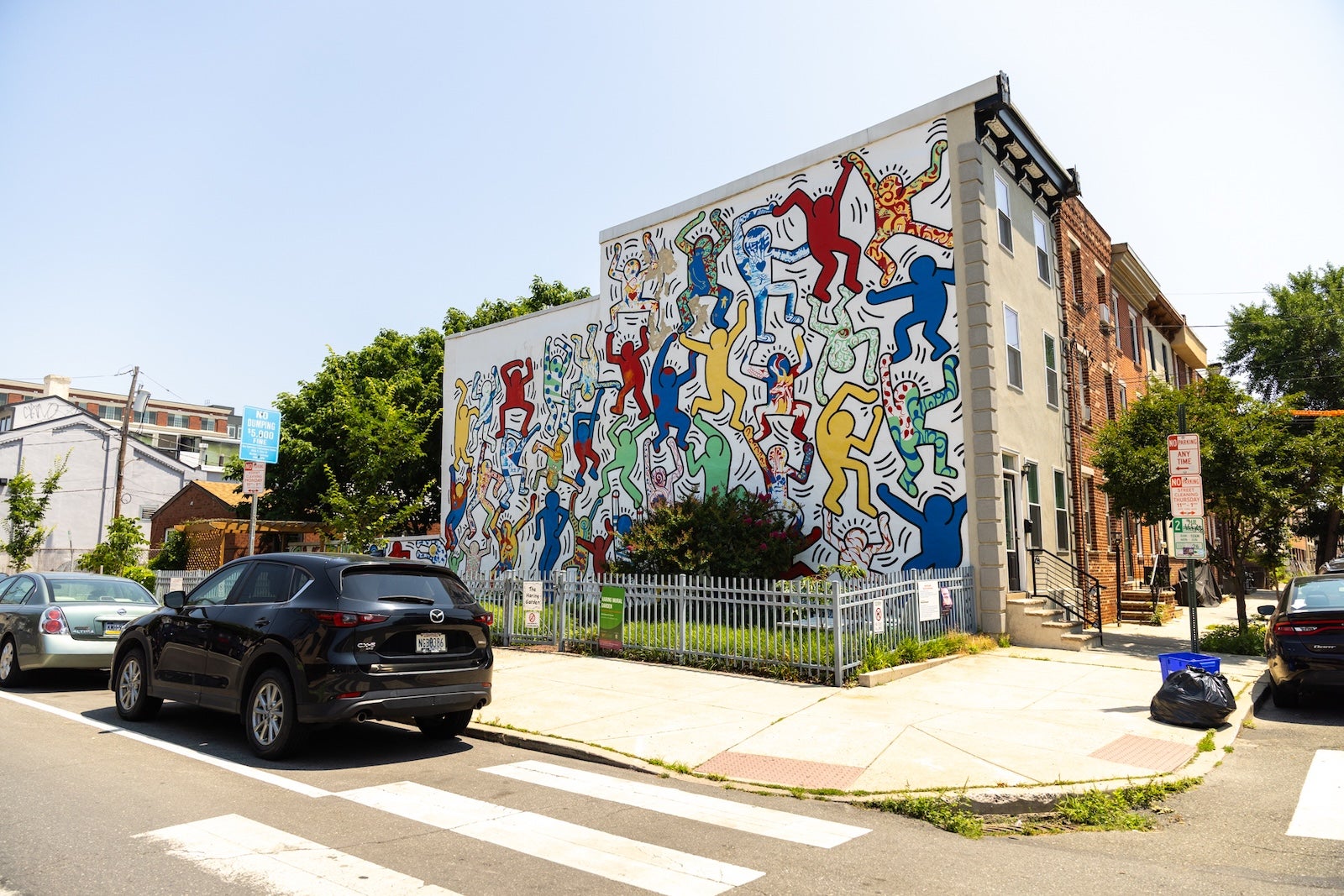
The ''We the Youth'' mural by artist Keith Haring in South Philadelphia’s Point Breeze neighborhood. (Kimberly Paynter/WHYY)
Have a question about Philly’s neighborhoods or the systems that shape them? PlanPhilly reporters want to hear from you! Ask us a question or send us a story idea you think we should cover.
In 1987, at the height of his career, pop artist Keith Haring came to Philadelphia to paint a mural on the side of a Point Breeze rowhouse with a group of teenagers.
The vibrant design, featuring a colorful array of Haring’s signature dancing figures, still graces the same wall at 2147 Ellsworth St. — and might in perpetuity if the Philadelphia Historical Commission approves a nomination submitted by a staffer.
That would thrill Mural Arts Philadelphia, which stewards the artwork, titled “We the Youth.”
“It is the only Keith Haring collaborative public mural still located at its original site and holds significance in Philadelphia not only because it is a Keith Haring, but also because it is beautifully painted and has become an important icon of the Point Breeze community,” Executive Director Jane Golden said in a statement.
But the proposal to protect the mural — created as part of Philadelphia’s bicentennial celebration of the U.S. Constitution — isn’t a sure thing.
The commission rarely considers nominations to historically designate murals, and there isn’t a consensus among preservationists on whether they should be included on the Philadelphia Register of Historic Places.
In 1998, for example, the commission voted to designate Maxfield Parrish’s “Dream Garden” mosaic inside the Curtis Center. Two decades later, the commission declined to designate the mosaic murals covering the Painted Bride Art Center, which were created by the late Isaiah Zagar, a Philadelphia icon.
“We recognize that Keith Haring was an internationally renowned artist, but murals have always been understood to be temporary interventions. We are not sure that historic designation is the right approach to balance mural preservation with the overall best interests of the city,” said Paul Steinke, executive director of the Preservation Alliance of Greater Philadelphia.
Steinke declined to elaborate on his statement.
Related Content
After 2 centuries, this historic Mt. Airy home may be demolished
The city recently determined that the Leibert House is “imminently dangerous.” It’s unclear if its owners will move to repair the property.
4 weeks ago
Listen 1:13Should outdoor murals be historic landmarks?
Under the city’s historic preservation laws, murals can be nominated as an “object,” a designation that so far has also included a select group of fountains, statues and horse troughs.
The measure defines such an object as a “material thing of functional, aesthetic, cultural, historic, or scientific value that may be, by nature or design, movable but yet related to a specific setting or environment.”
Alexander Till, a historic preservation planner with the commission, said he nominated the mural because he considers Haring “an extremely important artist.” The designation, he said, would give the city “an opportunity to preserve this piece of his work and his legacy in Philadelphia.”
“We have only a handful of objects designated in Philadelphia, so this may also help set an example for the types of public artworks and other objects, like memorials or fountains, that could be highlighted and protected by designating them to the Philadelphia Register of Historic Places,” Till said.
The commission’s Committee on Historic Designation will consider the mural at its next meeting on July 22. The nomination would have to pass the full commission for the mural to be added to the register.
Haring came to Philly through a collaboration with the Brandywine Workshop, a Philadelphia-based nonprofit rooted in public art projects, and CityKids Foundation, a New York City-based youth outreach organization.
The piece covers an exposed party wall near the corner of 22nd and Ellsworth streets, rising above a community garden dedicated to the late artist.
Haring outlined the dancing figures in thick black paint, and the students filled them with color. The final design features bright primary and secondary colors — green, blue, yellow and red — along with a variety of patterns and symbols. Haring said the students’ contribution was substantial.
“Because of how much paint they put on, it still comes out being a pretty half-and-half combination,” Haring said in a video made that year.
The title, “We the Youth,” is a riff on the first three words of the Constitution’s preamble, “We the People.”
“The actual picture doesn’t really say much about the Constitution, but bringing people from all different backgrounds, and all different places in this case, here to work on this mural, that’s like doing something unified,” one of the student artists says in the video.
Keith Haring’s enduring legacy
In subsequent years, the mural deteriorated, and there were fears that it would be lost after the property was flipped and underwent renovations.
Its new owners wanted to preserve the mural, however. And with help from the Keith Haring Foundation, Mural Arts Philadelphia painstakingly restored the wall and the mural in 2013. The piece is now part of the organization’s Restoration Program.
“Keith believed that art was for everyone and should be accessible, so having this mural still at this location for nearly 40 years is historically important,” Golden said.
According to the nomination, “We the Youth” is one of 50 public murals Haring painted in locations around the world between 1982 and 1989. Many of them were created at schools, hospitals and other community spaces.
Haring, who was born and raised in Berks County, Pennsylvania, rose to prominence through New York City’s downtown art and graffiti scenes of the 1980s.
He first gained notoriety by creating hundreds of spontaneous chalk drawings in New York City subway stations. Drawn on matte black advertising panels, the ephemeral graffiti became a familiar sight for commuters, many of whom would stop to talk with Haring while he worked.
From there, he started doing larger works, including paintings, sculptures and installations. His art appeared in major international shows and on the cover of Vanity Fair.
He “frequently addressed political and social issues important to him through his work, including anti-apartheid activism, drug use, homosexuality, safe sex, and AIDS awareness,” according to the nomination.
Haring died in 1991 at 31 years old from AIDS-related complications.

Subscribe to PlanPhilly
WHYY is your source for fact-based, in-depth journalism and information. As a nonprofit organization, we rely on financial support from readers like you. Please give today.
Brought to you by PlanPhilly

PlanPhilly
In-depth, original reporting on housing, transportation, and development.
Thousands of West Philly tenants remain in limbo as city considers saving 925 affordable rentals
The city missed its exclusive window to bid on the homes, opening the door to outside buyers and possible displacement.
9 hours ago
Listen 1:12
The Big Fix: Philadelphia at 2076
What could the city become over the next half-century? How could we redesign the city for the future?
Air Date: June 30, 2026 12:00 pm
Listen 47:40
Apartments on top, murals on bottom: Philly approves building plan, saves Painted Bride facade
The Zoning Board of Adjustment decision would allow construction of a 70-unit modernist apartment building in exchange for preserving the mural.
5 years ago