
How to save a few dollars on your electricity bill in the Philadelphia region
From switching to LED light bulbs, to turning down your hot water heater, here are a few things you can do to save on your electricity bill.
Listen 6:08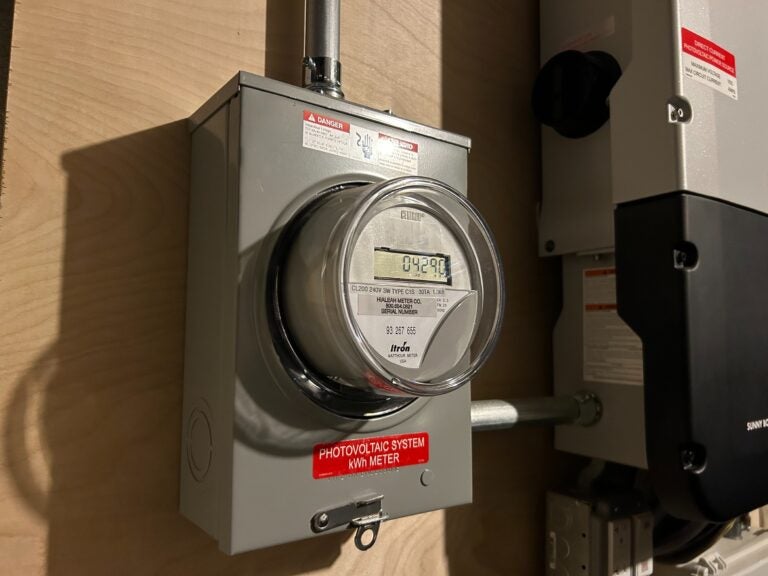
A meter shows energy produced by a photovoltaic system on the roof of a home in West Philadelphia. (Sophia Schmidt/WHYY)
This story is part of the WHYY News Climate Desk, bringing you news and solutions for our changing region.
From the Poconos to the Jersey Shore to the mouth of the Delaware Bay, what do you want to know about climate change? What would you like us to cover? Get in touch.
Electricity rates are high and expected to keep rising. PECO just asked state regulators to increase rates by 12.5%. A recent settlement by PPL Electric would increase rates by almost 5% this summer if approved by the Pennsylvania Public Utility Commission.
A number of factors have combined to send electricity bills soaring in Pennsylvania, including the planned increase in data centers, rising supply costs as demand increases and infrastructure expansion. While ratepayers have little control over most of these factors, there are a few things consumers can do.
WHYY News’ senior climate reporter Susan Phillips joined WHYY’s Morning Edition host Jennifer Lynn to share quick tips to lower your bills.
Jennifer Lynn: I like this topic a lot. I’m the kind of person who puts the shades down tight in the summer to block out the summer heat. You know, let’s start with some of this easy stuff. Our bills are going up. What can we do?
Susan Phillips: First of all, if you still have incandescent light bulbs, it’s a good idea to switch to LED light bulbs. The Department of Energy says that this can save the average household $225 a year in electricity costs. Second, check the thermostat on your hot water heater. It should be set at 120 degrees Fahrenheit. So if it’s electric and set at 140 degrees, for example, the DOE says if you turn it down 20 degrees, that will save you up to $400 a year.
JL: Well, that’s pretty good. What about heat and air conditioning?
SP: So the DOE recommends a setting of 68 degrees Fahrenheit when you’re awake and 58 to 60 degrees when you’re asleep or not at home. Again, this is if you have electric heat.
Most Pennsylvanians actually use gas to heat their homes. For air conditioning, the recommendation is 74 to 76 degrees, and a way to make things cooler is to add a fan. A cheap box fan that can circulate the air and cool things down further.
JL: There are often the family wars, the temperature wars, right? We all know about that. So you got to navigate that too. What is the top user of electricity in my house?
SP: Your refrigerator, which you can’t do much about because it has to run. However, experts say if your appliances like your refrigerator, washer, dryer or dishwasher are at the end of their life, it may be worth it to get a new one that is high efficiency. They encourage you to get as high-efficiency of an appliance as you can afford. And to do that, of course you look for that Energy Star rating.
JL: It’s worth it if my appliance is really old and ready to just conk out.
SP: That’s right. There is one exception though. If you have a window air conditioning unit, those will last forever, but apparently they become really inefficient over time. So it may be worth looking for a higher efficiency window unit, even if the one you have is not about to die.
Related Content
Your PECO bill could increase by $20 each month starting in 2027
The utility wants to raise its rates for electricity customers and suburban natural gas users. The CEO of PECO's parent company, Exelon, made more than $15.6 million in 2025.
2 weeks ago
Listen 1:15JL: Let’s talk about weatherization, making sure the heat and the air conditioning are not leaking from the house.
SP: Yes, very important. So you can hire a home energy auditor to assess your house, or Pennsylvania provides one for free if you are under a certain income level. Making sure there’s insulation in the crawl space below your roof is really important. And for the summer, especially in Philly, if you’ve got a row home, painting your rooftop white or silver helps a lot because those black tar roofs really absorb the sun’s heat.
JL: So I know I have two different parts of my bill, Susan. There’s distribution and there’s supply. Is there anything I can do about the cost of supply?
SP: Yes, Pennsylvania does allow customers to shop around for supply to try to get a better price than what you would get from your utility. Right now, the supply part of your bill, that supply cost, is also rising, and it’s simply supply and demand.
JL: OK, I’ve never shopped for supply. How does that work?
SP: So one thing to note is that public and consumer advocates don’t recommend shopping for a cheaper supplier, and that’s because it’s easy to get ripped off. Suppliers may have things in the fine print that you didn’t read. So they may offer you a cheaper rate than PECO or PPL, for example, but it could be a variable rate. Then the next month it might jump up, and they might charge you a fee if you try to switch.
I have spoken to people who do shop on the PA Powerswitch marketplace. They say the key is to use a calendar alert to make sure you go back to the online marketplace every month or so to check and see if what you signed up for is still a good deal. They have saved money this way, but they caution not to accept a variable rate and not to choose a supplier that has cancellation fees.
JL: What’s another good thing to think about?
SP: The best way to get rid of high bills is rooftop solar, which can have a high upfront cost and so it is prohibitive to many of us. But over time, rooftop solar can save you lots of money on your bills, obviously.
Also, you can sign up for what is called time-of-use pricing as long as you have a smart meter. The way it works is you can save money by agreeing to run your high energy-use appliances like the dishwasher, the washer, the dryer during off-peak hours, and most utilities offer this.
JL: I like that since I’m usually all about off-peak hours. I do a lot of things earlier and later than some people because of these crazy hours in the morning.

Get daily updates from WHYY News!
WHYY is your source for fact-based, in-depth journalism and information. As a nonprofit organization, we rely on financial support from readers like you. Please give today.
Part of the series

Philly-area MACH2 hydrogen ‘hub’ gets greenlight from Biden administration
It’s one of seven hubs across the country that the Department of Energy originally announced in 2023, which will receive a combined $7B from the Bipartisan Infrastructure Law.
1 year ago

New EPA soot standard could bring healthier air to parts of the Philly region
Officials predict Delaware County, Pa., and Camden County, N.J., will fail to meet the new standard without further action to reduce pollution.
2 years ago
Listen 1:14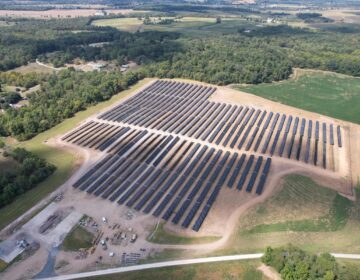
Philadelphia takes steps toward renewable energy goals with a solar farm in Adams County.
2 years ago
Listen 1:05