

New tool shows toxic PFAS chemicals pervasive in Delaware River
The so-called “forever chemicals” were found at higher levels between Chester and Pea Patch Island.
Listen 1:15
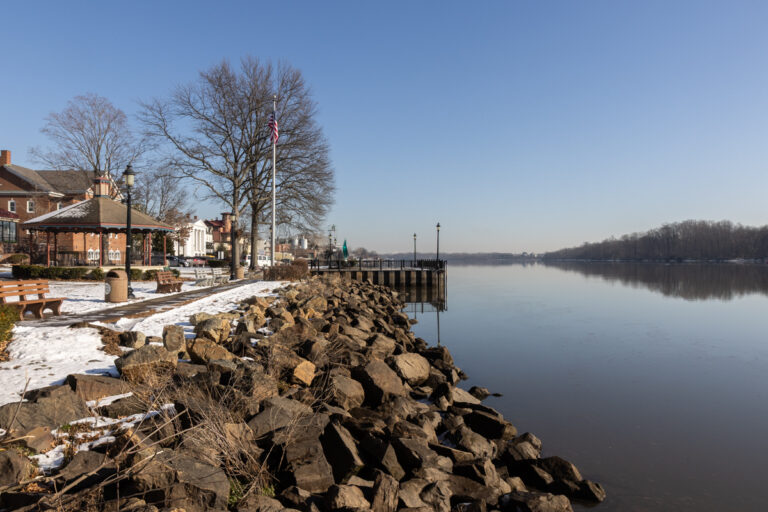
The Delaware River near Bristol, Pennsylvania. (Kimberly Paynter/WHYY)
This story is part of the WHYY News Climate Desk, bringing you news and solutions for our changing region.
From the Poconos to the Jersey Shore to the mouth of the Delaware Bay, what do you want to know about climate change? What would you like us to cover? Get in touch.
Toxic PFAS chemicals are pervasive across the Delaware River, as well as in the fish that swim along the waterway and its tributaries, according to a Delaware River Basin Commission report published in May.
The study finds that PFAS concentrations are increasing at a faster rate than the volume of water moving downstream toward the Delaware Bay. Researchers say the lack of dilution downstream suggests the so-called “forever chemicals” continue to be discharged from potential sources like industrial and wastewater facilities.
The chemicals were detected at higher levels in the river between Chester, Pennsylvania and Pea Patch Island, located across from Delaware City, Delaware — indicating that there are sources of PFAS contamination south of Chester.
“We will continue our decades-long active monitoring of PFAS and heighten our focus on targeted tracking, trend modeling and data communication, ultimately allowing DRBC to help reduce PFAS prevalence throughout our shared waters,” said Kristen Bowman Kavanagh, DRBC’s Executive Director, in a statement.
The results are the latest in a three-part study marking more than 20 years of PFAS research in the Delaware River Basin, which provides drinking water to more than 14 million people in Delaware, Pennsylvania, New Jersey and New York.
Members of the public can use a new interactive application that maps out PFAS hotspots around the basin. The public is invited to learn more about the study during a webinar on Monday, June 15.
PFAS are commonly used in the manufacturing of household products such as nonstick cookware and waterproof clothing, as well as in firefighting foam. The toxic chemicals have been linked to serious health problems, including some cancers.
PFAS have tainted water, air and soil in the U.S. for decades. The so-called “forever” chemicals don’t break down naturally in the environment, and can remain in the human bloodstream for years.
Related Content

Delaware lawmakers advance measure to protect state’s wetlands
After several failed attempts to protect nontidal wetlands, Delaware lawmakers have introduced legislation that developers say they can get behind.
6 months ago
Listen 1:19There has been increasing concern about levels of the “forever chemicals” in drinking water, prompting state and federal regulations that require water providers to eliminate them in tap water. Some states, including New Jersey, have passed laws that prohibit manufacturers from using PFAS in specific products.
The first commercially produced PFAS compound, best known for its use in Teflon pans, was accidentally discovered in 1938 at the former DuPont Chambers Works facility in Deepwater, New Jersey, located along the Delaware River.
The study finds that not only are PFAS levels widespread along the river and its tributaries, but high levels of the forever chemicals can be found in fish. The chemicals were found in higher levels among smallmouth bass, including in Yardley, Bucks County, and among white perch at several sites, including in the Schuylkill River.
New Jersey currently has fish consumption advisories in place that recommend limiting consumption of these species, but they do not address PFAS specifically.
“PFAS are a little different in that they tend to stick to proteins more than fats,” said Jeremy Conkle, lead author of the study and a chemist and toxicologist for the DRBC. “So if you’re eating that filet, that’s where some of that PFAS is going to accumulate more.”
He said people shouldn’t be alarmed unless they’re consuming fish daily, and suggested that anglers continue to follow their state’s fish consumption advisories.
Conkle said he hopes the study’s results will lead to future reductions in PFAS contamination. Previous detections of PFAS compounds by DRBC researchers have led to increased monitoring and efforts by industries to reduce their PFAS use.
“Say you know this area has these four compounds regularly, let’s see if we can track those and do some more targeted sampling to find where those might be coming from, and hopefully reduce some of the PFAS that’s out there,” Conkle said.

Get daily updates from WHYY News!
WHYY is your source for fact-based, in-depth journalism and information. As a nonprofit organization, we rely on financial support from readers like you. Please give today.
Part of the series

Watershed
Preserving Our Water: How we use our Delaware Watershed.
The project is funded by The William Penn Foundation.
Part of the series

Delaware’s Mt. Cuba Center touts the benefits of native goldenrods
Goldenrods are not to be confused with ragweed. These fall-blooming native plants don’t trigger allergies and insects love them.
15 hours ago
Listen 1:23
A network of air quality monitors grows in a formerly redlined area of West Philadelphia
The network will provide residents of formerly redlined areas of West Philly and Harrisburg real-time info about the air they’re breathing.
6 days ago
Listen 1:07
In Philadelphia’s Eastwick neighborhood, plans for a temporary solution to flooding hit a snag
The issue with temporary HESCO-style flood barriers comes after a plan for a levee in Eastwick was deemed not viable.
7 days ago
Listen 1:07