



Pa. may ban cellphones in schools. Some Delco and Hershey educators say they’re already seeing results — without pouches
The “bell-to-bell” bans face skepticism from students and parents. After going phone-free, early adopters say the difference is striking.
Listen 3:44
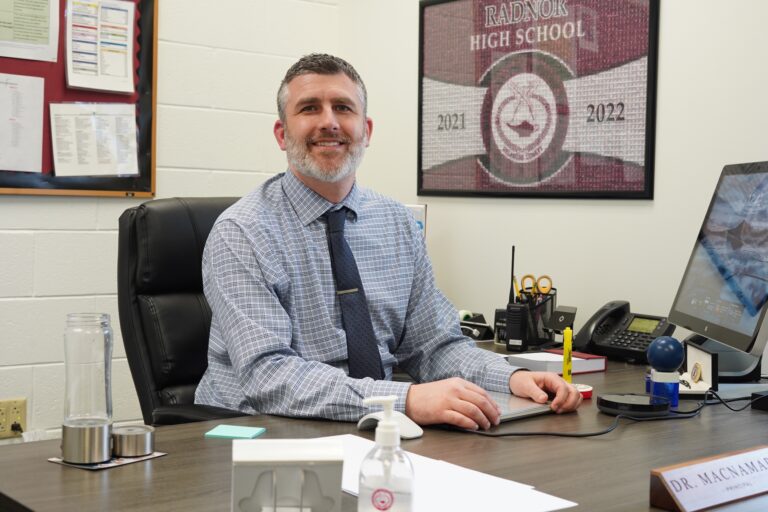
Joe MacNamara, principal of Radnor High School, says the school has seen improvements in the educational performance of students and their social interactions. (Kenny Cooper/WHYY)
This reporting is part of the newest season of “Schooled,” a WHYY News podcast that examines how technology is reshaping the educational experience in Pennsylvania’s schools.
Find “Schooled: Rewired” on Apple Podcasts, Spotify or wherever you get your podcasts.
A bipartisan bill aiming to ban cellphone use from the start of the school day until dismissal in Pennsylvania’s K-12 schools nearly made it to Gov. Josh Shapiro’s desk, but lawmakers failed to agree on a final version.
Legislators in Harrisburg are expected to work on a resolution during the fall session. But even if they reach an agreement, schools would still have to decide how to enforce such a sweeping prohibition.
Would schools need to purchase lockable pouches and storage caddies to keep phones out of students’ hands throughout the school day?
Radnor High School and Hershey High School, a pair of early adopters of so-called bell-to-bell cellphone bans, have found success simply asking students to turn off their phones and keep them away.
“We’ve seen so much more social interactions since we’ve implemented this initiative,” said Joe MacNamara, principal of Radnor High School. “Kids are just face to face, having conversations, not buried in their phones. They’re talking to each other.”

In addition to the social benefits, MacNamara said the classroom data shows a decrease in over failures — although he was careful not to attribute the lion’s share of the improvement to the new cellphone policy.
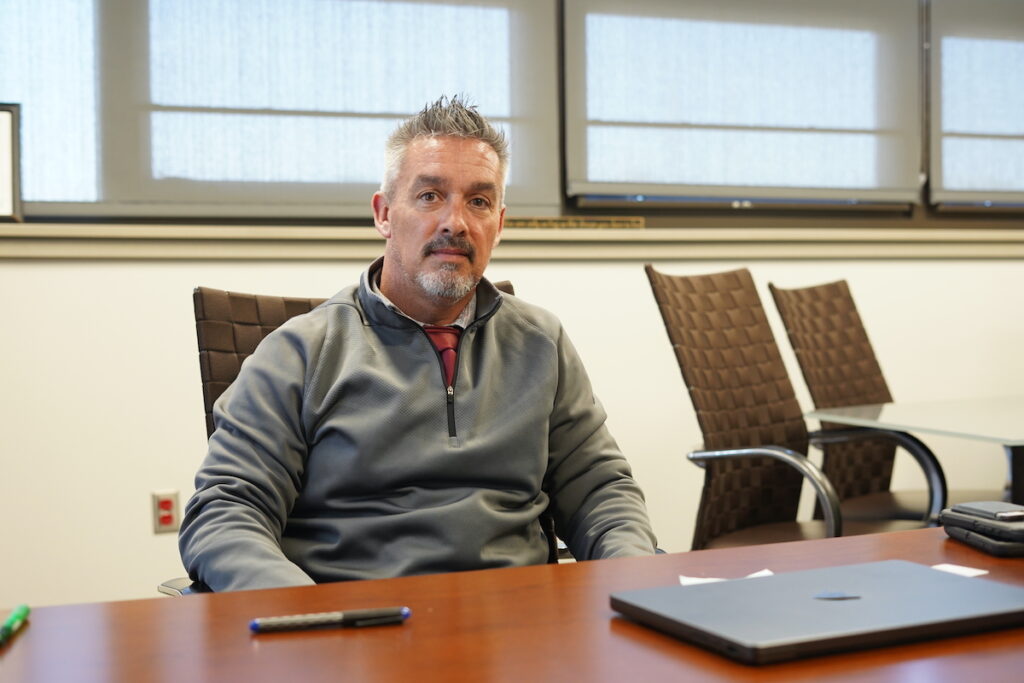
At Hershey High School, students are asked to turn their phones off and keep them in a locker or their bookbag during the entire day. Derry Township School District Superintendent Stacy Winslow said the impact is tangible.
“We have seen a dramatic reduction in spillover conflict because kids are able to just put it away and have that cooling off time,” Winslow said.
How did Hershey and Radnor get here?
Hershey English teacher Shari Taylor-Stuckey, who has spent nearly four decades in the classroom, recalled first seeing a cellphone in class “many moons ago.”
“I remember thinking: What is this kid doing in my class with this cell phone?” she said.
Eventually, every student caught the cellphone bug. However, she said, things got worse during the advent of social media.
“Honestly, I became really frustrated as a teacher,” Taylor-Stuckey said. “I felt like I was not only trying to teach this lesson and to engage my students, but now I have this outside thing that I had to figure out — and I didn’t even totally understand all of its ramifications.”
She tried to take matters into her own hands.
“I actually had these plastic bins in the middle of the tables,” Taylor-Stuckey said. “I have round tables, so I’d have the kids take those cell phones out and put them in there. Now, not all kids would do that. Sometimes I would have the kids turn them off and put them up front.”
None of that worked, she said. Administrators and teachers finally decided enough was enough. Parents, however, gave feedback that ran the gamut of safety and access to their children.
“The bigger concern that came from the feedback from our families was that they didn’t want us spending money on pouches for the phones,” Winslow said.
With that in mind, the school drafted a bell-to-bell cell phone ban. All students would have to keep their phones off and away during the school day, either in a bookbag or their locker. There would be no fancy pouches or storage bins. Taylor-Stuckey was skeptical.
“I could not for the life of me figure out how we were going to get 1,200 kids to buy into this,” she said.

Related Content
Early reaction to off-and-away bans: ‘It’s been like night and day’
Taylor-Stuckey is now happy to have been proven wrong.
“Oh my goodness,” she said. “It’s been like night and day. Kids are now more focused on the learning that is occurring within the classroom. They are not being distracted by those devices and social media and technology.”
Just as importantly, she said students are talking to one another again and acquiring all of the soft skills that should make school enjoyable: cracking jokes, laughing and listening to each other. She credited the policy with having real consequences for cellphone use and effectively communicating the change to students and their families.
“I think for the overall school atmosphere, I think it reminds us why we’re here,” Winslow said. “We’re not here to mitigate drama. We’re not here to see what’s happening on social media. We’re here to learn.”
Caleb Michael Tinsley, a senior during the 2025-26 academic year, said students were “not thrilled” about the policy. However, the complaints later evaporated once they got used to the ban. He said he’s reclaimed something he didn’t exactly know was missing.
“There’s something that you lose when you’re in a phone versus speaking to somebody, and I really think that I’ve gotten it back for my senior year and I actually really appreciate that,” he said.

During the 2024-25 academic year, Radnor experimented with phone pouches as a way to ban cellphones during instruction, but they proved to be unpopular with some parents and ineffective for crafty students eager to take a peek at their device. With a sleight of hand, some students put calculators and fake phones in pouches.
“We just realized it wasn’t necessarily working to the highest level,” MacNamara said.
After months of focus groups and discussions, administrators decided to take a different approach. The policy was simple: a “bell-to-bell” ban with a caveat. Phones just had to be “off and away.” Violators would be disciplined. The school gave students notice before the 2025-26 academic year began.
“ I heard … that people were gonna come to my door with pitchforks and hang me out to dry,” MacNamara said. “There wasn’t a single kid who did that. So it really transitioned well, and through my administrative team and our teachers being consistent and following this rule, this initiative, we are making gains.”
What does science say about cellphones and child health?
According to Education Week, at least 39 states and the District of Columbia require school districts to either ban or restrict students’ cellphone use.
In February, the Pennsylvania Senate passed a bill to ban cellphones bell-to-bell in the state’s K-12 schools. In June, the state House passed a similar bill. However, progress stalled over the summer.
For years, educators and parents have viewed cellphones as a classroom distraction. Growing research tying cellphone use to mental health issues and other problems has intensified calls for restrictions.
Dr. Ran Barzilay, a child and adolescent psychiatrist at Children’s Hospital of Philadelphia and an assistant professor of psychiatry at the University of Pennsylvania, studies how environmental and lifestyle factors affect children’s health, particularly under stress.
“But over the last, I would say, five years, watching my own kids grow up and seeing patients come in, you see that the environment of the kids these days, much of it, if not most of it, is online,” Barzilay said.
He said smartphones reflect an inflection point in the kids’ digital environment. Using data from the Adolescent Brain Cognitive Development study, Barzilay, along with researchers at CHOP, the University of California, Berkeley and Columbia University, studied the impact cellphones had on young people.
In December 2025, Barzilay and his collaborators found that 12-year-olds who owned a smartphone had higher rates of depression, obesity and insufficient sleep than those who did not.
In June 2026, that same team of researchers followed up with a slightly older cohort. Getting a smartphone around age 13 was associated with insufficient sleep a year later, while heavier smartphone use was associated with depression, obesity and insufficient sleep.
In his profession, Barzilay said they “let science speak, not opinions.”
“We are not saying that smartphones are bad in any way. That’s not my point,” Barzilay said. “We are saying that giving your kid a smartphone has implications for your kid’s health. Now, it’s not bad and it’s not good. It may have both bad and good components that we’re just not too sure about yet.”
He encouraged parents to speak with their children before purchasing their first cellphone in order to mitigate some of the risks.
“I think that the same way that we should have discussions as parents with our kids on what they eat, how they handle themselves in the world, when they go outside of the house, how they should behave in terms of their safety — we should talk about cellphones in a similar manner,” Barzilay said. “And we should use science such as our paper, for example, as something to discuss with them. That this just came out and there seems to be something going on, so we should think about this seriously.”

Get daily updates from WHYY News!
WHYY is your source for fact-based, in-depth journalism and information. As a nonprofit organization, we rely on financial support from readers like you. Please give today.
Brought to you by Schooled

Part of the series


Parents sue Central Bucks School District, allege ‘concerted cover-up’ of abuse
A former school board member and his wife say that their 10-year-old son endured “horrific abuses” at the hands of instructors in an autistic support classroom.
7 days ago
Pennsylvania Gov. Shapiro signs legislation guaranteeing 30 minutes of recess to elementary students
The governor signed a bill Wednesday that was approved by the state legislature as part of the 2026-27 budget.
4 weeks ago

Kensington High School students will travel to a building 7 miles away on shuttle buses after an asbestos issue shuttered their school.
2 months ago
Listen 1:14