



COVID funding provided underfunded Philly-area schools with laptops. ‘RAMageddon’ might send them back in time
The worldwide computer memory shortage is driving up the cost of laptops.
Listen 4:40
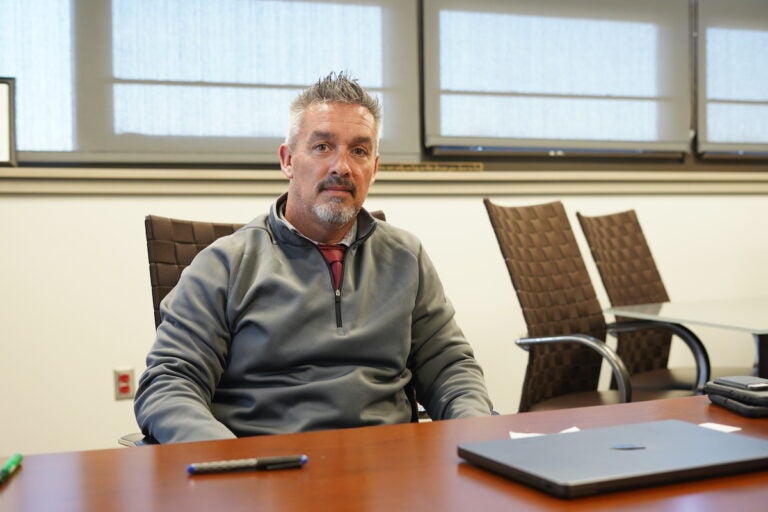
Upper Darby School District Superintendent Dan McGarry says a computer was "like a campfire" in the district before COVID-19-era funding gave Upper Darby access to funds to purchase technology for each student. (Kenny Cooper/WHYY)
This reporting is part of the newest season of “Schooled,” a WHYY News podcast that examines how technology is reshaping the educational experience in Pennsylvania’s schools.
Find “Schooled: Rewired” on Apple Podcasts, Spotify or wherever you get your podcasts.
Years after the COVID-19 pandemic, school districts across Pennsylvania are still working to pull students out of a nationwide reading slump.
While the collective learning loss remains one of the longest-lasting impacts from the pandemic, there was also a silver lining: student access to laptops.
“We were not a school district that was able to be a one-to-one school district literally hours before school shut down for the pandemic — I mean literally hours before,” said Dan McGarry, superintendent of the Upper Darby School District.
More than 12,500 students are enrolled in the Upper Darby School District, making it among the largest in the state. Yet prior to the pandemic, students in the district largely missed out on the technological boom of the 21st century.
“I joke around like a computer was a campfire in the Upper Darby School District,” McGarry said. “Like six kids would sit around one computer and they would like warm their hands around it because that’s all we could afford.”
In March 2020, Congress allocated $13.2 billion to the Elementary and Secondary School Emergency Relief Fund, or ESSER, to help districts mitigate the impacts of COVID-19. Many districts used ESSER funding to help schools run remotely. ESSER dollars provided the district with the resources to give every student a laptop.
“We didn’t have any of those things,” McGarry said. “We were literally out in line, I was, ’til 8:30 at night, got in trouble because we weren’t socially distant, handing out Chromebooks that we were getting like quickly ordered in overnight to give them out to try to get kids their education going without being out of school for so long during the pandemic.”
-

The Upper Darby School District logo. (Kenny Cooper/WHYY) -
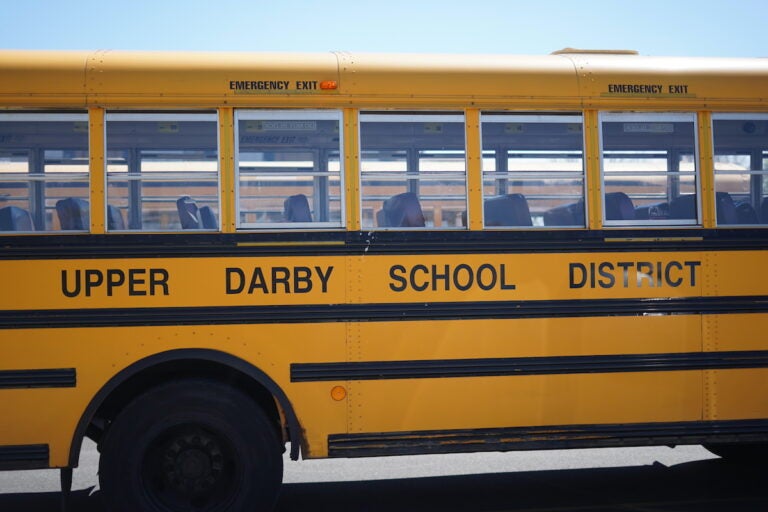
A school bus idles outside of Upper Darby High School in Delaware County. (Kenny Cooper/WHYY) -
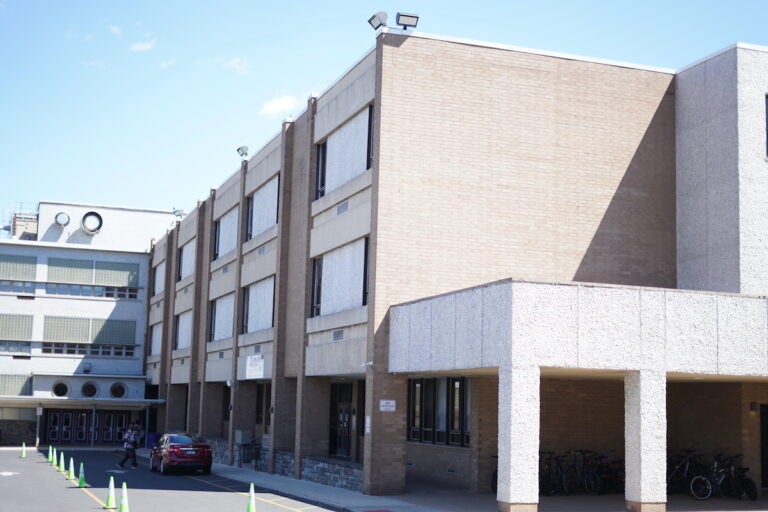
Upper Darby High School is the oldest high school in Delaware County. (Kenny Cooper/WHYY)
Six years later, that funding has dried up, while the cost of the technology has skyrocketed.
“We’re looking at [$2 million to $3 million] a year to keep up with Chromebooks,” McGarry said. “Chromebooks were like $400 a kid. They’re now over $600 a kid, right? And so how do I keep up with that?”
The district might not have a choice.
“My fear financially is I don’t think we’re going to be able to financially keep going one-to-one with our kids in the near future,” McGarry said.
McGarry said the district replaces about 3,000 Chromebooks each year.
“We’re not trying to replace everything at once,” said Daniel Kitchen, the district’s director of technology. “So, we try to create a strategy where we’re bringing a certain number of a year to match what’s aging out [and] what’s damaged.”
Kitchen said that across vendors, the cost of the average Chromebook increases 25% year over year.
“It’s out of control right now,” Kitchen said.
Related Content
How the costly digital age is leaving behind Pa.’s rural, underfunded schools
Students in remote school districts like Otto-Eldred are using failing, outdated technology. In some cases, it's costing them their futures.
1 month ago
Listen 4:12Why are computer prices increasing?
Dr. Benjamin Lee, a computer science and electrical engineering professor at the University of Pennsylvania, attributed the skyrocketing prices to an increase in demand for key computer components.
“When you see the largest data center operators and [artificial intelligence] companies investing hundreds and hundreds of billions of dollars in data center compute, they’re going to have to fill these facilities with hardware,” Lee said. “This means processors and this means memory and this means storage and networking equipment. And because there is only so much manufacturing capacity for all of these hardware components, more hardware going into the data centers means potentially less hardware available going into consumer electronics.”
Even though a data center sits at the opposite end of the spectrum in regards to a typical laptop, a computer is still a computer. As Lee explained, it’s a processor that executes instructions and performs calculations.
“That processor has to be doing those calculations on some data that’s coming from somewhere — that data is sitting in memory: dynamic random access memory, sometimes referred to as DRAM, sometimes referred to as RAM,” Lee said.
Lee clarified that even though these computers may share some parts, they are not necessarily interchangeable, meaning you can’t pluck a processor out of a data center and place it into a student-issued laptop or vice versa.
“Oftentimes when we’re talking about competition for a scarce supply of hardware, we’re really not talking about hardware here versus being deployed here versus being deployed there. We’re talking more about factory capacity,” Lee said. “So it turns out that some of these factories, these fabs, that are making memory chips, they can choose whether or not they want to devote essentially factory capacity to building chips that are dedicated for AI-based servers or chips that are dedicated for consumer electronics.”
Therefore, if these factories shift more of their assembly line to AI chips or AI memory, there might be less space for other chips needed for consumer electronics like laptops, Lee said. Some tech journalists have dubbed this worldwide shortage in computer memory as “RAMageddon.”
Lee said computer hardware manufacturing is notorious for its “boom or bust” cycles.
“The demand for memory chips and the extraordinary prices we’re seeing here — the profit margins that these companies are getting for these memory chips — are unprecedented,” Lee said. “I haven’t seen this for 20–30 years since I’ve started working in this space.”
Related Content
Schooled Rewired Episode 3: Tech Equity
How technology is reshaping the educational experience in Pennsylvania's schools.
Air Date: July 24, 2026
Listen 30:00Other Philly-area school districts face similar tech cost problems
Solving this problem is not as simple as asking students to foot the bill. While more affluent districts can weather the storm, chronically underfunded school districts don’t have that much runway.
There’s no turning back the clock either.
Pennsylvania has mandated that all standardized testing be administered online, with the exception of students who require accommodations.
McGarry said he got into education to “teach Shakespeare,” among other reasons.
“I never thought in my wildest dreams as a superintendent I’d be worried about things like Anthropic,” McGarry said, referring to the California-based AI company behind the Claude chatbot. “How do I give a kid a computer? How do I make sure the cameras are keeping kids safe in school and the software updates? How do I make sure the kids aren’t getting sucked into online chat rooms where inappropriate things are happening? So there’s all this complication — and it all costs money.”
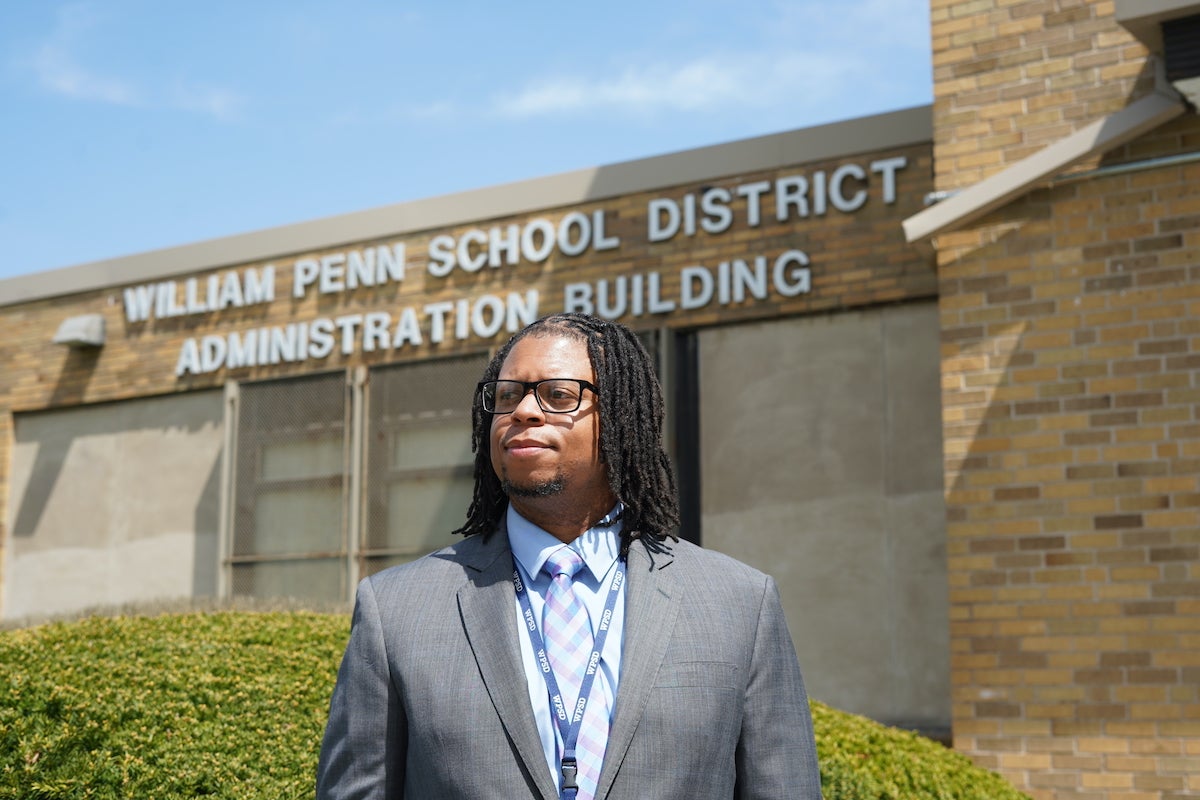
In the neighboring William Penn School District, one of the six districts to successfully sue Pennsylvania during the landmark fair funding trial, the harsh realities are slowly setting in.
Darnell Deans, the chief of operations at the William Penn School District, said the slow flow of adequacy funds is leaving the district to confront tough choices.
“When all the resources are not there, something has to give,” Deans said. “And where do those ‘gives’ always happen? On the operations side. And technology is one of the areas in which we had to make some budgetary decisions on what we’re going to do next year from an investment perspective.”
Roughly 4,500 students attend the William Penn School District — 75% of whom are eligible for free and reduced-priced lunch, Deans said. Although the district has 4,900 laptops for students, it is not a true one-for-one district. William Penn doesn’t have enough to comfortably guarantee that kids can take devices home and still have enough for the classroom, Deans said.
“So we are being forced into these precarious places in which we have to figure out: Are we gonna make sure that they can do what they need to do here in the classroom? Or are we gonna make sure they can do what they need to do at home? And it’s just a difficult position that we shouldn’t have to be in,” he said.
Kitchen, of Upper Darby, proposed a solution. Eligible school districts across the country receive federal funding for telecommunications and infrastructure upgrades through the Federal Communication Commission’s E-Rate program.
“So creating a system like that for devices for Chromebooks if they’re going to be things [that] are mandated in the classroom — they have to be online, you have to use a device — then that funding should be available for school districts like ours: a similar program to E-Rate for devices rather than just infrastructure,” Kitchen said.

Get daily updates from WHYY News!
WHYY is your source for fact-based, in-depth journalism and information. As a nonprofit organization, we rely on financial support from readers like you. Please give today.
Brought to you by Schooled

Part of the series


New leader of Philadelphia organization for arts in schools sees hope in collaboration
As Anjoli Santiago takes the helm of Philadelphia Arts in Education Partnership, the state has changed its arts funding priorities.
5 days ago
Listen 1:14
The “bell-to-bell” bans face skepticism from students and parents. After going phone-free, early adopters say the difference is striking.
2 weeks ago
Listen 3:44
Kensington High School students will travel to a building 7 miles away on shuttle buses after an asbestos issue shuttered their school.
3 weeks ago
Listen 1:14