Pennsylvania lawmakers want to ban products like playmats, infant bedding that contain toxic PFAS chemicals
Toxic PFAS chemicals are found in hundreds of everyday products, including cosmetics, menstrual products, dental floss and items for babies.
Listen 1:08
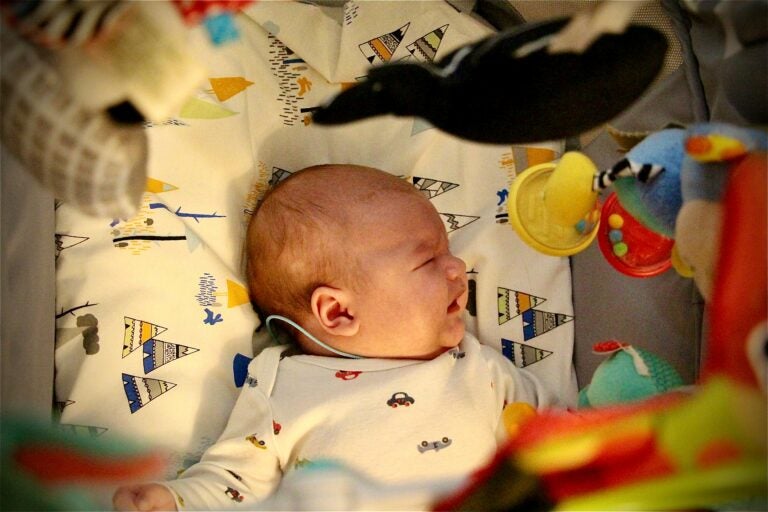
File: Infant products like bibs and bedding are among everyday household items that may contain toxic PFAS chemicals. (Ольга Макарова/Unsplash)
From Philly and the Pa. suburbs to South Jersey and Delaware, what would you like WHYY News to cover? Let us know!
Cosmetics, menstrual products, dental floss and children’s items like bedding and playmats — these common household items could contain toxic PFAS chemicals.
The so-called “forever chemicals” have been linked to serious health problems, including some cancers, thyroid problems and reduced immune response.
Now, lawmakers in Pennsylvania are taking steps that aim to protect consumers from these products. Legislators advanced legislation this week that would prohibit the manufacture or sale of certain products that intentionally contain PFAS beginning in 2028.
The legislation was unanimously released from a state House committee, and now awaits a vote on the House floor. Bill sponsor state Rep. Greg Scott, D-Montgomery County, said he hopes the measure will spark awareness.
“A lot of people just did not know that it’s in these products. A lot of people don’t know how it escapes these products,” he said. “So learning about it and learning what PFAS is, how it can cause cancer and other bad illnesses, is a good first step.”
Toxic PFAS chemicals have tainted water, air and soil in the U.S. for decades. The so-called “forever” chemicals don’t break down naturally in the environment, and can remain in the human bloodstream for years.
The group of chemicals are widely used in consumer products such as nonstick cookware and waterproof clothing, as well as in firefighting foam. There has been increasing concern about levels of the “forever chemicals” in drinking water, prompting state and federal regulations that require water providers to eliminate them in tap water.
However, people are commonly exposed to PFAS by using a number of household products, including pots and pans, microwave popcorn bags, waterproof clothing and boots, stain-resistant carpet, cosmetics and food packaging.
More than 98% of people are estimated to have varying levels of “forever chemicals” in their bloodstreams, according to studies by the Centers for Disease Control and Prevention.
The chemicals are used by manufacturers because they can make products water and oil resistant. PFAS also don’t break down chemically, or by heat.
Scott’s legislation focuses on four categories of household products: cosmetics, menstrual products, dental floss and children’s items. Under the law, manufacturers would have to certify that products sold in the state do not contain PFAS.
Related Content

New Jersey bans some products with toxic PFAS chemicals. Here’s what to know
People can be exposed to the so-called “forever” chemicals from household products like carpets and cosmetics.
8 months ago
Listen 1:03A 2021 University of Notre Dame study found high levels of fluorine, an indicator of PFAS use, in a significant proportion of foundations, lip products and mascaras. Studies have also indicated that people can absorb PFAS through their skin, and health experts say that people who use menstrual products may absorb them at higher levels.
Other studies have found that people who use gliding dental floss products often have higher levels of PFAS in their bodies.
“There’s PFAS in a lot of consumer products, but the ones that we are excited that this bill is addressing, they are particularly high stakes because they’re used by particularly vulnerable populations or used in a particularly intimate way,” said Stephanie Wein, a clean water and conservation advocate at PennEnvironment.
As a parent, Wein said she worries about how her children could be exposed to the chemicals. A 2022 Environmental Working Group report found high levels of PFAS in infant products like bibs and bedding. A law banning these products in Pennsylvania would be a significant win for parents, Wein said.
“When I had my kid two years ago, all of a sudden I started seeing, ‘Wait, it could be in the diapers, it could be in the wipes, it’s common in their pajamas,’” she said. “The idea that that’s one more thing that parents have to worry about in terms of keeping their kids safe, that should not be something consumers are thinking about when they’re preparing for a new kid or caring for their child.”
More than a dozen other states have passed similar legislation. New Jersey was the first state in the region to ban products containing “forever chemicals,” including carpets, fabric treatments and food packaging, beginning in 2028.

Never miss a moment with the WHYY Listen App!


WHYY is your source for fact-based, in-depth journalism and information. As a nonprofit organization, we rely on financial support from readers like you. Please give today.
Part of the series

Watershed
Preserving Our Water: How we use our Delaware Watershed.
The project is funded by The William Penn Foundation.

$1.3 million dam-removal project in Bucks County aims to create and ease fish passage
The project aims to restore river flow in the Neshaminy Creek and help fish to migrate.
2 weeks ago

Conservationists to restore wetlands, save habitat for diamondback terrapins in New Jersey
Tidal salt marshes across New Jersey are being drowned out by sea level rise.
2 weeks ago
Listen 1:17
Researchers find microplastics in insects from Schuylkill River watershed
The researchers found that microplastics were as prevalent in forested parts of the watershed as they were in urban areas.
4 weeks ago
Listen 1:21