

How data center battles in the Philadelphia suburbs could impact party control of the Pa. legislature
Democrats have a chance to control the three branches of government in Pennsylvania. In a tightly contested state Senate race, the battle is focused on data centers.
Listen 5:06
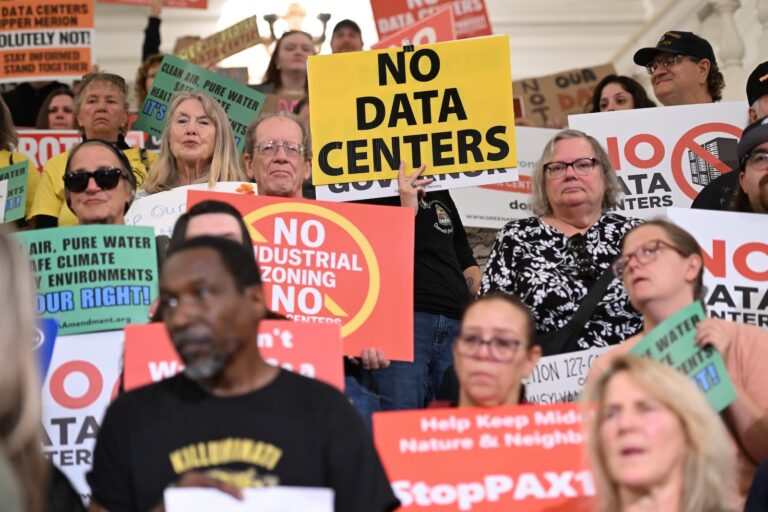
File: Anti-data center demonstrators protest at the Pennsylvania state Capitol, Oct. 6, 2026, in Harrisburg, Pa. (AP Photo/Marc Levy, File)
What questions do you have about the 2026 elections? What major issues do you want candidates to address? Let us know.
Data centers are front and center in the battle for control of Pennsylvania’s legislature, which the Democrats have not held since 1994.
But the energy, environmental and existential issues that underlie the rapid development of hyperscale data centers don’t fall so neatly along party lines, resulting in TV, radio and digital ads from both sides of the aisle touting opposition to data centers, while painting opponents as pro-data centers.
It’s enough to confuse the average voter on where politicians stand. Regardless of political affiliation, most people oppose data centers.
“This has really brought together people from every party, Democratic, Republican, independent, it really is a unifying community issue,” said Chrissie Dziembowski, who lives between two proposed hyperscale data centers in Limerick Township. Those sites lie a mile in each direction from Dziembowski’s home in the tightly contested race for state Senate District 24, which straddles Montgomery and Berks counties. Dziembowski and her neighbors have been inundated with fliers, ads and visits from both major party candidates.
“There’s just a lot of money being poured into this race,” Dziembowski said. “I wouldn’t even say it’s a bipartisan [issue], I would say it’s nonpartisan.”
Related Content

Pa. election 2026: Voter guides, key races and more
Election Day is Tuesday, Nov. 3. Here’s what you should know beforehand, from voter deadlines to who’s on the ballot in Philadelphia and statewide.
3 months ago
How data centers came to dominate the race for Pennsylvania’s 24th state Senate District
The 24th District includes suburban and ex-urban housing developments and strip malls built on former farmland. It’s facing rapid development on what little open space is left.
The proposal for the two data centers included a controversial land swap approved by the Pennsylvania Game Commission. The planned 2.8 million-square-foot facility would be about the size of the King of Prussia Mall, while the other would encompass 1.8 million square feet.
Incumbent Republican Tracy Pennycuick is fighting to maintain her seat after championing data centers by sponsoring legislation to fast-track the facilities in 2025. At the time, she stood with U.S. Sen. Dave McCormick, who continues to tout data centers. She’s since shifted her stance, and this September she proposed a package of bills that would impose restrictions on data center development.
Democrat Chris Thomas is running for office for the first time, and says he too will support data center regulations.
Each candidate is hammering the other with negative ads over data centers. Neither candidate supports the data center moratorium introduced by Democratic state Sen. Katie Muth, which currently has one Republican co-sponsor.
Green Party candidate Michael Schonewolf Jr. said he doesn’t believe in a moratorium because he thinks data centers should be banned completely.
Related Content

What we know about Delaware County’s potential data center plan, ‘Project Trainer’
Link Logistics is testing the waters for a data center that would sit around 100 feet from homes in Trainer, Pennsylvania.
2 months ago
Political ads focused on data centers have skyrocketed nationwide
Nationwide, political ads that “mention” data centers have “quadrupled since June,” according to Marketing Brew. The publication, citing data from Sensor Tower, said the Shapiro for Pennsylvania PAC in support of Gov. Josh Shapiro’s campaign accounted for 42% of those data center ads. Shapiro is running against Republican challenger Stacy Garrity.
“Data centers have really burst on the scene as an issue, really just in the past year as more and more voters have gotten concerned about them,” said J.J. Balaban, a media strategist and ad maker who has worked for Democratic congressional candidates nationwide for the past 25 years.
“I think the reason why it’s a subject for so many ads is that it is a new issue that people really care about, and it hasn’t been locked into a partisan frame at this point,” Balaban said. “It’s not really associated with any party yet, and the reason why there are so many ads on it is because the people that seem most unhappy about the growth of data centers seem to be in both parties. So it’s a way for people running for office to try to broaden their appeal and to potentially pick off some members of the other party’s coalition.”
Related Content
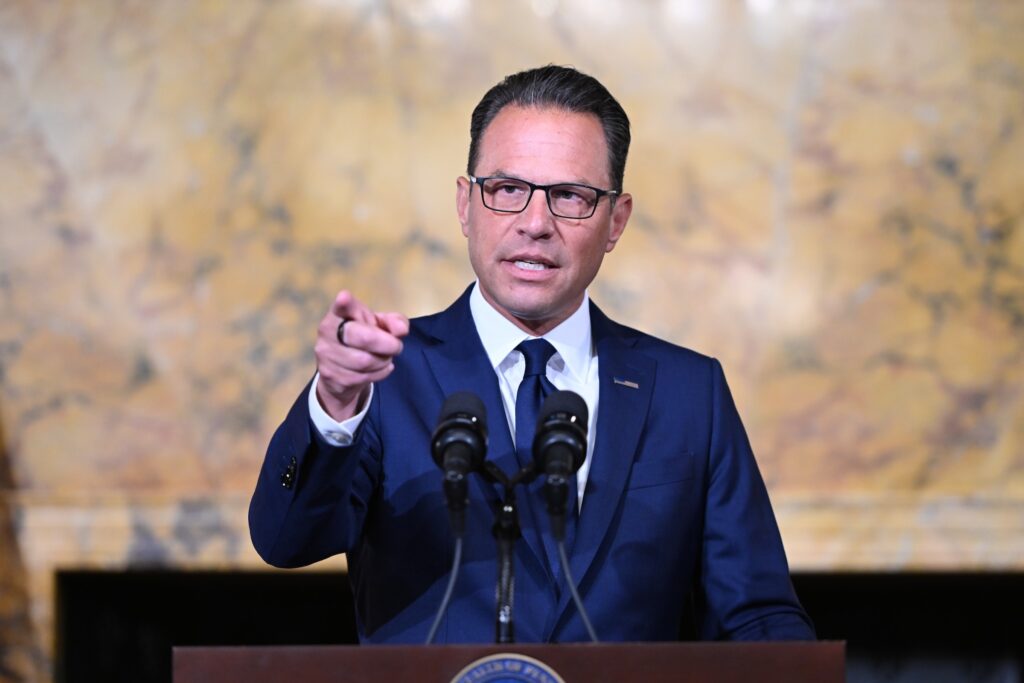
Governors’ races are being increasingly buffeted by the toxic politics of data centers
Pennsylvania Gov. Josh Shapiro is just one of several governors across the country trying to address the hot button issue of residents not wanting data centers near them.
3 months ago
How Trump’s support of data centers could impact local races
Samuel Chen, a political science professor and Republican political strategist, said hundreds of thousands of dollars have been poured into the state Senate race for Pennsylvania’s 24th District because it’s one of just a few competitive districts that could help decide who controls the state’s upper house.
Chen said he’s not surprised by the rise of data centers as an issue motivating voters.
“Data centers are one of the issues where there is largely a disconnect between the policy hive mind, the insiders so to speak, and the voting public,” said Chen. “The voting public is adamantly against it, versus insiders, whether in Harrisburg or D.C. … it’s almost the polar opposite.”
Chen said pressure from lobbyists, donors and party leaders has put local lawmakers in a bind, especially Republicans like Pennycuick.
“The Republican struggle is that the president is very, very pro data centers and pro AI, and so you see [U.S.] Senator McCormick has been very vocal about his support of this even though the majority of the state is not,” said Chen.
State Sen. Pennycuick said she’s “not worried” that President Donald Trump’s position on data centers could impact her race.
“I think it’s a very local issue and I think people respond to it locally and say it’s good for some places, but it’s not good for us,” said Pennycuick.
Pennycuick said she’s shifted her position on data centers since sponsoring the fast-track legislation, which she later amended to include local control, but it has not moved out of committee.
“Two years ago when data centers first came up, we were kind of sold this idea that they were a better alternative than warehouses because they were kind of benign,” Pennycuick said. “Big buildings with computer servers inside and not a lot of traffic from trucks. And then as you learned more about them, it was like, well, wait a minute, these aren’t great for every community, and it seemed like every community had someone that wanted to put one there.”
Related Content

The task force would be required to develop recommendations for data center regulations. Residents say a moratorium is needed in the meantime.
2 months ago
Listen 1:01When neither candidate supports a moratorium on data centers
Pennycuick said she doesn’t want to see agricultural land converted to data center use. But she said that some communities may welcome them.
“I would not support a moratorium statewide because there are areas in our state that want them, that actively seek them out, and I don’t want to deny a community that opportunity if that’s what they want,” she said.
Instead, Pennycuick said, she now supports “serious regulatory oversight,” including the ability for local authorities to reject a proposal, along with protections on water usage, provisions to prevent additional electricity costs to be borne by ratepayers, no foreign ownership, and a ban on nondisclosure agreements between data center developers and elected officials.
Pennycuick won the district by 4 percentage points in 2022. The 24th District supported Trump by only about 2 points in 2024.
A recent poll found Democratic challenger Chris Thomas leading Pennycuick 46% to 44%, with Green Party candidate Michael Schonewolf receiving 3% and 7% undecided. The poll’s 4-point margin of error means the race remains effectively tied.
Like Pennycuick, Thomas also opposes a data center moratorium.
“The purpose of the moratorium is to give time to allow some breathing room,” Thomas said. “We already know the guardrails that we need to put in place: stopping Big Tech from jacking up our utility bills, demanding accountability from utility providers, ending backroom deals, not treating public land like a corporate giveaway, stopping big tech from polluting our air, water, and land.”
Pennycuick has launched ads questioning Thomas’ commitment to opposing data centers. She points to the support he’s received from the building trades unions.
“He took money from the trades, and those trades want the data center developer money, they want to get these data centers,” said Pennycuick. “It’s good construction jobs and [the building trades] don’t care.”
Pennycuick has also tried to tie Thomas to a data center developer but the connection is tenuous — Thomas said he was hired by a company that had previously done work on a site that later became the proposed Amazon data center in Falls Township.
Thomas referred to the ads linking him to data centers as a “blatant lying and smear campaign.”
Thomas supports Gov. Shapiro’s GRID plan to regulate data centers. Shapiro himself shifted gears after touting data center development in his February budget address. In August, the governor signed an executive order implementing the plan after opposition to AI data centers grew, and he pivoted away from voluntary compliance.
Pennycuick also expressed support for the bulk of the governor’s executive order.
Dziembowski, who has two school-age children and is a public health educator, said she’s frustrated that neither candidate will sign on to a moratorium. She said she can’t speculate about Thomas’ opposition but that it could be external pressures like the building trades unions. She said she spoke with Pennycuick about her position on a moratorium and told her it’s not her job to represent other district’s wishes, and that given the overwhelming opposition to data centers in the 24th District, she should sign on to a moratorium.
Dziembowski said the battle against data centers has larger implications than the quality of life for her and her neighbors.
“I have students that are using AI to complete their assignments,” Dziembowski said. “So that’s frustrating. I go home and I’m worried about my kids and AI creeping in, and them being exposed to untrue things. And now it’s like, oh, the physical manifestation of that is being proposed to be built on both sides of my house. When you zoom out, it really shows how people feel the government is not working for them and they want change. [Data centers] could be the symbol of it. Listen, this community is saying no, and the people that we elect to move this needle for us are not doing that. So, something needs to change.”
Carmen Russell-Sluchansky contributed to this story.

Get daily updates from WHYY News!
WHYY is your source for fact-based, in-depth journalism and information. As a nonprofit organization, we rely on financial support from readers like you. Please give today.
Part of the series
Part of the series

Trump’s Justice Department faces a new era of scrutiny under a Democratic-led Congress
Attorney General Todd Blanche says the department will cooperate with Congress but has also insisted that “we will not back down” from the Republican president's agenda.
2 days ago
Delaware district judge rejects Trump’s DOJ attempt to obtain the state’s voting data
The U.S. Department of Justice wanted the state’s unredacted voter list, including Social Security numbers and addresses.
4 days ago
Listen 0:58
Camden County residents agree to tax increase to reduce sewage spills, preserve nature
Millions of gallons of raw sewage spills into Camden’s waterways because of outdated sewer systems.
6 days ago
Listen 0:57