
Pennsylvania lawmakers push federal bill to boost clean energy
The Energy Bills Relief Act would reinstate tax incentives and speed the development of new clean energy projects.

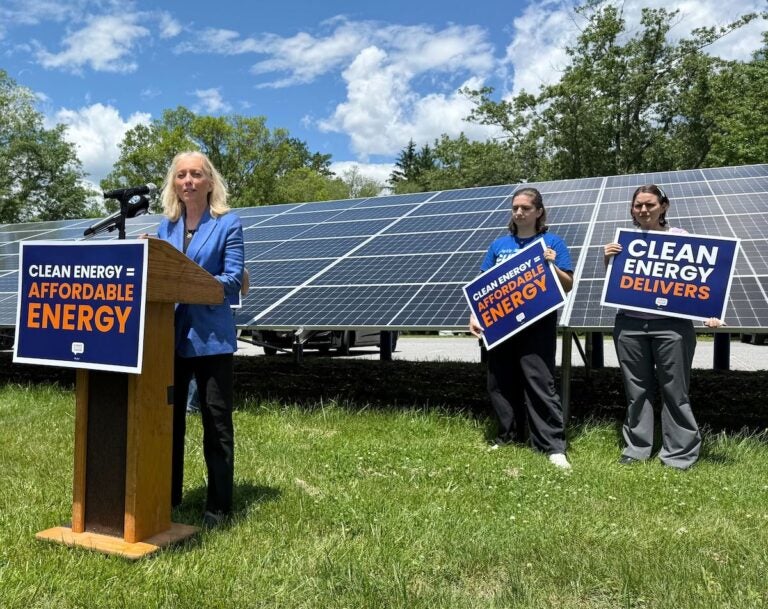
U.S. Rep. Mary Gay Scanlon is advocating for federal legislation that aims to promote clean energy and reduce peoples’ energy bills. (Zoe Read/WHYY)
This story is part of the WHYY News Climate Desk, bringing you news and solutions for our changing region.
From the Poconos to the Jersey Shore to the mouth of the Delaware Bay, what do you want to know about climate change? What would you like us to cover? Get in touch.
Democratic lawmakers and environmental advocates from Pennsylvania are advocating for proposed federal legislation that aims to promote clean energy and reduce peoples’ energy bills.
The Energy Bills Relief Act, sponsored by U.S. Rep. Sean Casten, D-Ill., and U.S. Rep. Mike Levin, D-Calif., would expand payment assistance programs and tax credits for renewable energy.
The bill was drafted in response to the Trump administration’s decision to dismantle parts of the Inflation Reduction Act that provides incentives for green energy and fund programs that aim to reduce climate warming emissions.
President Donald Trump has called for more oil and gas drilling.
“We have an administration now that is doing everything it can to promote fossil fuel energy, even when it means that Americans are paying higher costs,” said U.S. Rep. Mary Gay Scanlon, D-Delaware County, who is co-sponsoring the legislation.
“Families should not be stuck paying higher utility bills because of massive new energy demands from giant corporations and data centers. This legislation would push for fairness and accountability so that everyday ratepayers come first.”
The bill would reinstate tax credits for homeowners who want to install solar panels or upgrade their air conditioning units and furnaces, which can help reduce electricity bills. It would also expand the federal Weatherization Assistance Program, which provides free home energy upgrades by funding essential structural repairs like plumbing and allowing contractors to take on more comprehensive improvements.
Trump’s “One Big Beautiful Bill Act,” which Congress passed last year, rolled back energy efficiency, home improvement and electric vehicle tax credits.
“Not only is this a blow to climate action, it also comes at a time when families and businesses are suffering from rising costs, frankly, of everything,” said U.S. Rep. Madeleine Dean, D-Montgomery County, another co-sponsor of the Energy Bills Relief Act.
The bill would expand funding and eligibility requirements for the Low-Income Home Energy Assistance Program, known as LIHEAP, which about 300,000 residents in Pennsylvania rely on.
The proposal comes as the price of electricity is soaring.
Though freezing weather conditions have contributed to high utility bills, rate hikes have also been driven by a supply-and-demand imbalance, increased power demand from data centers and slow construction of new energy-generation infrastructure.
Electricity bills are also rising as utilities recover costs and earn returns on their system upgrades above their financing costs. PECO’s profits increased by almost 50% after it imposed rate hikes in 2025 that were approved by utility regulators.
Related Content
A Philly lawmaker’s bill would rein in utility profits: ‘The entire system is out of whack’
The bill’s supporters say it would align investor-owned utility profits with typical Wall Street earnings. Utilities say it would threaten infrastructure investment.
2 weeks ago
Listen 1:04People across the U.S. say they are struggling to pay their bills, and it’s evident in states like Pennsylvania, where utility shutoffs increased by 21% last year.
Soaring energy prices have affected residents like Holly Taylor of Concord Township, who said she’s bracing for impact as the summer heat creeps around the corner.
“It’s become clear to me that individual household habits are not the main root cause of our skyrocketing energy bills,” Taylor said.
The legislation aims to tackle the boom of artificial intelligence-focused data centers, which are straining the power grid. PJM Interconnection, which manages the region’s electrical grid, has pointed to the proliferation of data centers as a reason for higher electricity bills.
Though the legislation doesn’t directly hold data centers accountable, it would direct states to adopt standards to protect ratepayers. While utility regulators, and Pennsylvania Gov. Josh Shapiro, have made proposals that strongly encourage data centers to pay for their own energy usage and infrastructure, enforcement of such measures would require legislation.
The Energy Bills Relief Act also proposes several steps to combat Trump-led policies intending to divert the U.S. from renewable energy. The bill would block U.S. presidents from invoking harsher permitting requirements for clean energy projects and from invoking “energy emergencies” to open fossil plants — a move Trump made during his first days in office to prevent the closure of aging coal and oil power plants.
The legislation would also speed up the process of connecting new clean energy sources to the grid and provide tax credits for certain projects. It would streamline permitting for energy systems that generate electricity at or near where it will be used rather than sending it through high-voltage transmission lines. The bill would also ease hurdles for offshore wind development.
“As energy prices continue to rise with no end in sight, the path forward is clear,” said Alice Lu, a policy analyst for the nonprofit Clean Air Council during a press conference. “Clean energy delivers. It lowers costs, reduces harmful pollution and builds the resilient grid that Pennsylvania needs to meet rising energy demands today and for decades to come.”

Get daily updates from WHYY News!
WHYY is your source for fact-based, in-depth journalism and information. As a nonprofit organization, we rely on financial support from readers like you. Please give today.
Part of the series
A Philly lawmaker’s bill would rein in utility profits: ‘The entire system is out of whack’
The bill’s supporters say it would align investor-owned utility profits with typical Wall Street earnings. Utilities say it would threaten infrastructure investment.
2 weeks ago
Listen 1:04
Pa. Gov. Shapiro says regulated utility system is ‘broken’
In a letter to the state’s regulated utilities, the governor laid out a new system to rein in corporate profits.
4 weeks ago
Listen 6:05
Delaware lawmakers advance measure to protect state’s wetlands
After several failed attempts to protect nontidal wetlands, Delaware lawmakers have introduced legislation that developers say they can get behind.
1 month ago
Listen 1:19