

PECO bills will rise by about $5 on average starting June 1
The increase comes as rising demand and infrastructure costs continue pushing electricity bills higher.
Listen 1:01
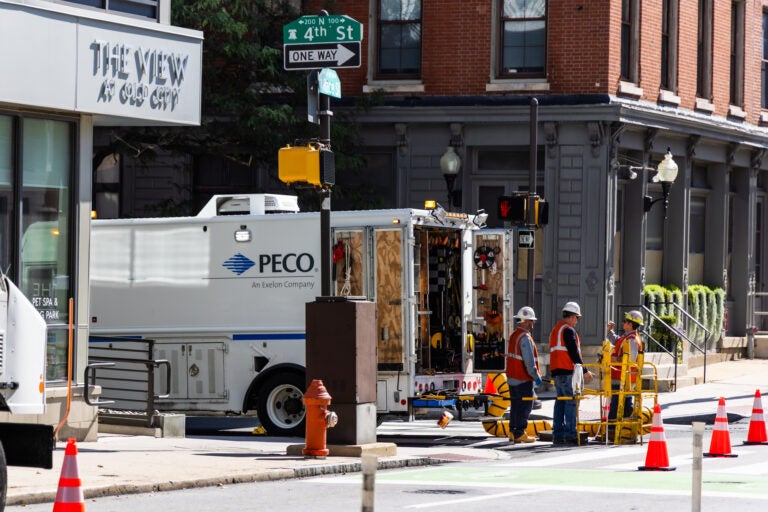
PECO employees do electrical work at 4th and Race Streets in Philadelphia. (Kimberly Paynter/WHYY)
This story is part of the WHYY News Climate Desk, bringing you news and solutions for our changing region.
From the Poconos to the Jersey Shore to the mouth of the Delaware Bay, what do you want to know about climate change? What would you like us to cover? Get in touch.
PECO ratepayers will see their bills rise again in June, just as households start to turn on their air conditioners for the summer.
The typical household’s monthly electricity bill will increase around $5 due to a roughly 5% hike in the portion of the bill that covers electricity supply.
“We keep seeing that these prices are increasing, and we recognize that affordability is a concern for our customers,” said Candice Womer, a spokesperson for PECO.
Electricity bills have been rising for a variety of reasons, an energy policy expert told Philadelphia City Council earlier this month. Those include increasing power demand on the regional grid driven by data centers, more widespread use of electricity for cars, heating and manufacturing, and utility investments in infrastructure and extreme weather preparedness.
The price hike hitting bills June 1 results from an increase in the cost of the electricity supply, which makes up about half of the typical customer’s bill and which utilities pass along to ratepayers without an upcharge. The rest of a bill covers a utility’s delivery of electricity to homes and businesses, including the rates a utility charges to build and maintain grid infrastructure.
The supply price increase reflects the cost of producing the electricity itself and the capacity costs, or the fees utilities pay to power generators to ensure the electricity supply will meet future peak demand. Capacity costs, which are set during auctions held by the regional grid operator, PJM Interconnection, have recently surged due to a supply-and-demand crunch on the grid. Record-high capacity prices set during auctions in 2024 and 2025 will continue to phase in June 1.
Related Content
A Philly lawmaker’s bill would rein in utility profits: ‘The entire system is out of whack’
The bill’s supporters say it would align investor-owned utility profits with typical Wall Street earnings. Utilities say it would threaten infrastructure investment.
3 months ago
Listen 1:04Pennsylvania Gov. Josh Shapiro negotiated a lower cap on capacity auction prices last year, which limited bill increases from the last two capacity auctions. PJM agreed to extend this lower cap to cover auctions held through the end of this year, which will determine capacity costs for electricity supply delivered through 2030.
PECO bills have been rising faster than inflation the past five years, according to a WHYY News analysis of rate data published by the Pennsylvania Public Utility Commission. But when adjusted for inflation, bills are similar to what customers paid a decade ago.
PECO profits skyrocketed nearly 50% last year after the company raised its distribution rates in 2025. The company withdrew a request for another rate hike earlier this spring after Shapiro called the request “pure greed.”
From the beginning of 2026 through the end of April, PECO shut off electric service to roughly 17,000 customers for missing payments, a more than 14% increase over the same period last year, according to the commission.
In the Philadelphia metro area, the typical low-income household spends more of its income on energy bills than the typical low-income household across the U.S., according to the American Council for an Energy-Efficient Economy. Energy cost burdens are disproportionately high for Black and Hispanic families in the Philadelphia area.
Womer recommended that PECO customers struggling to pay their bills contact the company about assistance programs, payment plans and budget billing. She also encouraged customers to improve their home energy efficiency through steps such as paying for a PECO energy assessment or using rebates to purchase energy efficient HVAC equipment or weatherization.
“Energy efficiency can really be a way for customers to save money,” Womer said. “Little tips like closing the blinds, making sure that their house stays cool naturally and using fans when they’re in the room. Those little things really do add up.”

Get daily updates from WHYY News!
WHYY is your source for fact-based, in-depth journalism and information. As a nonprofit organization, we rely on financial support from readers like you. Please give today.
Part of the series
Amazon to install hundreds of gas-fired generators at Bucks County data center site
Nearby residents opposed the project during a tense public meeting Tuesday.
3 weeks ago
Listen 1:07
PECO strike ends as union and utility announce deal
IBEW Local 614 is celebrating a deal that offers pensions to recent hires and boosts health care coverage. Union members will now vote on whether to ratify the contract.
1 month ago
Listen 1:20
Public utility regulators say the natural gas explosion was not caused by PGW infrastructure.
1 month ago
Listen 1:13