

Pennsylvania Gov. Josh Shapiro calls PECO rate hike request ‘pure greed’
PECO seeks to raise rates again by 12.5% for Philly and suburban electric customers. The governor's office says Shapiro believes the rate case should be withdrawn immediately.
Listen 1:33
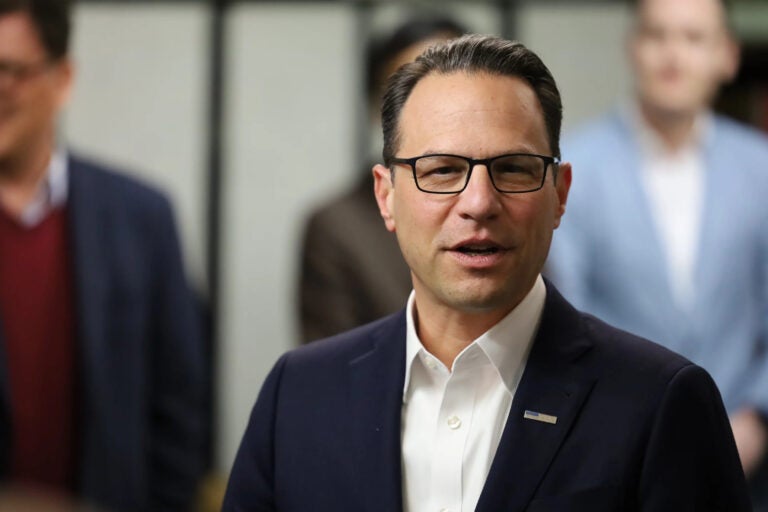
FILE - Gov. Josh Shapiro speaks at Al-Aqsa Islamic Society in Philadelphia on Tuesday, March 25, 2025. (Carmen Russell-Sluchansky/WHYY)
This story is part of the WHYY News Climate Desk, bringing you news and solutions for our changing region.
From the Poconos to the Jersey Shore to the mouth of the Delaware Bay, what do you want to know about climate change? What would you like us to cover? Get in touch.
Pennsylvania Gov. Josh Shapiro is lashing out at PECO on social media for proposing new rate hikes in the face of record profits.
“Last year PECO raised prices on Pennsylvanians and made an obscene $814 million in profit,” Shapiro wrote on X on Friday.
“They could have used that money to offset people’s costs — instead they passed it onto shareholders,” he continued. “Now they want to jack up prices even more. It’s pure greed, and I’ll do everything I can to stop it.”
In an email, the governor’s office said he “believes PECO should withdraw their rate case immediately. If they do not reconsider, the Governor will use all means at his disposal to prevent PECO from raising rates on hardworking Pennsylvanians.”
It’s unclear what Shapiro can or will do to prevent the rate hikes. In response to a question on whether the utility would withdraw the proposal, PECO spokesperson Candice Womer said in a statement that the company “shares Governor Shapiro’s concerns about affordability and remains focused on keeping customer bills as low as possible while continuing to invest in safe and reliable service.”
“We look forward to continuing to work constructively with the Governor and other stakeholders to balance affordability with the investments needed to serve customers across southeastern Pennsylvania,” Womer said.
PECO’s 2025 net profits, as reported by WHYY News, came after the utility raised electricity rates for customers by 10% in 2025. As a result, net profits rose from $551 million in 2024 to $814 million in 2025, a nearly 50% jump.
Calvin Butler, the president and CEO of PECO’s parent company, Exelon, earned more than $15.6 million in 2025.
The utility is seeking to raise rates again in 2027 by 12.5% for electricity customers in Philadelphia and its suburbs. Suburban natural gas customers could also pay an increase of 11.4%. If approved by the Pennsylvania Public Utility Commission, the increase would raise a typical electricity customer’s bill by $20.08 a month and a typical gas user by $14.52 a month, according to PECO.
PECO sought and received rate increases four times between 2015 and 2025. PECO’s gas division received approvals to raise rates three times between 2020 and 2024.
The rate of return, or return on equity, for investors that PECO is seeking with this new rate hike is 10.95%, which is much higher than the national average, said Marissa Gillett, a senior fellow at the American Economic Liberties Project and a former chair at the Connecticut Public Utility Commission where she advocated for more meaningful public input.
“My take on the governor’s tweet, what caught his eye in the situation was the 10.95% [return on equity] that they’ve embedded in their request,” Gillett said. “That is alarmingly high. That is almost 100 basis points higher than the national average.” The national average was 9.75% in the first quarter of 2025.
Last year PECO raised prices on Pennsylvanians and made an obscene $814 million in profit.
— Governor Josh Shapiro (@GovernorShapiro) April 3, 2026
They could have used that money to offset people's costs — instead they passed it onto shareholders.
Now they want to jack up prices even more.
It’s pure greed, and I'll do everything… https://t.co/2kPa3xjfot
Investor-owned utilities like PECO make their profits off of infrastructure spending, so the more they spend, the more money they can make.
“And considering that the level of profit that PECO has been earning over the past couple of years is also in excess of the national average,” Gillett said.
Shapiro is up for reelection this year against Republican Stacey Garrity, a campaign where affordability features prominently.
PECO said in a statement that the company shares “Shapiro’s concerns about affordability” and that it remains “focused on keeping energy bills as low as possible for customers across southeastern Pennsylvania.”
The company said the rate hike is necessary for “maintaining a safe and reliable energy system amid growing demand, more frequent severe weather, and aging infrastructure.”
PECO said it plans to spend $10 billion over five years to “reduce outages, strengthen the grid, protect customers during extreme weather, and modernize the natural gas system. About 90 percent of what PECO earns is reinvested directly back into system reliability, safety, and service quality.”
Related Content
How PECO’s profits impact your electricity bill
Electricity rates are rising along with profits for investor-owned utilities.
1 month ago
Listen 6:59Pa. lawmakers speaking out on PECO rate hikes a ‘sign of the times’
It’s not just the Democratic governor weighing in on this rate hike. Last week, a group of Bucks County Republican lawmakers sent a letter to PECO asking the company to “reconsider” its proposal.
“It is not lost upon us that PECO received a rate increase of 10% for electric and 12.5% for natural gas in January 2025. Since those rate increases were implemented, PECO’s net revenue increased 47.7% over the previous year to $814 million in 2025,” reads the letter signed by four Republican state representatives and one state senator.
“While we understand the need to improve electrical and natural gas infrastructures, we believe raising rates will have a negative impact on our constituents who are already burdened with high costs,” it continued.
A group of Montgomery County Democrats is also pushing back with a petition for residents to sign asking the commission to reject PECO’s proposal.
“At a time when residents are concerned about increased grocery costs, the lack of affordable health care, the rising price of filling their gas tanks while they are already stretched thin by prior utility rate increases, these rate increases are unacceptable,” Democratic Rep. Joe Ciresi wrote on Facebook.
Related Content
PECO’s profits skyrocket almost 50% after 2025 rate hikes
Critics say investor-owned utilities, which enjoy a monopoly, earn too much at the expense of ratepayers. PECO says the increased rates fund needed infrastructure upgrades.
2 months ago
Listen 1:15It’s unusual for politicians to be so outspoken on rate cases, which are typically bureaucratic legal proceedings where the public’s interests are represented by consumer advocates, said Gillett.
“I got to tell you, I love it,” Gillett said. “I think that it’s a sign of the times.”
Gillett said that while these communications may be outside of the official rate case proceedings, they do have an impact and could be considered evidence.
“I think seeing elected officials leverage the bully pulpit to escalate the issues that their constituents are facing is entirely appropriate,” she said.
“At the end of the day, the regulator has to sit down and see what the evidence is in the record before it,” Gillett said. “The standard is they have to be just and reasonable, and part of that has to be whether our ratepayers or customers can afford to pay these rates and hearing from elected officials who are amplifying the issues facing their customers, I think is entirely relevant evidence.”

Never miss a moment with the WHYY Listen App!


WHYY is your source for fact-based, in-depth journalism and information. As a nonprofit organization, we rely on financial support from readers like you. Please give today.
Part of the series
PECO withdraws its rate hike case after backlash from Pa. governor, lawmakers
PECO made record profits in 2025 after a recent rate hike. Pa. Gov. Josh Shapiro had called the new proposal “pure greed.”
4 days ago
Listen 1:25
Wilmington residents encouraged to sign up for community solar initiative
Proponents of community solar energy say the initiative is a solution to rising costs of electricity.
6 days ago
Listen 1:26
PGW’s proposed liquefied natural gas plant in Philadelphia’s Port Richmond neighborhood now in limbo
PGW says it needs to replace an aging liquefier in Port Richmond. Philadelphia Gas Commission staff had recommended not to approve the project.
6 days ago