
NJ Transit launches a campaign raising awareness about human trafficking ahead of the World Cup
The campaign features messaging and ads on billboards, transit shelters and at stations emphasizing vigilance and help options for victims.
Listen 1:17
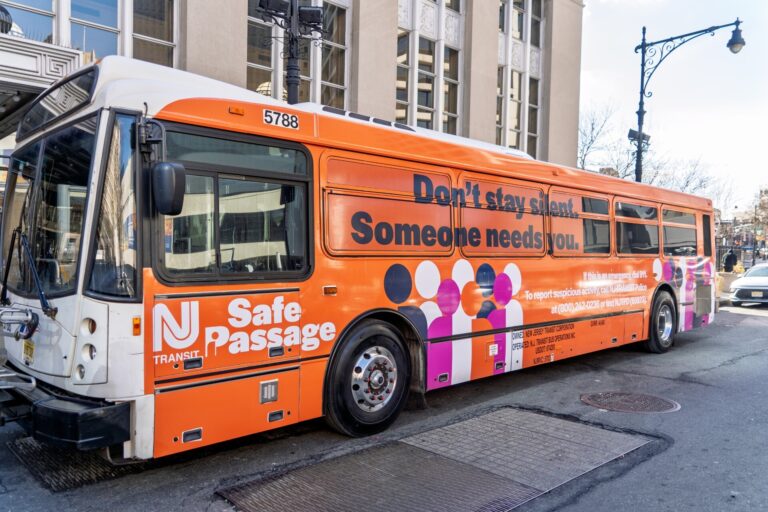
One of two NJ Transit buses wrapped in anti-human trafficking messaging that is touring the state, in recognition of January being National Human Trafficking Prevention Month. (Courtesy NJ Transit)
From Philly and the Pa. suburbs to South Jersey and Delaware, what would you like WHYY News to cover? Let us know!
With several FIFA World Cup soccer matches taking place in New Jersey this summer, NJ Transit has launched a “Safe Passage” antihuman trafficking awareness campaign.
New Jersey is often considered a hub for human trafficking because of its proximity to several major metropolitan areas, including New York City and Philadelphia, as well as for its dense and diverse population, and the extensive transportation routes that connect the state to the entire Northeast.
There is little empirical evidence that ties an increase in human trafficking to major sporting events. Korin Arkin, the director of survivor care and outreach at Polaris, a nonprofit organization that works to combat human trafficking, said that the state playing host to World Cup games does raise a red flag. The tristate area will welcome more than 1 million visitors for the FIFA World Cup 2026, which begins at Met Life Stadium in East Rutherford on June 13.
“It does create opportunities for trafficking in the construction industry, in the hospitality industry,” she said. “Obviously when you have a lot of people gathering in one place, there could be a lot more exploitation opportunities that occur.”
Arkin said human trafficking is an underreported crime across the nation. She said in 2024, which is the most recent data available, the National Human Trafficking Hotline received 884 calls, emails, texts and webchats from individuals in New Jersey.
“It does indicate people in New Jersey were reaching out to the hotline quite a bit,” she said. “It is significant.”
The ‘Safe Passage’ campaign
The campaign will focus on public safety and awareness with billboards, transit shelter ads and station signage signs emphasizing protection, vigilance and help options. The agency will also distribute victim-support materials targeted at moments of potential separation from traffickers.
For the rest of this month, in recognition of National Human Trafficking Prevention Month, two NJ Transit buses wrapped in antihuman trafficking messaging will operate statewide.
During a press conference at Newark Penn Station on Thursday, NJ Transit President and CEO Kris Kolluri said the agency’s most important obligation is to be a good community partner.
“What we’re talking about is making sure we’re protecting our fellow human beings, that’s what this is about,” he said. “I think of no greater calling or privilege to make sure we protect our fellow human beings.”
Related Content
World Cup final will be an afternoon match at MetLife Stadium, allowing prime-time viewing in Europe
FIFA revealed matchups for the new round of 32 and other stages.
3 months ago
NJ Transit Police Chief Christopher Trucillo said human trafficking often occurs in plain sight anonymously, in situations when people are distracted by getting from point A to point B, so law enforcement needs to be vigilant.
“That is why here at New Jersey Transit, every police officer is trained in the signs and indicators of human trafficking,” he said.
According to Trucillo, 1,500 frontline employees are receiving training, but he stressed that members of the traveling public are often the first to notice when something doesn’t look right.
“Maybe you don’t want to get involved, you’re worried about being mistaken, don’t feel that way. Don’t be shy about reporting. Your eyes and ears matter too,” he said.
The National Human Trafficking Hotline number is 1-888-373-7888.
How trafficking works
According to Polaris, labor trafficking most often involves a simple job offer. The website indicates:
- Anyone can be victimized by a labor trafficker, but certain people are far more vulnerable than others. Economic need is a key risk factor and immigrants – including immigrants who are in this country legally – are particularly vulnerable to labor trafficking.
- “It becomes trafficking when pay or working conditions are abusive and the worker cannot quit or complain because the boss is threatening them or exploiting their desperate economic circumstances. Kidnapping or physical force are rarely part of how labor trafficking situations begin,” Polaris said.
- Traffickers can be business owners, bosses or other workers with a managerial role in a formal business. Traffickers can also be victims’ families or legal guardians, including parents, spouses and intimate partners.
Signs of trafficking
According to the Polly Klaas Foundation, a nonprofit dedicated to the safety of all children, there are indicators suggesting a child may be at risk of, or already is being trafficked:
- Sudden changes in behavior: Unexplained shifts in personality, increased secrecy or involvement with questionable associates.
- Physical indicators: Bruises, burns, tattoos, which are often used for branding, or multiple cellphones.
- Unusual access to money or luxuries: Items outside a child’s means, unexplained absences from school or new, expensive belongings.
- Online solicitations: Communication with unknown adults or receipt of inappropriate content.
Officials said mass transit passengers can send an anonymous text message to NJTPD or call 911 if they believe something is wrong.

Never miss a moment with the WHYY Listen App!


WHYY is your source for fact-based, in-depth journalism and information. As a nonprofit organization, we rely on financial support from readers like you. Please give today.
Human trafficking is a growing problem in New Jersey. Many teen runaways are lured, manipulated and controlled by ruthless traffickers.
2 years ago

In the rough: Felony convictions could cost Trump liquor licenses at 3 New Jersey golf courses
The state’s attorney general’s office is looking into whether Trump’s recent felony convictions make him ineligible to hold liquor licenses at his three N.J. golf courses.
2 years ago
Suit: Workers lured to N.J. from India paid $1.20 per hour for years
The lawsuit filed in federal court accuses the leaders of the organization known as BAPS of human trafficking and wage law violations.
5 years ago