

Rare Revolutionary-era documents on display at N.J. State Museum for 250th anniversary exhibit
Rare documents and artifacts are on display at the museum in Trenton through the end of the year.
Listen 1:05
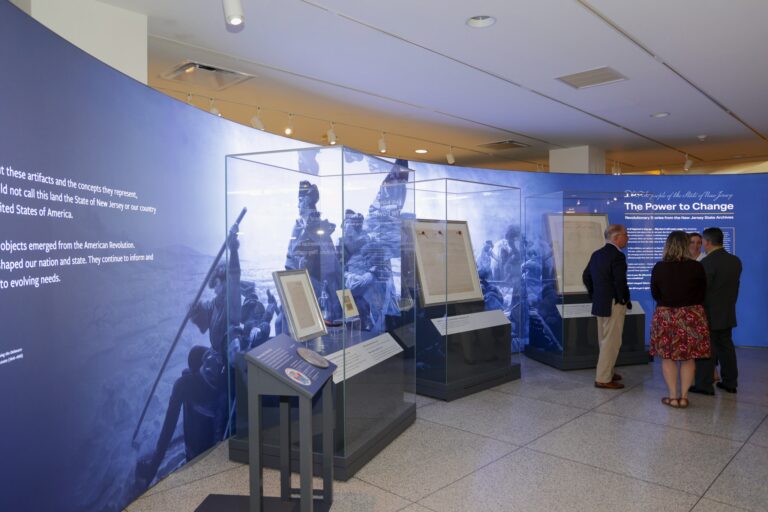
The Power to Change exhibit features rare documents from the NJ State Archive. (Courtesy of New Jersey State Museum)
From Camden and Cherry Hill to Trenton and the Jersey Shore, what about life in New Jersey do you want WHYY News to cover? Let us know.
As part of a celebration of the United States’ 250th anniversary, the New Jersey State Museum, in partnership with the New Jersey State Archives, is presenting an exhibit titled “The Power to Change: Revolutionary Stories from the New Jersey State Archives.”
“We call this exhibit the power to change because it’s about this awesome authority that our fathers vested in the people of New Jersey and the people of the United States to govern themselves,” said Joseph Klett, executive director of the New Jersey State Archives. “They gave us the ability to change our course as we need to over time, through the founding documents.”
As visitors enter the exhibit, they will stand before the state and federal charters.
“The first is the state constitution of 1776,” he said. “It’s New Jersey’s declaration of independence from the crown [British monarchy].”
The second document on display is the ratification of the United States Constitution from 1787, and alongside it is the New Jersey ratification of the Bill of Rights, circa 1789.
“New Jersey was the first state to ratify the Bill of Rights. It was the third state to ratify the Constitution, so we’re called the third state,” Klett said.
He stressed that having these documents on display for the public to see is rare.
“For most of the last 50 years, these documents have lived in the vault of the state archives; they have not been on display for a duration of time,” Klett said. “This is the first time since the Bicentennial that you’ll be able to see these documents for an extended period of time.”
Claudia Ocello, the consulting curator for the exhibit, said different themes are highlighted, from the 1600s to the present.
“In thinking about our history and talking to the staff at the Archives, I was able to narrow things down and put things into categories,” she said. “The goal was to bring out some of the stories that show how the past has influenced the present, and how we’re continuing some of the ideals and stories that were started in the revolution.”
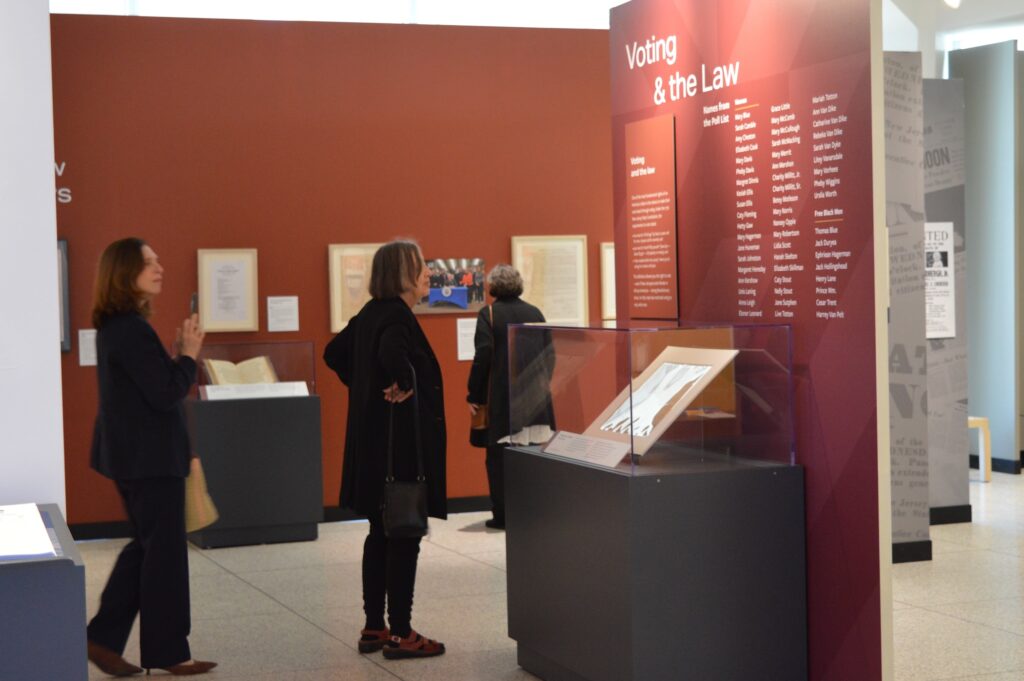
Owning property and land
In the first section, “Owning Property and Land in New Jersey,” a deed displayed from the Duke of York gave two Englishmen the proprietary rights to what is now the Garden State in 1664. Another document, written in 1677 on vellum, a type of parchment made from animal skin, bears the marks of several Indigenous leaders who sold the rights to what is now Gloucester County to a group of English settlers.
Klett said the tribes understood there would be an influx of people from Europe, and they were interested in getting guns, utensils, tools and other materials.
Belonging
The second section of the exhibit is called “Belonging.”
“Obviously in the history of our country and in our state different groups have not always felt they were welcome, that they belonged,” Klett said. “We also explore how groups formed their own communities so they could establish their own sense of belonging.”
In this section, visitors can learn about the Bordentown Manual Training and Industrial School for Colored Youth that operated from 1886 to 1955.
“It was where young Black men and women learned trades,” he said. “We have a motion picture showing the school and the classrooms.” The campus was situated on 400 acres overlooking the Delaware River.
Another display focuses on Seabrook Farms in Cumberland County, where Japanese Americans were interned during World War II.
Patriotism and loyalty
A separate section of the exhibit focuses on patriotism and loyalty.
“We explore whether it is patriotic to protest against the government if you believe there’s something wrong that should be fixed,” Klett said. “We wanted to look at that from different angles.”
He said one document on display from 1762 is the appointment of William Franklin, Benjamin Franklin’s son, as a royal governor by King George III.
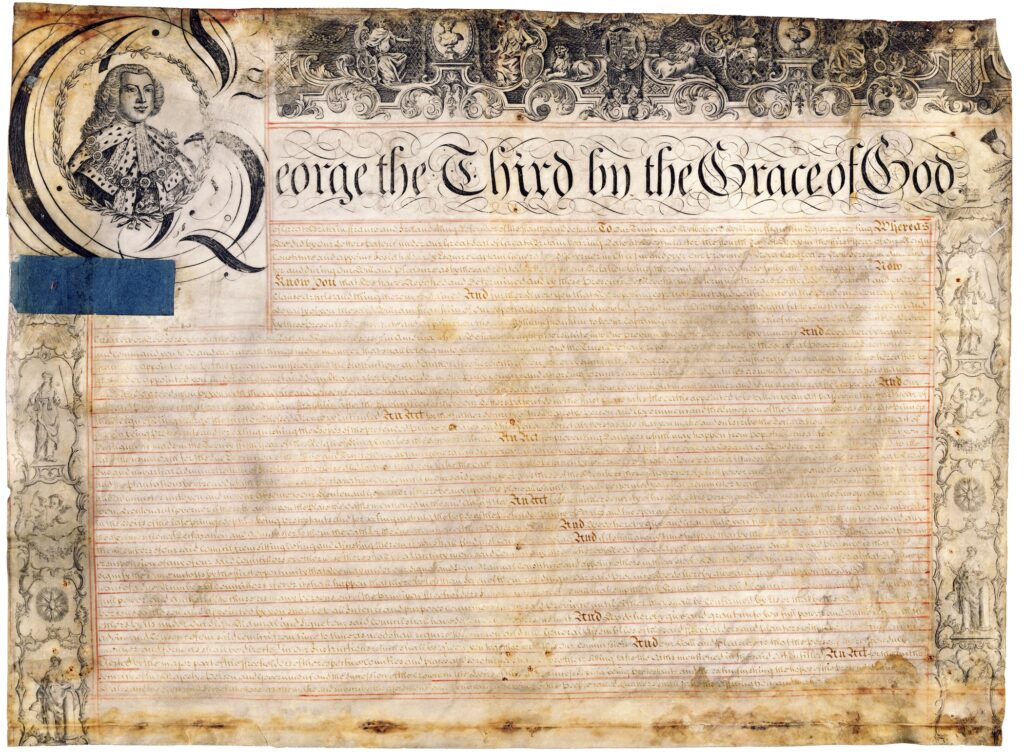
“That’s a symbol of loyalty to the king,” he said. “William Franklin, unlike his father, stayed loyal to the king throughout the Revolutionary War and ended up in exile in England.”
The exhibit also features a “Hello Girls” uniform, the outfit worn by women who operated the telephone communication systems for the American military during World War I.
Related Content
What Thomas Jefferson meant by "the pursuit of happiness" may be very different from what Americans mean today.
4 months ago
Listen 1:18Laws
A section of the exhibit also looks at laws pertaining to everyday life.
“We explain how you can petition the legislature to create laws to make society a better place, how laws have been in place for centuries to protect the environment and natural resources, how laws affect us and how people get involved in changing laws,” he said.
One petition on display was from a group of Quakers in Burlington County calling for the abolition of slavery in 1783.
The exhibit also features a poll list from Montgomery Township, showing the names of women and slaves who voted in 1801. Klett said they were able to do so because the original state constitution did not restrict voting by race or gender.
“You had to have 50 pounds to your name, whether it was land, or money in your pocket, and as long as you had that, you could vote, even if you were a slave,” he said.
Klett noted voting rights for slaves were abolished in 1790, and New Jersey women and free Black people lost the right to vote in 1807.
“Women would not get the right to vote again until 1920 and Black men would not get to vote until 1870,” Klett said.
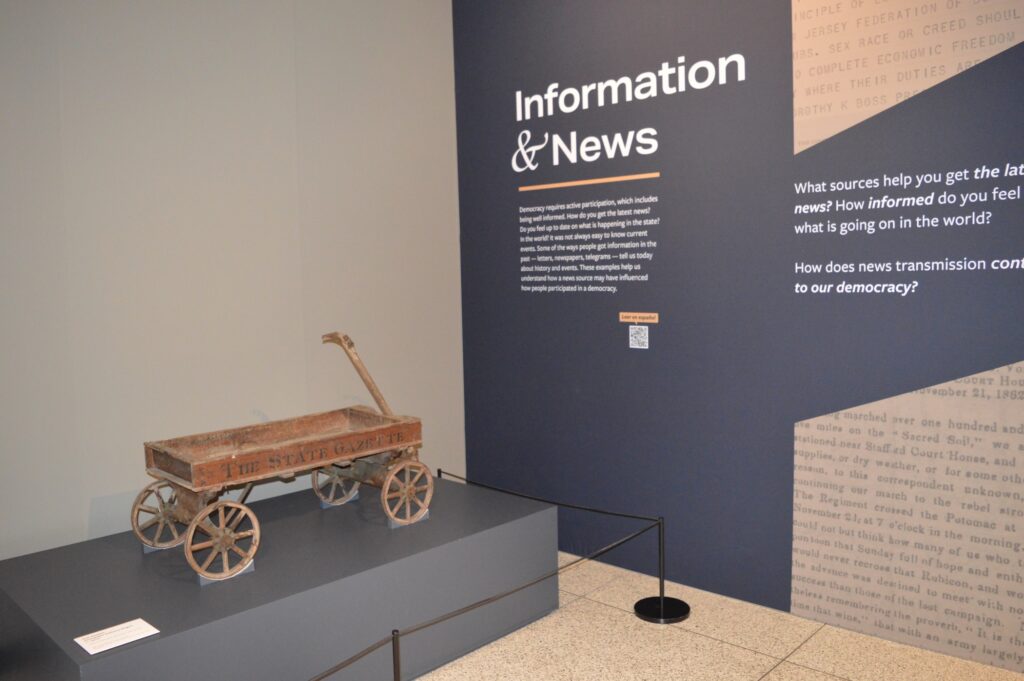
Information and news
This section of the exhibit examines how news and information got to the people.
“We start with letters that may have taken months to get across the ocean, up until what you see on your cell phone in almost real time,” he said. “We have on display a delivery wagon that was used by the New Jersey State Gazette in Trenton, that tells the story of newspapers and media and how information was shared.”
Also on display is an early printing of the U.S. Constitution in 1787.
“There were some typographical errors in the first printing, and they were replaced by a second printing right away,” he said. “But before that happened the New Jersey delegation sent the original printing to the New Jersey legislature. We have one of only 12 copies that exist worldwide.”
The revolution continues
The exhibit closes with a section called ‘The Revolution Continues.’ Klett said while the Revolutionary War between the colonies and Great Britain ended in 1783, America continues to reinvent itself.
“We have the ability to rethink things and revise things and to redirect ourselves,” he said. “The question we ask is, What would you like the United States to look like in 2076, 50 years from now? We invite visitors to write on a card what they would like to see happen, we’ll keep that archived as a record.”
Ocello said it’s important for people to see the American Revolution as relevant to their lives.
“We know that it helped us become a free country, independent from Great Britain, but sometimes you lose sight of other details,” she said. “We’re showcasing stories of real people, regular people living in New Jersey, and we can see ourselves reflected in what they went through.”
She said the exhibit includes interactives and videos.
“We know everybody learns differently so we really wanted to share information in lots of different ways,” Ocello said.
Margaret O’Reilly, executive director of the New Jersey State Museum, said collaborating with the New Jersey State Archives created an opportunity to share rarely seen documents and significant displays.
“The different themes in the exhibit tell the story of the American experiment, from the beginning to the contemporary era,” she said. “All of our laws really inform everyone’s life every day, showing folks the foundation of this is critically important.”
The Power to Change: Revolutionary Stories from the New Jersey State Archives exhibit will remain at the museum for the rest of this year. The museum currently has two other related exhibits, Remembering the Revolution, and Spirit of ’76: The Bicentennial.
Located at 205 West State St. in Trenton, the New Jersey State Museum is the largest museum collection in the state and encompasses three buildings, including a state-of-the-art Planetarium. It is open from 9 a.m. to 4:45 p.m. Tuesday to Sunday. The museum is closed Mondays and New Jersey state holidays.
Editor’s note: This story has been updated to reflect the correct date of the state’s constitution and date when women and people held in slavery voted.

Get daily updates from WHYY News!
WHYY is your source for fact-based, in-depth journalism and information. As a nonprofit organization, we rely on financial support from readers like you. Please give today.
Part of the series
Philadelphia 250
The United States is marking its semiquincentennial — or its 250th anniversary — in and around the City of Brotherly Love.
El muralista Christian Kanienberg afirma que le interesa “más crear obras de arte que, simplemente, resultan ser murales capaces de suscitar conversaciones”.
3 months ago
Muralist Christian Kanienberg says he’s “more interested in creating pieces of art that just happen to be murals that are conversation starters.”
3 months ago
Listen 2:11
Take that, Boston: Philly has more Declarations of Independence than any other city
Institutions blocks apart from each other have assembled 15 Declarations of Independence among them. They all tell a different story.
3 months ago
Listen 1:22