

Most New Jersey school districts are still recovering from COVID-19 pandemic learning loss; a few are ahead of the curve
The Princeton school district is one of a few “districts on the rise” for math and reading.
Listen 1:02
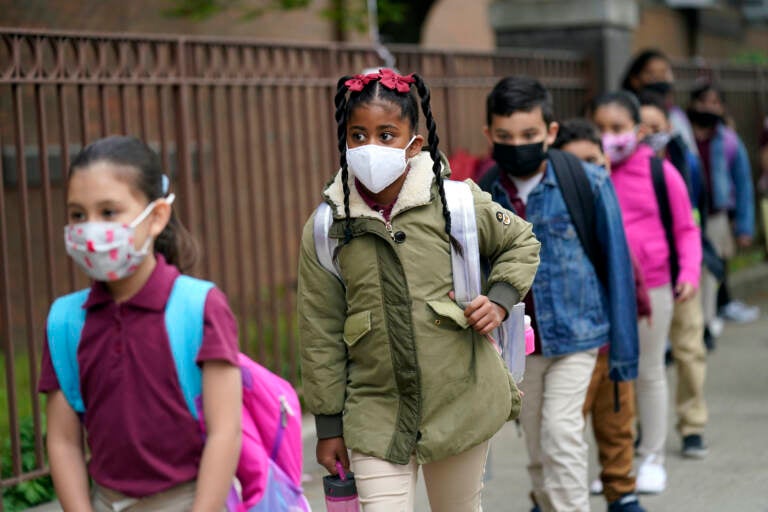
File photo: Students line up to enter Christa McAuliffe School in Jersey City, N.J., Thursday, April 29, 2021. (AP Photo/Seth Wenig, File)
From Camden and Cherry Hill to Trenton and the Jersey Shore, what about life in New Jersey do you want WHYY News to cover? Let us know.
In March 2020, shortly after the World Health Organization declared a global pandemic due to COVID-19, New Jersey Gov. Phil Murphy signed an executive order requiring schools to implement “appropriate home instruction” in place of in-person teaching.
On March 18, 2020, all public schools were closed.
School instruction was disrupted for more than a year, and pandemic learning loss was significant, with student test scores plummeting.
A new report found that the impact of the pandemic continues to be felt among students. The report observed reading and math test score data in almost 6,000 school districts across the nation, including New Jersey, starting in 2019 – the year before the COVID-19 outbreak began – through 2025.
The Education Scorecard, a collaboration between the Center for Education Policy Research at Harvard University and the Educational Opportunity Project at Stanford University, does not compare test scores from states, as states measure academic proficiency levels in different ways. Instead, the data focuses on trends within each state.
The report finds students in grades 3-8 in New Jersey remain nearly .6 grade equivalents below 2019 levels in math, with reading continuing to decline since 2022.
New Jersey ranks 20th out of 38 states in academic growth in math and 19th out of 35 states in reading between 2022 and 2025. The report says that not all states had the data necessary to be included in the study.
According to the report, “each grade-level equivalent represents the average increase in test scores between one grade and the next in the pre-pandemic era. It can therefore be thought of as one year’s worth of learning.”
In math, the average student was found to be performing about .17 grade equivalents above their 2022 level, but about .59 grade equivalents below 2019 levels. Some districts like Edison Township, Trenton and Paterson continued to lag behind 2019 levels.
Statewide, only 10 out of 305 districts were ranked as “districts on the rise” in math: Bloomfield, Freehold, Lawrence, Livingston, Millville, Montclair, Montgomery, Old Bridge, Paramus and Princeton.
In reading, the average student was performing about .14 grade equivalents below their 2022 level, and .41 grade equivalents below 2019 levels. A number of districts like Trenton, Toms River Regional and Edison Township continued to slip and remain over a full grade equivalent behind their 2019 levels.
Across New Jersey, 17 school districts were ranked as districts on the rise in reading, including Bernards, Brick, Fair Lawn, Haddonfield, Lawrence, Livingston, Montclair, Montgomery, Moorestown, Paramus, Piscataway, Princeton, Ridgewood, Wall, Washington (Gloucester County), [a second] Washington and Wayne Townships.
Related Content

Nearly 1 million New Jersey students take arts classes by law. Advocates say sustaining those gains amid budget pressures is the next fight.
6 months ago
Listen 1:11Tom Kane, faculty director of the Center for Education Policy Research at Harvard University and co-author of the report, said different districts are making improvements in math and reading in different ways.
“We can’t tell you exactly what are the things that they’re doing that are making the big difference, but we’re just trying to highlight, ‘Here are the places where it sure looks like good things are happening,’” Kane said.
In addition, Kane said the impact of COVID-19 was significant, but there were earlier signs of academic trouble in many districts.
“The pandemic was the mudslide that followed seven years of erosion in student achievement,” he said. “The learning recession started a decade ago, after policymakers switched off the early warning system of test-based accountability and social media took over children’s lives.”
Sean Reardon, an education sociologist at the Educational Opportunity Project at Stanford University and co-author of the report, agreed that more must be done to improve math and reading comprehension.
“We can provide better educational opportunities and more equal educational opportunities, but we haven’t been doing that very effectively over the last decade or so,” Reardon said.
Across the Garden State, chronic absenteeism has improved but remains more than 4 percentage points above prepandemic levels.
The report also noted that New Jersey received about $4.31 billion in federal pandemic relief for K–12 schools — roughly $3,200 per student.
The analysis found that while there were gains made in many high-poverty districts driven by the federal support, many middle-poverty districts, which were defined as those with 30-70% of students receiving federal lunch subsidies, received little federal aid.
With no additional federal COVID-19 relief funding being given, the report recommends that New Jersey should focus school improvement dollars on the middle- and higher-poverty districts that remain behind their prepandemic levels.

Get daily updates from WHYY News!
WHYY is your source for fact-based, in-depth journalism and information. As a nonprofit organization, we rely on financial support from readers like you. Please give today.
Pa. schools are in a ‘reading recession,’ but these Philly-area schools are on the rise
Years after the COVID-19 pandemic, learning loss has left Pennsylvania schools lagging behind much of the country.
3 months ago
Listen 0:53
New Jersey becomes latest state to sanction girls’ flag football at high school level
Flag football will officially be offered as a varsity-level sport beginning in the 2026-27 school year in New Jersey, making it the 18th state to do so.
3 months ago
Eighth grader wins South Jersey regional spelling bee, advances to Scripps National Spelling Bee
Isaac Geremew, 13, from William Davies Middle School, will compete at the Scripps National Spelling Bee in Washington, D.C., in May.
5 months ago
Listen 1:00