

Adam Hamawy won a wide-open Democratic primary in New Jersey’s 12th Congressional District. What were his keys to victory?
With no more county line ballot design in the Garden State, a super PAC played a crucial part in the outcome of the race.
Listen 0:56
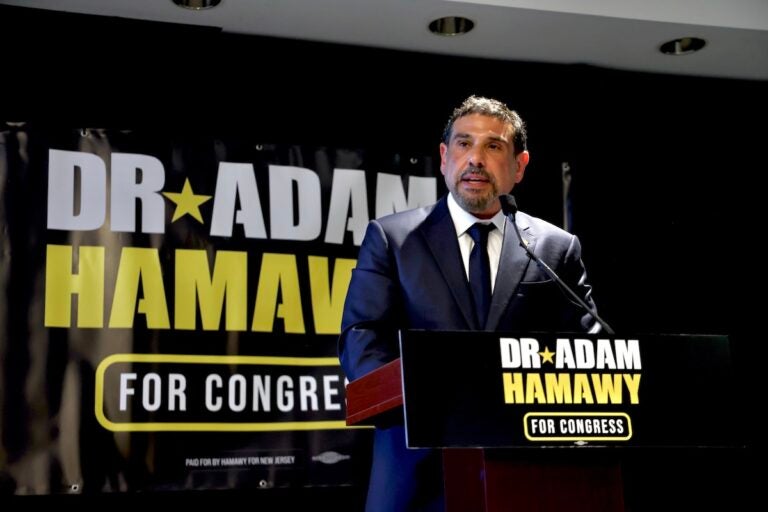
Adam Hamawy addresses supporters after winning the Democratic nomination for New Jersey’s 12th Congressional District. (Emma Lee/WHYY)
What questions do you have about the 2026 elections? What major issues do you want candidates to address? Let us know.
In Tuesday’s primary election for New Jersey’s 12th Congressional District, Dr. Adam Hamawy, a surgeon who served in the U.S. Army and a political newcomer, defeated a dozen other candidates, including an assemblywoman, two mayors, a county commissioner, a fitness instructor and a neuroscience professor, with about 28% of the vote. So how did he do it?
Political observers say he didn’t do it by building a traditional county political machine. Micah Rasmussen, director of the Rebovich Institute for New Jersey Politics at Rider University, said he capitalized on the first open congressional primary held without the state’s controversial “county line” ballot system, while benefiting from millions of dollars in outside spending that helped him reach voters.
What was the ‘county line’?
For many years, the names of primary election candidates endorsed by power brokers and county party organizations in New Jersey were placed together in the first row or column of the ballot, while other candidates were listed on an obscure section of the ballot known colloquially as “ballot Siberia.” Rasmussen said ballot placements would usually determine election outcomes, but a federal judge ruled two years ago that the county line was unconstitutional, allowing candidates to compete on a more level playing field.
Because of this change, Hamawy did not need to secure the endorsement of party bosses or county chairs, Rasmussen said.
“He was able to present himself in the way that he wanted, and he was able to succeed by finding progressive voters across the district rather than relying on any one regional strength,” he said.
He noted Hamawy was a strong second-place finisher in every county in the 12th Congressional District: Mercer, Middlesex, Somerset and Union.
“What wound up happening was he wasn’t reliant on any one county party to help get him over the finish line,” Rasmussen said. “He was able to do well across the board.”
Money gains influence
With a much more wide-open primary ballot design, money replaced the county line as the major influencing factor, Rasmussen said.
“Hamawy raised the most money by far in this race, so he had the opportunity to present himself to the voters across the district in a way that the other candidates did not,” he said.
He said voters got messages that were very supportive of Hamawy and critical of some of the other candidates in the race.
“Money does become the overriding factor if it allows you to present yourself and it doesn’t allow your opponents to present themselves,” Rasmussen said
He noted that Hamawy received $2 million from American Priorities, a pro-Palestinian super PAC.
A super PAC is a political action committee that can raise and spend unlimited amounts of money. Super PACS are referred to as independent expenditure committees, because the one thing that they are not allowed to do is coordinate their messaging with the campaigns themselves.
“Outside of that, almost anything goes,” Rasmussen said.
Related Content

New Jersey 2026 primary election results
See full results from New Jersey's 2026 primaries, including races for the U.S. Senate and the U.S. House.
2 days ago
Possible campaign issues
During the campaign, it emerged that when Hamawy was in his 20s, he was called as a defense witness in the trial of Omar Abdel-Rahman, the Egyptian-born cleric convicted of conspiracy in the 1993 World Trade Center bombing. Hamawy, through a spokesman, said in a statement that he “condemns that man’s violent rhetoric and actions, and all violence, hatred, and terrorism — and he will always.”
Rasmussen said this could be raised by Republicans, and their candidate Gregg Mele in the upcoming congressional campaign, but it won’t become a decisive issue.
“The 12th District is overwhelmingly Democratic. It is not a competitive district,” he said. “[Hamawy’s] real election is the one that he just won.”
Hamawy, who was born in Egypt, could become New Jersey’s first Muslim member of Congress, but he is not the first Arab American to run for the House of Representatives. In 1959, George Kasem, who was of Lebanese descent, became a member of Congress, representing California’s 25th District. Several other Arab Americans since then have run for office and won.
Rasmussen noted Mele has run for public office seven times, in different districts — as an independent, a libertarian and now as a Republican — and he has never won. But Rasmussen doubts that Democrats will try to use this in Hamawy’s campaign.
“I think that Democrats will mostly try to ignore him,” he said. “The fact that [Mele] has never been able to raise a lot of money hamstrings his ability to get out and present himself as an alternative to Hamawy. It will be very difficult for him to attract voters if they do not know about him.”
Dark money concerns
One of the candidates in the primary race, Sue Altman, who received strong support in the Princeton-Central Jersey area, was repeatedly attacked by a nonprofit registered in Texas called Florence Avenue Initiative. The group sent out several mailers with strange pictures of Altman, calling her a liar, a flip-flopper and a carpetbagger.
Rasmussen said having mysterious groups based in other parts of the county launch these kinds of attacks in New Jersey is concerning.
“It’s important to know who they are and why they’re doing what they’re doing, but we don’t know that, and because of that we’re just left with messages that are not really designed to inform,” he said. “They’re designed to misinform, to give a perspective that we don’t understand.”

Get daily updates from WHYY News!
WHYY is your source for fact-based, in-depth journalism and information. As a nonprofit organization, we rely on financial support from readers like you. Please give today.
Part of the series
New Jersey primary election 2026: Here’s who won and who lost, plus full results
Among other races: Democrats chose a nominee for the 7th Congressional District, which could decide control of the chamber.
1 day ago
Justin Murphy wins New Jersey’s Republican Senate primary. He’ll face Cory Booker in November
Murphy, an attorney, campaigned on tax cuts, spending reductions and boosting private sector growth.
2 days ago
Listen 0:38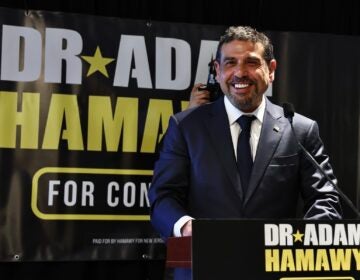
Army surgeon Adam Hamawy wins crowded New Jersey primary in 12th Congressional District
Hamawy bested 12 other primary candidates and will face Republican Greg Mele in November in the race to succeed retiring U.S. Rep. Bonnie Watson Coleman.
2 days ago
Listen 0:45