

Under Trump, immigration arrests surge in Pennsylvania, Delaware and New Jersey
New Jersey and Pennsylvania rank among the 10 states with the most immigration arrests during the first 14 months of President Donald Trump’s second term.
Listen 1:43
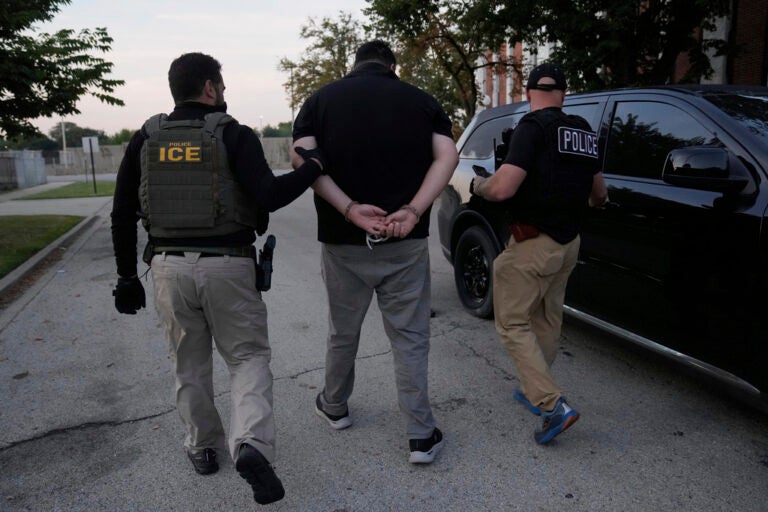
FILE - U.S. Immigration and Customs Enforcement agents make an arrest during an early morning operation in Park Ridge, Ill., Friday, Sept. 19, 2025. (AP Photo/Erin Hooley)
From Philly and the Pa. suburbs to South Jersey and Delaware, what would you like WHYY News to cover? Let us know!
Immigration arrests surged in Pennsylvania, Delaware and New Jersey during the first 14 months of President Donald Trump’s second term.
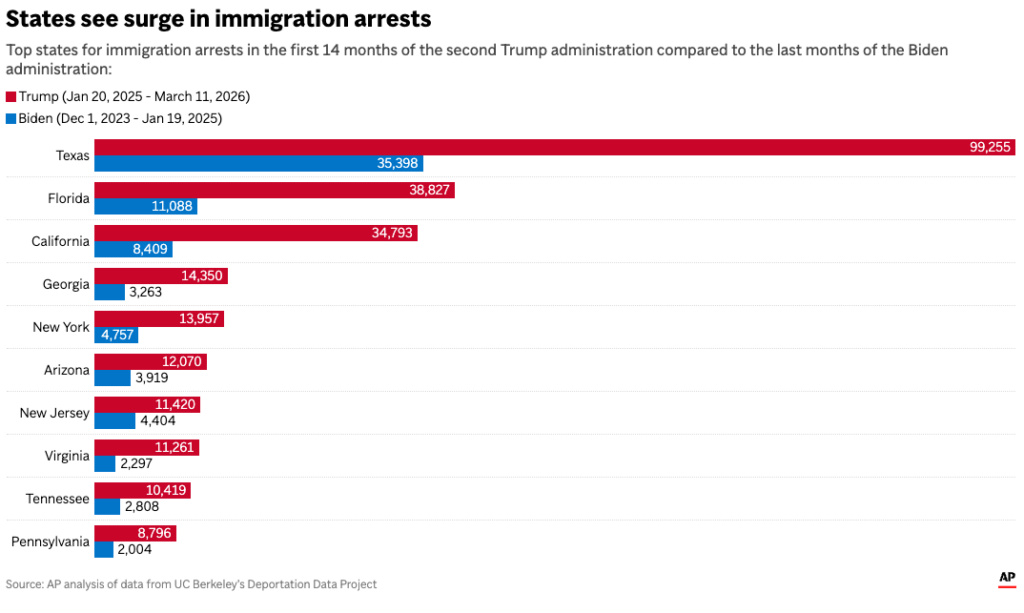
Immigration arrests in Pennsylvania more than quadrupled during the first 14 months of President Donald Trump’s second term, rising from 2,004 during the final 14 months of the Biden administration to 8,796 between Jan. 20, 2025, and March 11, 2026, according to an Associated Press analysis of the Deportation Data Project from University of California, Berkeley.
Immigration arrests have more than tripled in Delaware in the same time period.
In New Jersey, there has been a 159% increase in immigration arrests in the past 14 months.
New Jersey and Pennsylvania rank in the top 10 states with the most immigration arrests from when Trump took office in January 2025 to March 11, 2026.
New Jersey ranks eighth in the country, while Pennsylvania ranks 10th.
Pennsylvania is home to Moshannon Valley Processing Center, the largest immigration detention center in the Northeast with a capacity of 1,876 detainees. Delaney Hall Correctional Facility, another major immigration detention facility, is the largest in New Jersey. There is no immigrant detention center in Delaware.
Increase in ‘at-large’ immigration arrests fuels surge
Immigration arrests taking place since Trump assumed office in January 2025 fall into two categories: people who are in the custody of the criminal justice system, and people who are not, said Jennifer Lee, an associate professor of law at Temple University Beasley School of Law.
Historically, all administrations have moved people in the custody of the criminal justice system who are also facing civil immigration violations into the U.S. Immigration and Customs Enforcement removal deportation system, Lee said.
The second category of arrests that Lee said “feels more new to people” are arrests that are unrelated to someone being in the custody of the criminal justice system. That includes arrests conducted during workplace raids and traffic stops, as people are coming to or leaving the courthouse and at routine immigration check-in appointments.
In January, the number of immigrants in detention reached a record high of about 73,000. Those “unprecedented” numbers are in part due to the Trump administration’s new policies about who can be detained, Lee said.
More than 70% of immigration detainees have no criminal conviction, per data from the Transactional Records Access Clearinghouse, a research group that compiles immigration detention data via records requests.
Lee said previous administrations had more discretion over whether people facing removal proceedings were held in detention. Under current policy, she said, broader categories of immigrants are subject to mandatory detention.
“For example, if you enter the country without a visa, the policy now is that you have to be detained, so it’s spiked the number of people in detention,” she said.
When people are in detention, the deportation process is “much quicker,” Lee said, and that has, in turn, hastened deportations.
Lee said the spike in arrests in Pennsylvania during the last year and a half could be attributable to the exponential growth of collaboration agreements between local law enforcement and ICE under the federal agency’s 287(g) program.
Related Content
Plaintiffs include three Philadelphia residents who fear being re-detained by U.S. Immigration and Customs Enforcement at their next routine check-ins.
1 month ago
Listen 1:18In Pennsylvania, the number of 287(g) agreements has grown from a handful in early 2025 to 106 as of June 22. Most are under the agency’s “Task Force Model,” which trains and deputizes local law enforcement agents to assist in carrying out some federal immigration enforcement operations.
“That formalized collaboration might be one reason why we’re seeing increased [arrests] numbers in Pennsylvania,” Lee said.
There are no 287(g) collaboration agreements in New Jersey and Delaware. New Jersey Gov. Mikie Sherrill signed a bill into law in March that codifies a preexisting directive restricting local law enforcement agencies in New Jersey from collaborating with federal immigration enforcement.
An ICE spokesperson said in a statement to WHYY News that “any perceived increase in ICE arrests in any state is a direct result of ICE carrying out the mission that Congress has mandated by law: enforcing the immigration statutes already on the books nationwide.”
According to the agency, in the first year of Trump’s second term, more than 3 million people residing in the U.S. illegally “have left the U.S. because of the administration’s crackdown on illegal immigration.” That figure includes an estimated 2.2 million self-deportations, the spokesperson said.
The agency said it has deported more than 948,000 people and arrested more than 981,000 people.
“While ICE cannot comment on current operations or future operational planning, every day, DHS conducts law enforcement operations nationwide,” the spokesperson said. “ICE will continue to make arrests routinely across the United States. All aliens who violate U.S. immigration law are subject to arrest and detention, regardless of their criminal histories.”
Impact in immigrant communities
The surge in immigration arrests has “created an immense amount of concern and fear in immigrant communities,” Lee said.
“Obviously, different people have different reactions, but some people absolutely think that this is the time to lie low, and they’re very worried about themselves and their families, and the potential for family separation, and the kind of anxiety that it’s creating among people … is really problematic,” Lee said.
Some research from economists has shown that the increase in arrests, detention and deportation of immigrants “isn’t actually economically benefitting” the U.S. economy, or U.S. workers, she said.
“It’s actually backfiring in the sense that it’s not making us safer and it’s also not making us economically better off,” Lee said.
An ICE spokesperson said in a statement that “being in detention is a choice,” and they offer $2,600 and a free flight for people residing in the United States without legal status to self-deport.
“We encourage every person here illegally to take advantage of this offer and reserve the chance to come back to the U.S. the right legal way to live the American dream,” the spokesperson said. “If not, you will be arrested and deported without a chance to return.”

Get daily updates from WHYY News!
WHYY is your source for fact-based, in-depth journalism and information. As a nonprofit organization, we rely on financial support from readers like you. Please give today.
Part of the series

ICE abandons plans to convert 2 rural Pennsylvania warehouses into detention centers
The Pennsylvania Department of Environmental Protection said doubling the population of the rural communities would tax the sewage system and drain drinking water supplies.
1 day ago
Listen 1:00
State Democratic leaders announced the effort in the district of U.S. Rep. Scott Perry, one of four Republican-held seats they hope to flip in November.
6 days ago
Listen 1:13
Gov. Matt Meyer said he cannot justify the expense when Delawareans are struggling to afford rising prices.
2 weeks ago
Listen 0:58