
New Jersey Gov. Sherrill signs data center legislation that aims to protect ratepayers
Sherrill signed a package of legislation this week that aims to prevent data centers and utility companies from passing costs onto ratepayers.

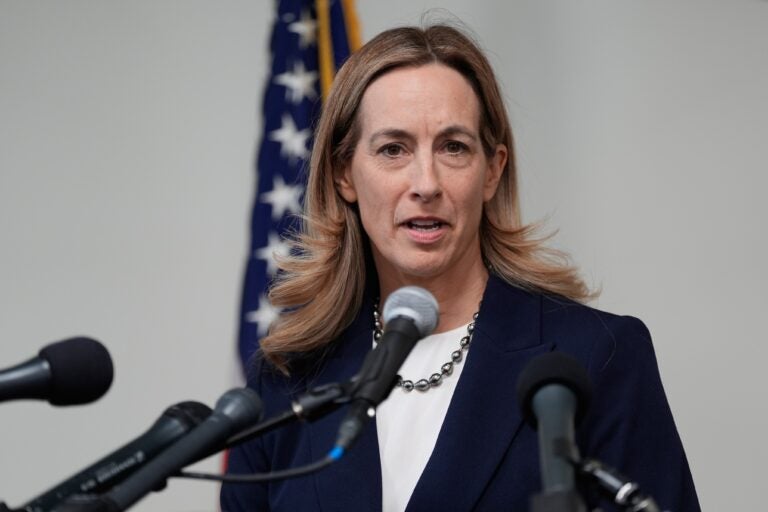
New Jersey Gov. Mikie Sherrill talks to reporters during a news conference in Trenton, N.J., Wednesday, Nov. 5, 2025. (AP Photo/Seth Wenig)
This story is part of the WHYY News Climate Desk, bringing you news and solutions for our changing region.
From the Poconos to the Jersey Shore to the mouth of the Delaware Bay, what do you want to know about climate change? What would you like us to cover? Get in touch.
New Jersey Gov. Mikie Sherrill signed legislation this week that aims to protect ratepayers as the increasing demand for data centers threatens a surge in electricity bills.
The goal of the new legislation is to prevent data centers from passing on the costs of required infrastructure expansion and energy usage to residential customers.
Specifically, the new law creates a separate ratepayer class for data centers to prevent energy costs from being passed down to other utility customers. The bill also requires data centers to pay for the electrical and clean energy infrastructure upgrades they create.
“For too long, New Jersey families have paid the price for poor oversight, outdated policies, and rising demand on our electric grid by unchecked actors,” Sherrill said in a statement. “Today, we’re putting money back into people’s pockets while holding utility companies and large data centers accountable through stronger oversight and smarter incentives that will drive down costs and strengthen our grid.”
The measure comes as the price of electricity is soaring. Though freezing weather conditions contributed to high utility bills this past winter, rate hikes have also been driven by a supply-and-demand imbalance, slow construction of new energy-generation infrastructure and an increased power demand from data centers.
PJM Interconnection, which manages the region’s electrical grid, has pointed to the increase in data centers as a reason for higher electricity bills.
Data centers, operated by big tech companies, house large computer servers necessary to power the growth of online processing, storage and artificial intelligence. While they have been around since the mid-20th century, the acceleration of AI has boosted demand for more energy and larger sites.
Related Content

A new high-water rescue vehicle was pressed into service after more than 4 inches of rain fell within one hour.
3 months ago
Though proponents of data centers tout the prospect of increased tax revenue, some local residents are concerned about their impact on air quality, increased water use and rising electricity bills.
“Data center growth will drive up the cost of electricity if we don’t create guardrails,” said bill sponsor Assemblyman Dave Bailey, D-Salem, in a statement. “We want to make sure data centers pay for the energy they use and the infrastructure they need, not our constituents. This bill is about protecting ratepayers and preventing households and small businesses from paying for data centers to connect to the grid.”
The Data Center Coalition, a trade group for the industry, said members are committed to paying the full costs for the energy it uses and to pursue clean energy.
However, the organization said it’s concerned the legislation could make New Jersey less competitive.
“A workable approach, like those established in other markets, should align costs with cost causation, protect existing customers, and give data center customers a clear path to help drive jobs, economic growth, and new clean energy resources in New Jersey. Protections should be evidence-based, structured carefully, and grounded in specific cost risks, otherwise they risk creating market friction, introducing uncertainty, and making New Jersey less predictable and less competitive,” said Dan Diorio, vice president of state policy, in a statement.
Sherrill also signed legislation that aims to prevent utility companies from taking advantage of ratepayers. The “Repeal ROE Adder” bill requires electric utility companies to join the regional power grid, and prevents them from charging ratepayers an extra “bonus” fee for voluntarily connecting to the grid.
The Advanced Grid Technologies Act requires the state’s utility regulators to closely monitor so-called “supplemental” grid projects, such as wires, poles and substations, in an effort to prevent wasteful spending that increases ratepayers’ bills. The legislation also speeds up the approval process for projects that use advanced transmission technologies.
Electricity bills are already on the rise in New Jersey. In 2024, there were 128,828 electricity shutoffs in New Jersey, according to the U.S. Energy Information Administration. Since then, electricity rates have increased by more than 16% in the state, according to a U.S. Senate committee report.
“New Jersey’s energy infrastructure faces growing demands, making modernizing New Jersey’s electric grid more important than ever,” said bill sponsor Assemblyman Cody Miller, D-Gloucester, in a statement.
“We are establishing new review processes that will ensure that projects meet better grid performance benchmarks. At the same time, by requiring State oversight, we’re making sure that investments in supplemental utility projects are necessary, cost effective, and meet our energy goals.”

Never miss a moment with the WHYY Listen App!


WHYY is your source for fact-based, in-depth journalism and information. As a nonprofit organization, we rely on financial support from readers like you. Please give today.
Part of the series

EPA announces rollback of climate pollution rules for power plants
The announcement is the latest in a back-and-forth between Democratic and Republican administrations over whether or not to limit power plants’ greenhouse gas pollution.
6 days ago

Pennsylvania’s first congressional race pits five-term incumbent Republican Brian Fitzpatrick against Democratic County Commissioner Bob Harvie.
1 week ago
Listen 1:15
Data center opposition could become a key issue in New Jersey’s midterm elections
A growing number of towns are banning data centers because of quality-of-life and financial concerns.
2 weeks ago