N.J. breastfeeding service providers face pay cuts with UnitedHealthcare insurance’s lactation billing change
Lactation consultants can only bill UnitedHealthcare for services provided to a mother, but not her baby, starting Sept. 1.
Listen 1:11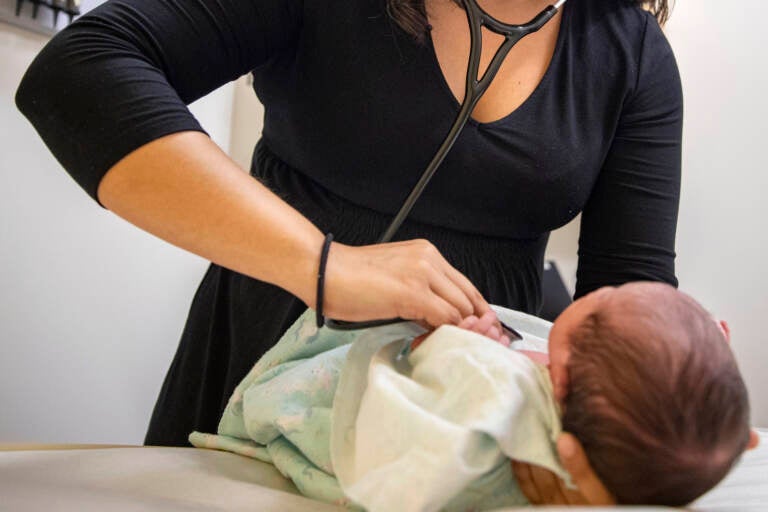
FILE - A pediatrician examines a newborn baby in her clinic in Chicago on Tuesday, Aug. 13, 2019. (AP Photo/Amr Alfiky)
From Philly and the Pa. suburbs to South Jersey and Delaware, what would you like WHYY News to cover? Let us know!
Lactation consultants who visit families at home to provide breastfeeding support services and care are currently able to bill UnitedHealthcare twice per visit: once for the mother and again for the infant.
This nets New Jersey lactation consultant Danielle Tropea about $250. That amount is supposed to cover her travel time and expenses, the 90 minutes or more she spends with mothers and their babies, and health care supplies that she uses and distributes on these visits.
The amount falls short of what the work entails, Tropea said, but providers like her take it so that they can see families who would otherwise be unable to afford lactation support without insurance coverage.
However, UnitedHealthcare will only reimburse health providers once for providing services to mothers, not their infants, beginning Sept. 1 for private health insurance plans. UnitedHealthcare is the country’s largest insurance provider, covering tens of millions of Americans.
The change addresses “duplicate payments” and adopts payment recommendations by the federal Centers for Medicare and Medicaid, a UnitedHealthcare spokesperson told WHYY in a statement.
“Lactation counseling is an important service that mothers rely on during their breastfeeding journey, and we continue to cover it,” a spokesperson stated.
But lactation consultants in the tri-state area say the change will cut their reimbursements roughly in half, make it more difficult for providers to earn a living wage, and potentially limit the number of families they can serve under the new policy.
“I just feel like this is a job we have been fighting for. It’s just a fight every time,” said Mary Lou Moramarco, a lactation consultant and founder of the New Jersey International Board Certified Lactation Consultant Association. “We are all mostly small women-owned businesses coming up against insurance conglomerates, and we feel very small in this arena.”
A challenging payment landscape for lactation providers
The Affordable Care Act, signed into law in 2010, mandated that health insurance plans, including group plans offered by employers, cover breastfeeding support, counseling and other lactation services at no cost to families.
But the law was written broadly and did not specify exact reimbursement amounts or billing mechanisms.
Over the years, other insurers like Horizon Blue Cross Blue Shield of New Jersey and Cigna Healthcare have restricted billing and payment for lactation services by treating mother and baby as one patient or by contracting with a single lactation provider organization for all in-network care.
Lactation support providers said this wouldn’t be much of an issue if insurance reimbursement amounts were substantial enough to cover all the services that consultants provide to mothers and their infants.
Related Content

Trump administration warns more than 500 hospitals to provide more price information or face fines
Failing to comply with the warnings comes with penalties as high as $2 million a year.
3 months ago
The work, which can be time-consuming, often involves upfront costs to pay for equipment and resources like breast plump flanges, or shields, that help women express milk.
“I have a huge duffel bag full of flanges, like hundreds of dollars’ worth of flanges,” said Tropea, president of the New Jersey Breastfeeding Coalition. “We all have a $1,200 scale that we have to drag around.”
But reimbursement rates have largely stayed flat, she said. The latest billing change at United could force lactation consultants to either take pay cuts or stop taking insurance altogether. Tropea would typically charge $400 for a home visit for those not using insurance.
“If someone’s going to do that, they would do it once, if at all,” she said.
Assessing the impact on access to breastfeeding support
The billing changes and inconsistent landscape of payment methods for lactation consulting services come at a time when federal agencies, states, local health departments and maternal health experts have emphasized the importance of increasing breastfeeding rates and access to support.
Breastmilk is considered a gold standard for infant nutrition and is associated with fewer gastrointestinal complications. Breastfeeding has also been shown to protect babies against some short- and long-term illness and disease, according to global research.
“What we do is preventive for moms and babies,” said Kathryn McLaughlin, a lactation consultant and co-chair of the New Jersey Breastfeeding Coalition’s advocacy and legal committee. “It saves lost days at work, there’s less absentee from daycares. So, it bolsters the economy across the board.”
Given the long-term benefits of breastfeeding, McLaughlin called United’s billing change “short-sighted.”
UnitedHealthcare officials said they are “committed to working collaboratively with [lactation consultants] to support a smooth implementation,” but Moramarco predicts that the change will negatively affect access to lactation support services for families.
“This is just so disappointing on so many levels,” she said.

Get daily updates from WHYY News!
WHYY is your source for fact-based, in-depth journalism and information. As a nonprofit organization, we rely on financial support from readers like you. Please give today.

Family Connects NJ offers at least one free home health visit to all families with newborns. Services will be offered in all 21 counties by January 2027.
4 months ago
Listen 5:37
Americans are furious over health care. Is this an Occupy Wall Street moment?
The public outrage unleashed by the killing of UnitedHealthcare's CEO echoes the anti-banking fury after the financial crisis.
2 years ago

CEO killing: A mirror to America’s broken healthcare system?
It’s been a week since ...
Air Date: December 11, 2024 12:00 pm
Listen 46:54