United We Heal celebrates Juneteenth with sold-out film festival amplifying Black and brown voices
The fifth annual festival showcased 11 films, including documentaries and a horror flick set in Philly’s Washington Square Park.
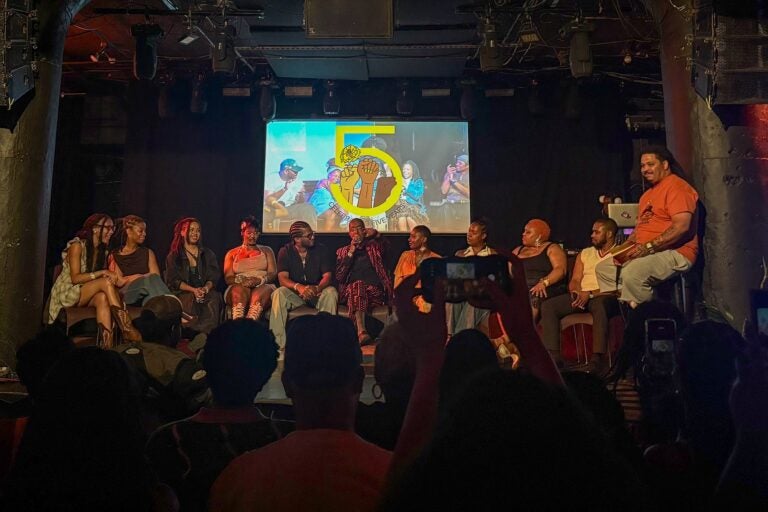
Following the programming, the filmmakers gathered on stage for a panel discussion. (Chelsea Lubbe for WHYY)
From Philly and the Pa. suburbs to South Jersey and Delaware, what would you like WHYY News to cover? Let us know!
The fifth annual United We Heal Film Festival brought a sold-out Juneteenth celebration to Underground Arts, showcasing 11 Philadelphia-area filmmakers and a lineup of films spanning documentary storytelling to reimagined Black history.
Executive director Ebony Roberts started United We Heal after directing her own film, which she called a love letter to the Black community during 2020’s racial unrest.
“The film was dedicated to unifying our community. I took it on the film festival run and I quickly realized that our films, Black and brown filmmakers, need a platform.” Roberts said.
Shuja Moore, director of “Changing Course,” won the judge’s selection for Best in Show. The documentary short explores the Philadelphia District Attorney’s Office’s work with youth diversion initiatives and their impact on young people.
Moore, who grew up in West Philadelphia, said he uses community voices to foster conversations about incarceration.
“We have a district attorney that is implementing [diversion programs],” he said. “But that is not the story that is being told. The more we educate and invest in people, the more safe we are.”
The audience’s vote for Best in Show was David Dylan Thomas’ “White Meat: Appetizer.”
The premise is simple: “Underneath Washington Square Park in Philly are the bodies of hundreds of enslaved people. What if one night they all came back from the dead as zombies, but they only ate white people?”
The film draws inspiration from the park’s real history as a designated burial ground for African Americans in the late 18th and early 19th centuries.
“A lot of my horror is based on taking things that have actually happened to Black people and recontextualizing it,” Thomas said. “It is just a way to invite people to deal with some of these uncomfortable issues through the lens of horror.”
Thomas said he wanted to preserve the history and context of how serious the issue is, along with including the names of the enslaved people who were owned by former U.S. presidents while living in Philadelphia.
“While we were working, the president of the United States decided to declare war on Black history, and I take that personally,” he said.
Related Content
Philadelphia’s oldest Juneteenth festival draws thousands to the Johnson House in Germantown
The festival celebrated its 20th year with music, vendors, a small-business opening and renewed calls to preserve Black history.
2 months ago
Films also included queer narratives about radically loving and freedom of expression.
“Glass Bricks” follows Curtis P. Lassiter II, also known as Finessa Jawn. The film began shooting during the pandemic as a narrative project, before cinematographer and director Simone Holland said it shifted into a documentary.
“It didn’t make sense to just make a narrative film that was empty. Curtis is such a light that it made sense to continue the conversation as it was [over Zoom],” said Holland, referencing the barriers pandemic restrictions had on filmmaking
“I’ve always felt as though my story was a little bit less than. It’s been a long journey to get to this light.” Lassiter said.
Lanaa Dantzler was the youngest filmmaker at 17. Dantzler’s film “At The End of the World” was an official selection at the Philadelphia Independent Film Festival.
The film is a romantic drama about a 17-year-old girl who learns to see love as an act of justice through a summer romance. The film focuses on love as a liberating experience for a Black person.
“When you do things that are affirming humanity and you’re vulnerable, I think that is always progressive. We live in a country that was not originally created with those values,” Dantzler said.
Roberts hopes that this fifth year of United We Heal’s programming spotlights how the community is coming together versus what is tearing it down.
“The theme of the festival is always inspired by social justice, and the films have to have a healing theme,” Roberts said. “Something mainstream [media] doesn’t necessarily show when they are telling Black and brown stories, is showing us as three-dimensional characters, showing us as whole characters and really having intentions behind the storytelling.”
Editor’s note: An earlier version of this story misidentified the film “Glass Bricks.” The article has been updated.

Get daily updates from WHYY News!
WHYY is your source for fact-based, in-depth journalism and information. As a nonprofit organization, we rely on financial support from readers like you. Please give today.
Philadelphia Asian American Film Festival in a ‘critical’ financial position
The film festival is feeling the pinch after cuts in federal funding, particularly in areas focused on diversity.
6 months ago
Penn Museum’s new Native North America exhibition collaborates with Indigenous curators
Eight curators from eight Indigenous nations redesigned Penn Museum’s Native North America display.
9 months ago
Listen 1:20
A new Holocaust mural on the Parkway tells a story of displacement in 28 languages
“Lay-lah Lay-lah,” by artist Ella Ponizovsky Bergelson, uses ancient texts to connect the historic atrocity to a range of communities and underscore a shared humanity.
11 months ago
Listen 1:22